10" 1954 BLUES LP JESSE FULLER WORLD SONG Ex
£
25
$
33


Favourite Auctions
To save auctions to your favourites, please login
If you don't have an account, please register
Description
AN EXCELLENT COPY OF THIS MEGA-RARE 1954/5 10" WORLD SONG LP FROM JESSE FULLER
Jesse Fuller 1958 with 'fotdella'
Jesse Fuller was unique, and he worked hard at keeping it that way. One of America's great musical nonconformists, he played a big, 12-string guitar, chugging harmonica, raucous kazoo, cymbal, washboard and fotdella, and called himself the "Lone Cat," a romping one-man band. A singer, musician, composer, inventor and jack of all trades, he was the Bay Area's greatest contribution to the folk-blues revival, but his musical career reached a long way back before "San Francisco Bay," the song that catapulted him to national prominence.
Fuller was born in Jonesboro, Georgia, in 1896. He never knew his father and lost his mother when he was eight. Adopted by a local family, he was abused and neglected, and started working at an early age, breaking rocks in a quarry, toiling in a corn mill, carrying water for a railroad grading crew, and riding freight trains from job to job. At age ten, he also started playing guitar. As he later recalled, his first teacher was a woman who hung out around the railroad gang and went by the name of Big Estelle. "I'd go up there and watch her play and she was terrific," he remembered. "She didn't teach me all 'bout the guitar, just the chords, and I learned the rest myself."
As soon as he felt old enough to make it on his own, Fuller headed out of the deep South, looking for a better life. "Hell, I don't like the South at all," he told an interviewer in the 1960s. "If I were in the South now, . . . I'd be dead. I'm too color blind. Someone pushes me, I'll fight him, I don't care who he is." He first headed for Cincinatti, then got a job with a circus and began moving west. By the 1920s, he was in Hollywood, where he set up a shoe shine stand and, in the course of business, made the acquaintance of the movie star Douglas Fairbanks. Fairbanks set him up with a hot dog stand and gave him a Model T Ford, which Fuller "souped up like a race car." Fairbanks would sometimes hire Fuller to play at his private parties, and helped him get work as a movie extra, using him in "The Thief of Bagdad" among other pictures. As if all of that was not enough, Fuller developed still another sideline, carving amazingly lifelike wooden snakes, and worked his way through the depression selling them for a dollar apiece.
In 1929, Fuller moved up to Oakland, where he would live for the rest of his life. Once again, he worked a variety of jobs before making the decision to go into music as a full-time profession around 1950. At first, he tried to put a band together, but decided it was too much of a hassle. As he would later explain, "[The musicians] were all too busy--running around, drinking and gambling." Instead, he began rigging up ways to be his own accompanist. He put together a rack that could hold a harmonica, a kazoo and a microphone, and invented the fotdella, a six-string bass with a modified piano action that drove felt hammers against the strings. The fotdella, which he played with his shoeless right foot, was a visual novelty and gave his music a solid bottom, and he completed the rhythm section by using his left foot to keep time with either a sock cymbal or another homemade contraption that scraped a rubber arm across a washboard.
Thus was born the "King of the blues one-man bands." Fuller became a regular street performer around the Bay Area. The folk revival had not yet hit, but the West Coast was a hotbed for New Orleans jazz revivalists, and the trad fans were entranced by his music. He recorded his first album, a ten-inch LP called Working on the Railroad with Jesse Fuller, in the early '50s, and spent the rest of the decade bouncing around a variety of small, jazz-oriented labels.
The music Fuller played ranged from old work songs, hymns and spirituals to blues, ragtime and pop tunes. He was what blues fans call a "songster," a performer who could play and sing anything the audience wanted to hear. Whatever the style, though, once Fuller had rearranged it for his battery of instruments it bore his own unmistakeable stamp. Folklorists have sometimes tried to sort out the songs he wrote from those that were adapted from previous sources, but that is beside the point. Whether singing a folk ballad like "John Henry" or a pop chestnut like "Everybody Works But Father," he sounded only like Jesse Fuller.
Adept as he was at reshaping older material, Fuller always prided himself on his abilities as a writer. Al Young, the poet and novelist, who knew Fuller in the early '60s, recalls going over to see him at his sister's house in Oakland, and being shown his basement studio. "He went there every morning, and spent three hours writing his tunes," Young says. "He'd set up his fotdella and all of his stuff and sit there and compose with a tape recorder, and get his stuff down. Everybody thinks that he's a guy who just kind of casually knocked these things out, but he listened to everybody, he was very aware that the folk movement was his chance to be heard, and he would go down there every day and write. "
While the fotdella might be what stopped crowds on the street, what made Fuller a national figure was his songwriting, especially his masterpiece and theme song, "San Francisco Bay Blues." He recorded the song for every label that signed him, and soon it was covered by a plethora of young folkies, becoming a ubiquitous standard. With its success, Fuller took to the road, touring in a big Nash station wagon that also served him as a makeshift hotel, and playing coffeehouses, colleges and folk festivals across the country, then taking ship for a European tour during which, in his words, he "got more people than the Rolling Stones."
That choice of comparison says a lot about him. Unlike most of the older bluesmen who appeared on the folk circuit in the 1960s, Fuller was at home in the present, in tune with the contemporary scene and fully in charge of his life, music, and business. He knew what he was doing, and knew he was good at it, and it did not surprise him when the young, white folksingers started coming around to admire and learn from him. And learn they did. Bob Dylan's harmonica work shows more of Fuller's influence than anyone else's, and he paid tribute by recording Fuller's "You're No Good" on his first album. Mark Spoelstra used to drop by for guitar lessons. As for all the people who sang "San Francisco Bay," from Jack Elliott on down, there are simply too many of them to count.
Fuller died in 1976, but he left behind a lot of good music and good memories. Friends still tell stories about his quirky self-reliance, his insistence on driving everywhere, even to the point of refusing to go to Europe unless he could drive his car onto the boat and make the trip in his usual style, and the ingenuity with which he not only invented a slew of instruments but wired all of them so that he could plug the entire mass into a house p.a. system and wail away like a rock band. He was a true original and, two decades after his death, his music is still as exuberant and entertaining as anything on record.
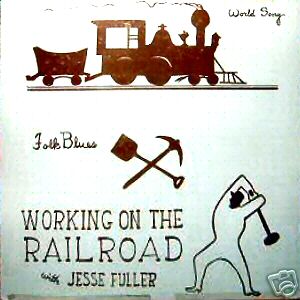
This is a historic record issued on the World Song label and is in Really Excellent condition although the stiff card outer cover is showing signs of age with splits to both top and bottom. The inner tissue paper sleeve has gone a little "sepia" coloured with age.The back of the cover has notes about Jesse Fuller and all of the lyrics.
Track listing as follows:-
Jesse Fuller: Folk Blues - Working On The Railroad
- Railroad Worksong
- Lining Up The Tracks
- John Henry
- Railroad Blues
- San Francisco Bay Blues
- Hanging 'Round A Skin Game
recorded: El Cerrito, California, c. 1954; prod. by Margaret and Irwin Goldsmith
AN ULTRA RARE RECORD IN GREAT CONDITION!
A VERY SOUGHT AFTER EARLY 10 " LP
DON'T MISS OUT - BID NOW!
On 20-Mar-07 at 14:32:41 GMT, seller added the following information: Pay instantly with your debit or credit card through PayPal.price rating