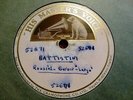
1905 Russian G&T Marie Michailowa AVE MARIA Maria Gamovetskaya violin piano 78
$
25


Favourite Auctions
To save auctions to your favourites, please login
If you don't have an account, please register
Description
A series of great Eastern European and Slavic Marches, Folk Band, Songs and Popular recordings
Check out more Russian, Polish, Ukrainian and Czech - Yugo-Slav recordings for sale by clicking the link below
More great Eastern European and Slavic Records in my other listings!
Marie Michailowa, first coloratura at the Imperial Opera St Petersburg, was the first international recording star: Her first recordings for Gaisberg and Berliner were pressed worldwide, though she never left Russia.
Bach Gounod Ave Maria w Violin Obbligato by Maria Gamovetskaya and piano
Gramophone matrix 2850L. Ave Maria / M. A. Michailova
Ave Maria (Vocal version) (Uniform title)
Charles Gounod (composer)
M. A. Michailova (vocalist : soprano vocal)
Maria Gamovetskaya (instrumentalist : violin)
Franz Hampe (recordist)
Description: Soprano vocal solo, with violin obbligato and piano
Language: Russian
1905 St. Petersburg, Russia [1] Master Victor 61131
Please see top of the page for condition
Perfil: Born: June 3, 1866, Kharkiv, Ukraine
Died: January 18, 1943, Perm, Urals
Russian opera, soprano vocalist.
She studied three years in St. Petersburg with Z. P. Grenning-Vilde, then approximately four years she studied in Milan with S. Ronconi and in Paris with Saint-Yves-Bax and De-Laborde.
From 1892 to 1912 she was a soloist of the Mariinsky Theatre in St. Petersburg where she made her debut as Margherita in ‘’Gli Ugonotti’’ of Meyerbeer. During of her career she also performed in Orel, Tambov, Odessa, at the Moscow Bolshoi Theatre (1902), Vladivostok (1903), Kharkov, in the cities of Sibir (1909). She made guest appearances in Prague (1903), Bulgaria, Serbia, Greece, Austria and Japan.
Marie Michailowa, soprano, was called "the first Gramophone Prima Donna", she was the first artist for whom the Gramophone created an international fame. Marie Michailowa made her first appearance in Charkow, Russia when she was a very young girl, in later years she held the position of chief prima donna with the Imperial Opera House in Petrograd.
Michailova, Maria Alexandrovna, soprano, * 3.6.1866 (according to other sources 1864) Kharkov, † 18.1.1943 Perm (then Molotov) in the Urals; She came from a Russian-Dutch family, the family name of her mother was van Puteren. She began her education with Mme Groewing-Wilde in Kharkov and the Conservatory of St. Petersburg, then a student of St. Yves-Bax in Paris and of Rauzzoni in Milan. Debut in 1892 at the Mariensky Theater (the Court Opera) of St. Petersburg as Queen Marguerite in the "Huguenots" of Meyerbeer. She sang a small role on 18.12.1892 in the premiere of Tchaikovsky's opera »Jolanthe«, on 29.10.1895 in the premiere of the trilogy »Oresteia« by Taneyev the part of Elektra. Throughout her career, she remained in St. Petersburg, where she was celebrated by the company of Czarist Russia. She was a guest in Moscow, Kiev, Kharkov, Odessa and other Russian cities. Her great parts were the Ludmilla in Glinka's "Ruslan and Ludmilla," Antonida in "Life for the Czar," Lakmé, Micaela in "Carmen," Tamara in Rubinstein's "Demon," Gilda in the "Rigoletto Juliette in "Roméo et Juliette," the Nannetta in Verdi's "Falstaff" (which she created for Saint Petersburg in 1894), the Amina in La Sonnambula, and the Marguerite in the Huguenots. She was known world-wide by her records, which appeared since 1900 and attracted general admiration. Nevertheless, it was never possible to persuade the artist to leave Russia; Only in 1903 was she in Prague. Oscar Hammerstein struggled in vain to oblige her to the Manhattan Opera House he founded in New York. In 1907, however, she was supposed to have made a concert tour through Japan. In 1912 she took leave of the stage at the Mariensky Theater of St. Petersburg as Antonida in Glinka's "Life for the Tsar." In 1913 or 1914 she was again to perform a concert tour in Russia. She later lived in Leningrad. Apparently, she was in financial difficulties after the October Revolution; In 1921, she sent a petition for help to the Directorate of the Leningrad Opera. Nothing is known about their further life circumstances. During the siege of Leningrad by German troops in the Second World War, she was evacuated to Perm in the Urals, where she died in 1943. - Your voice is one of the most beautiful things of the early days of the record; Sovereign mastery of technology and a more elegant style of presentation, are balanced in their interpretations.
Numerous records, the oldest still Berlin Records (1900-01), then G & T (also since 1900), Columbia, Lyrophon, HMV and Pathé; A recording on Amour Records.
price rating