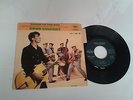
1908 MARCELLA SEMBRICH Polish Patti EMMA EAMES MOZART Nozze di Figaro VIC 95202
$
25


Favourite Auctions
To save auctions to your favourites, please login
If you don't have an account, please register
Description
A series of great OPERA Records from early G&Ts to World War II recordings on 78 rpm Victrola Records
Click this link for more great Opera and Vocal Records in my other listings!
One of Julian Moses 100 acoustic recordings of the Century
Emma Eames (1909)
Marcella Sembrich and Emma Eames in the superb duet from Nozze di Figaro: Che Soave Zeffiretto
This record is on the top of the must have list for vocal collectors
MARCELLA SEMBRICH, polish-german, an accomplished Violinist and Pianist, was famous for her beautiful voice and technique, as well as her astonishing musical intelligence and taste. She OPENED the Metrolpolitan Opera House in their first season in 1883!!!/
Le nozze di Figaro
Wolfgang Amadeus Mozart (composer)
Emma Eames (vocalist : soprano vocal)
Marcella Sembrich (vocalist : soprano vocal)
Description: Vocal duet (2 sopranos), with orchestra
Language: Italian
1/25/1908 New York, New York 3 Master Victor 95202
Please see top of the page for condition
Emma Eames (August 13, 1865 - June 13, 1952) was an opera soprano.
The daughter of an international courts lawyer, she was born in Shanghai, China. Attending school in Boston, she studied with the famous teacher Mathilde Marchesi, although she would later downplay Marchesi's influence on her voice. She was eventually called upon to play the heroine in RomTo et Juliette at the Paris OpTra. Debuting in 1889, she would play the role many other times in the next two years, finally leaving in 1891 for personal reasons.
The same year, she debuted at the Metropolitan Opera in New York playing the same role. New York was where she would have the most acclaim, performing in operas until retiring in 1909. She also made appearances at the Royal Opera House in London. She spent her free time touring in concerts around the United States after her retirement from the Met, until finally removing herself from the business entirely in 1916.
In 1929 Eames wrote an autobiography, Some Memories and Reflections.
Eames was reportedly unhappy with the way she sounded on her records, although in 1939 she went on a radio show and picked out some her most famous records, and she spoke immodestly about them. Eames can also be heard in the Mapleson Cylinders.
Eames had a wide repertoire, including Aida, Lohengrin, Tosca, Cavalleria Rusticana, Le Nozze di Figaro, Faust, and Don Giovanni.
[edit] Personal life
She was married twice, first to the painter Julian Story, and then to the famous baritone Emilio de Gogorza, with whom she made some records. She was raised in Portland and Bath, Maine. Both marriages ended in divorce and much bitterness. She had no children, but in her autobiography admitted that she was pressured into a "medical procedure".
She relocated to New York in 1936, where she became a renowned vocal instructor. In New York she was fond of attending Broadway shows. Eames died in 1952 at the age of 86. Emma Eames is buried in Oak Grove Cemetery in Bath, Maine.
Polish-American soprano, 1858 - 1935
(Philip H. Ward Collection of Theatrical Images, 1856 - 1910)
Biographical notes:
Thoroughly musical almost from day one, she was born Prakseda Marcelina Kochanska in Wisniewczyk, Galicia, and as a child studied violin and piano with her father. She continued her studies at the Lvov Conservatory and later in Vienna, and with Wilhelm Stengel, who eventually became her husband. When she pursued her vocal training, Sembrich headed for Milan and the Lampertis, and made her operatic dTbut as Elvira in BelliniÆs I Puritani at Athens in 1877. Her success was rapid, followed by engagements at Dresden, Milan and London in a repertoire including Gilda, Violetta, Dinorah and CathTrine in Etoile du Nord. She sang with great success in Russia (from 1880 û 1898), Paris, Berlin and in Spain before making her dTbut at the Met as Lucia on October 24, 1883 û the second night of the companyÆs very existence! By the time of that first Met season, the amiable, "un-diva-like" prima donna was able to command a kingÆs ransom in compensation for singing Donna Elvira, Juliette, OphTlie in Hamlet, Marguerite de Valois in Les Huguenots, Zerlina, the Countess in Le Nozze di Figaro and other roles. Sembrich returned to the Met in 1898 and stayed there for the remainder of her career in opera, adding the Queen of the Night, Elvira in Ernani, Nedda, LakmT, Susanna and Eva in Die Meistersinger, as examples, to her already vast repertoire. Her retirement in 1909 was a gala affair at the house, but she continued to give recitals until 1917. Sembrich then taught privately and at the Julliard and Curtis schools for as long as her health permitted. She died in New York.
Comments:
What set Marcella Sembrich aside from a number of her contemporaries, and elevated her to a plateau many aspired to but could not reach, was her remarkable musical intelligence. It is somewhat disheartening when discussing professional singers of any era that this should have been an unusual trait, but in SembrichÆs day, like our own, it was a fairly unique attribute. In matters of technique and style she had no equals, and had at her disposal an assured command of a florid coloratura which ranged most comfortably from middle C to high F.
Recordings:
Marcella Sembrich left behind a sizeable number of recordings.. Her first commercial recordings were a part of ColumbiaÆs ill-fated "Grand Opera Series" of 1903. Sembrich was paid the sizeable sum of $3,000 for recording "Ernani involami" from Ernani, StraussÆ "Voce di primavera" and "Ah, fors e lui" from La Traviata. [Alternate takes have been uncovered, and the entire "Grand Opera Series," including the voices of Suzanne Adams, Edouard de Reszke, Antonio Scotti, Ernestine Schumann-Heink, Giuseppe Campanari and Charles Gilibert has been issued on CDs by SonyÆs Masterworks Heritage label. The recordings are far from perfect, but valuable historical documents.]
Columbia never did learn how to cope with operatic voices in those early years, and the first of the companyÆs efforts were especially inadequate. When Columbia immediately bailed out of the opera business and let Victor snap up the best the Met had to offer, Sembrich was amongst the artists to join the famous "Red Seal" series.with so many selections to choose from, it is not difficult to find excellent examples of SembrichÆs voice, preserved for posterity, ringing out with a rather admirable brilliance.
There are examples from her operatic repertoire, notably "Una voce poco fa" and the "Letter duet" (sung with Emma Eames), that are attractive to the ear, but probably her finest recordings are of songs. Usually with her accompanist Frank La Forge, she recorded pieces otherwise left pretty much untouched by American labels at the time; fine examples of lieder by Chopin, Loewe and Brahms, and more familiar titles by Schubert and Schumann. Her bravura rendition of ArditiÆs "Parla" is thoroughly enjoyable. But in a wider array of operatic selections, too many times there is a stiffness, with too forceful an attack on the staccati that shows none of the assuredness of TetrazziniÆs recordings of the same arias. Fortunately, as in the case of Lillian Nordica, we can turn to the "in-house" cylinder recordings of Lionel Mapleson for an exciting peek at Marcella Sembrich in action, away from the confines of the studios of nearly a century ago. As is always the case with these cylinders, a horrendous racket of surface noise must be ignored, but it is worth the effort to hear her soar quite easily to high Ds as if there was nothing to it, and create thrilling effects that were never quite matched on her commercial discs.
price rating