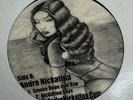
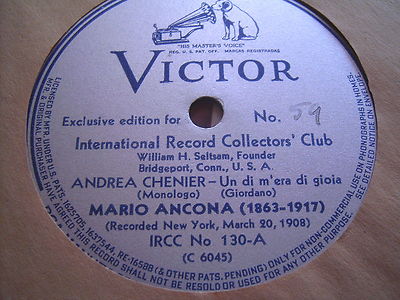
1908 MARIO ANCONA Victor IRCC Andrea Chenier Un di m era di gioia/ Faust Valen78
$
35


Favourite Auctions
To save auctions to your favourites, please login
If you don't have an account, please register
Description
WEEK 2 of two weeks of great auctions ending May 11.
I will send you a bill after close of auctions May 11. Due to the high volume of records, pls allow 2 - 3 days for packing and invoicing
IF you are a non-US buyer or if buy multiple records, pls do not use EBAY check out.
Send me an invoice request (click on MORE ACTIONS to the right of the item), I can probably get you better shipping rate.
****
Great italian Baritone MARIO ANCONA in early VICTOR RECORDINGS
on Victor IRCC
Andrea Chenier Un di m era di gioia/ Faust Valentine's Death
12" 78 rpm Record
Condition: EXCELLENT PLUS, two faintest scratches last 15 mm of Faust.
Plays EXCEPTIONALLY SUPERQUIET
Mario AnconaMario Ancona (February 28, 1860 – February 23, 1931), was a leading Italian baritone and master of bel canto singing. He appeared at some of the most important opera houses in Europe and America during what is commonly referred to as the "Golden Age of Opera".
CareerAncona was born into a middle-class Jewish family at Livorno, Tuscany, on February 28, 1860. After embarking on a business career he decided to study voice with a local singing teacher named Matteini in his native city of Livorno. Later, he took lessons from Giuseppe Cima in Milan.
Ancona is reputed to have made his debut as an amateur singer as far back as 1880; but according to The Concise Oxford Dictionary of Opera—from which many of the ensuing appearance dates, venues and career highlights are taken—his earliest known professional appearance in an opera did not occur until 1889, when he sang the role of Scindia in Massenet's Le roi de Lahore in Trieste. Not long afterwards, he appeared in another Massenet opera, Le Cid, at Italy's principal theatre—La Scala, Milan. His arrival at La Scala so soon after his debut reflects the excellence of the technical grounding that he must have received as an amateur performer.
On May 21, 1892, Ancona was asked to create the part of Silvio in the first performance of Leoncavallo's Pagliacci, which took place at Milan's Teatro Dal Verme with Arturo Toscanini conducting. The next year, he appeared in the first London performance of Pagliacci at the Royal Opera House, Covent Garden. On this occasion, however, he sang the role of Tonio. (Soprano Nellie Melba and tenor Fernando De Lucia were also in the high-quality cast.)
Ancona would appear regularly at Covent Garden until 1901, being held in high esteem by London audiences. He also sang as a guest artist in Cairo, Lisbon, Madrid, Warsaw, Moscow, St. Petersburg, Chicago, Boston and Buenos Aires.
The New York Metropolitan Opera first engaged him in 1893. He sang successfully at the Met until 1897, when he went back to Europe. In 1906-1908, he returned to New York—this time to join the Manhattan Opera Company, where he was paid a generous fee. He became a special favourite of this company, which had been established by Oscar Hammerstein I in direct rivalry to the Met. His suave interpretation of Mozart's Don Giovanni was singled out for particular praise by newspaper reviewers and the Manhattan's audiences.
Ancona sang in Paris in 1908, and again in 1914, at the Sarah Bernhardt theatre, where he was complimented by Bernhardt in person for his impressive singing. The illustrious French actress was not alone in her admiration for Ancona's vocal artistry. Music critics on both sides of the Atlantic commended Ancona on his elegant singing style and beautiful voice, with its easy top register and open-throated emission of homogenous tone. Indeed, the great tenor Jean de Reszke called him the best-schooled Italian baritone of his era. His histrionic skills were less developed however, and he was not considered to be an especially imaginative or exciting interpretive artist. Physically, he was said to resemble King Edward VII of England because of his pointed beard and ample waistline.
The fact that Ancona was able to establish himself as a major singer in the face of intense competition from a host of other first-class baritones is a testament to his sheer quality as a vocalist. His main Italian rivals in the period between his debut in 1889 and the outbreak of World War I were: Mattia Battistini, Antonio Scotti, Giuseppe Pacini, Antonio Magini-Coletti, Giuseppe Campanari and Giuseppe Kaschmann (born Josip Kasman)—and, from a younger generation of verismo opera-influenced baritones, Titta Ruffo, Riccardo Stracciari, Pasquale Amato, Giuseppe De Luca, Eugenio Giraldoni, Mario Sammarco, Domenico Viglione-Borghesi and the promising newcomer Carlo Galeffi.
[edit] RepertoireAccording to the critic Michael Scott, author of The Record of Singing, Ancona's smooth, fluent and refined method of singing pre-dated the verismo movement. His style and technique were particularly well suited to the operas of Verdi, and to the bel canto works composed by Bellini and Donizetti (such as I Puritani, Lucia di Lammermoor and La favorite). Ancona's repertoire of Verdi parts included Germont, Di Luna, Rigoletto, Amonasro and Iago, as well as Don Carlos in Ernani.
Ancona also undertook roles composed by Leoncavallo (Silvio and Tonio), Puccini (Lescaut and Marcello), Mascagni (Alfio and David in L'amico Fritz), Giordano (Gerard in Andrea Chénier), Mozart (Don Giovanni and Figaro) and Wagner (Wolfram, Telramund and even, on occasion, Hans Sachs). He appeared, too, in French operas written by Meyerbeer, Gounod, Bizet and, as we have seen, Massenet, performing such parts as Nevers, Hoël, Scindia, Escamillo, Zurga and Valentin.
[edit] Retirement, death and recorded legacyAncona was still in good vocal shape when he elected to retire from the stage in 1916. World War One was then reaching its height in Europe, and Ancona was singing with the Chicago opera company at the time. In retirement, he devoted himself to teaching. He died of lung cancer in Florence, Italy, on February 23, 1931. An extensive collection of documents, photographs and other items relating to Ancona's career is preserved at Stanford University's Archive of Recorded Sound in California.
Fortunately, however, Ancona's thoroughbred voice lives on in a series of gramophone recordings which he made during the first decade of the 20th century for Pathé in 1905-06 and, more rewardingly, for the Victor Talking Machine Company in 1907-08. Twenty of his Victor recordings are now available on CD transfers (see below). They consist of several songs as well as operatic arias and duets by Verdi, Bellini, Donizetti, Meyerbeer, Gounod, Bizet, Leoncavallo and Giordano.
* * *
Quick NOTE ON GRADING AND SHIPPING:
As you can see from my feedback, I try hard to earn your POSITIVE FEEDBACK and FIVE STAR RATINGS.
If for any reason your transaction was NOT SATISFACTORY, pls contact me and I will work something out with you. YOU WILL NEVER HAVE A REASON TO GIVE ME A NEGATIVE RATING or a LOW STAR RATING.
Quick note on grading:
The Grade (Excellent to Fair, I don't give Mint) refers to the WEAR of the record. Any other defects, like cracks, chips and scratches, are stated separately
When I listen to a record, I may also make a SUBJECTIVE judgment of the pressing quality for hiss and surface noise.
"SUPERQUIET" is basically noiseless, like a vinyl pressing.
"VERY QUIET" is an exceptionally quiet record for a given pressing.
"Quiet" is a record that is a great example without undue noise for a given pressing.
These judgments are SUBJECTIVE and will depend one the styli, phonograph etc. you use on your own equipment.
Pls check my other auctions for more great records and phonograph items:
http://stores.ebay.com/carstensf
http://stores.ebay.com/carstensf
====
Multiple item shipping: I am happy to combine items for shipment in one parcel.
If you win multiple items, pls send me an INVOICE REQUEST to calculate the correct postage. Ebay check out will not give you the multiple item discount!
Records will be packed safely between corrugated cardboard in a sturdy box with plenty of padding for safe shipment.
Shipment is usually Media Mail, unless another service is requested. Shipping is at your risk.
If you are in the San Francisco area, I encourage pick-up in person.
US Domestic Shipping:
Here is a guideline for US Media Mail Shipping:
Prices below are for regular 78 rpm records. Up to about 5 records, I will ship Edison Discs for the same rates. Albums from Album Sets count as 1 record. Above that and for international shipments, it will be actual weight plus a small packing charge (1-3$ depending on size of shipment)
1 record: 4.50$
2 records: 5.50$
5 records: 7.50$
10 records: 9.50$
MANY MORE RECORDS: Don't worry. I safely ship 40 - 50 pounds of records double boxed in moving boxes, and even then Media Mail will probably not exceed 30$.
Please send me a message if you would like to lower your shipping rates!
International Buyers:
All'attenzione degli acquirenti italiani:
ATTENTION TO ITALIAN BUYERS:
Due to rare problems with delivery in ITALY, I will NOT GUARANTEE delivery of parcels sent by US Postal Service First Class and Priority Mail. If you prefer secure delivery, I will be happy to quote you either Registered Mail or shipment by FEDEX
I am very happy to ship records worldwide.
The US POSTAL SERVICE has increased international shipping rates in 2013.
A single record ships for around 25$ worldwide, depending on the weight.
There are some great options available for shipping multiple records at excellent rates.
Pls contact me if you plan to buy multiple records, and I will be happy to give you an estimate for best rates on USPS or Fedex. Pls let me know your country, home town and postal code for an estimate
=====
As always, I would appreciate any suggestions and corrections from you, pls contact me with any question.
Thank you very much, and good luck bidding !!!
price rating