1910 LINA CAVALIERI Piu Bella di Mondo CARMEN HABANERA Maria Mari COLUMBIA A5179
$
30


Favourite Auctions
To save auctions to your favourites, please login
If you don't have an account, please register
Description
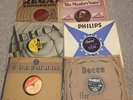
I am currently selling a series of great Richard Wagner and classic European 78 rpm orchestral recordings on all the great European labels:
Lina Cavallieri - "La Donna Piu Bella Del Mondo" got her life made as a movie with Gina Lollobrigida. Beautiful, temperamental and of amazing stage presence, had scandal following her from the Opera houses in Milan, St Petersburg, South America, the Met and Manhattan opera and finally Chicago. Having a healty throughput with husbands, she was married to a Russian Prince, an American Millionaire, Lucien Muratore, and another Italian. As a second career she ran a famous Beauty institute in Paris ...
During the war she was killed in an American Air raid on Milan, because she raced back to her villa to get her priceless jewels ...
Carmen Habanera/Di Capua: Maria Mari!
Original early Columbia issue thick record w raised rim 12" 78rpm
Condition: EXCELLENT MINUS, unworn rare faint rubs, two faint radial lams in middle of grooves do not sound,
Plays very quiet light hiss
A GREAT COPY
Lina Cavalieri (December 25, 1874 û February 7, 1944) was an Italian operatic soprano known for her great beauty.
Born Natalina Cavalieri in Viterbo, Latium, Italy, she lost her parents at the age of fifteen and became a ward of the state, sent to live in a Roman Catholic orphanage. The vivacious young girl was extremely unhappy under the strict raising of the nuns, and at the first opportunity she ran away with a touring theatrical group.
Blessed with a good singing voice, a young Cavalieri made her way to Paris, France, where her stunning good looks opened doors and she obtained work as a singer at one of the city's cafT-concerts. From there she performed at a variety of music halls and other such venues around Europe while still working to develop her voice for the opera. A soprano, Cavalieri took voice lessons and made her opera debut in Lisbon, Portugal, in 1900, the same year she married her first husband, the Russian "Prince" Bariatonsky. Eventually she followed in the footsteps of Hariclea DarclTe as one of the first stars of Puccini's Tosca. In 1904 she sang at the OpTra de Monte-Carlo then in 1905, at the Sarah Bernhardt Theatre in Paris, Cavalieri starred opposite Enrico Caruso in the Umberto Giordano opera, Fedora. From there, she and Caruso took the show to New York City, debuting with it at the Metropolitan Opera on December 5, 1906.
Lina Cavalieri as painted by Giovanni Boldini.
Cavalieri remained with the Metropolitan Opera for the next two seasons performing again with Caruso in 1907 in Puccini's Manon Lescaut. Renowned as much for her great beauty as for her singing voice, she became one of the most photographed stars of her time. Frequently referred to as the "world's most beautiful woman," she was part of the tightlacing tradition that saw women use corsetry to create an "hour-glass" figure. During the 1909û1910 season she sang with Oscar Hammerstein's Manhattan Opera Company. Her first marriage long over, she had a whirlwind romance and marriage with Robert Winthrop Chanler (1872û1930), a member of New York's prominent Astor family. However, this marriage lasted only a very short time and Cavalieri returned to Europe where she became a much-loved star in pre-Revolutionary St. Petersburg, Russia, and in the Ukraine.
During her career, Cavalieri sang with other opera greats such as the Italian baritone Titta Ruffo and the French tenor Lucien Muratore, whom she married in 1913. After retiring from the stage, Cavalieri ran a cosmetic salon in Paris. In 1914, on the eve of her fortieth birthday ù her beauty still spectacular ù she wrote an advice column on make-up for women in Femina magazine and published a book, My Secrets of Beauty. In 1915, she returned to her native Italy to make motion pictures. When that country became involved in World War I, she went to the United States where she made four more silent films. The last three of her films were the product of her friend, the Belgian film director Edward JosT.
Married for the fourth time to Paolo dÆArvanni, Cavalieri returned to live with her husband in Italy. Well into her sixties when World War II broke out, she nevertheless worked as a volunteer nurse. Cavalieri was killed in 1944 during an Allied bombing raid that destroyed her home in the outskirts of Florence.
La Cavalieri's discography is slim. In 1910, for Columbia, she recorded arias from Faust, Carmen, Mefistofele, La bohFme, Manon Lescaut and Tosca, as well as the song, "Maria, Mar8! (Ah! Mar8! Ah! Mar8!)" In 1917, for PathT, the soprano recorded "Le rOve passT," with Muratore.
She was painted by the Italian artist Giovanni Boldini (acquired by Maurice Rothschild) and by the Swiss-born American artist Adolfo Mnller-Ury (1862-1947). The latter is now the property of the Metropolitan Opera House in New York, the gift of Nicholas Meredith Turner in memory of his wife the soprano Jessica Dragonette. Hers is the face that appears repeatedly, obsessively in Piero Fornasetti's designs
In 1955, Italian actress Gina Lollobrigida portrayed Cavalieri in the film The World's Most Beautiful Woman. In 2004, a book was published authored by Paul Fryer and Olga Usova titled Lina Cavalieri -The Life of OperaÆs Greatest Beauty, 1874û1944.
[edit] Films
Manon Lescaut (1914)
La Sposa della morte (1915)
La Rosa di Granada (1916)
The Eternal Temptress (1917)
Love's Conquest (1918)
A Woman of Impulse (1918)
The Two Brides (1919)
price rating