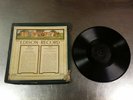
1912 Edison 80046 Diamond Disc Phonograph Record in Green Presentation Box Case
$
350


$ 350
Sold For
Jan 2, 2021
Sold Date
Aug 25, 2020
Start Date
1
Number Of Bids
USA
Country Of Seller
eBay
Sold at
Favourite Auctions
To save auctions to your favourites, please login
If you don't have an account, please register
Description
Another item from Ricky Young, Quality Artifacts, Springfield, Vermont.
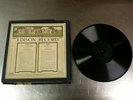
Early 1912 Edison 80046 Diamond Disc Phonograph Record in Green Presentation Box Case
- This is a very early Edison Record, No. 80046 (marked on the record edge and on the box).
- The Kiss Waltz (Luigi Arditi), Soprano and Chorus Orchestra Accompaniment
- Birds of Spring (R. Williams), Reed Orchestra
- Copyright 1912
- Green case with paper label on the front, small round label on the back, and cheese cloth lined
- Etched double shield record labels
- The record has some edge delamination, in one place just starting to touch the grooves. Aside from that, the grooves look very clean from the record sitting in the case for its life. I don't have an Edison phonograph to test this record on, so you may find some hard to see flaw when playing it.
- The case has some loss to one corner and general wear otherwise from age and storage conditions.
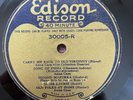
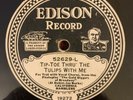
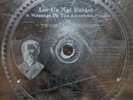
- Please see the pictures for more details.
- Although Thomas Edison invented the phonograph back in 1877, his was the last major record company to enter the record disc market. Edison held fast to cylinders until 1908, losing out in the marketplace to the likes of Victor and Columbia. In October 1913 they finally announced the commercial production of records, and the machines to play them on. These records are vertically cut, and require the Edison disc machines to play them using a diamond point reproducer (which is why they are called Diamond Discs).
- In 1912 and 1913, prior to the October 1913 announcement, Edison pressed small quantities as samples that were issued to dealers and jobbers in elaborate presentation boxes. The first ones (80,000 series) were in green boxes, and the later ones (82,000 and 82,500 series) were in blue boxes, both with a round notice/patent sticker on the back, the same size that would be affixed to the bottom of a cylinder box. The boxes were no longer used after commercial production started in October 1913. Some of these boxed records had song pairings that were never released together commercially.
price rating








![Paradise Lost - One Second. (20th Anniversary) [Remastered] 2 Vinyl LP](https://www.popsike.mobi/php/thumbnail.php?url=https://www.popsike.pics/pix/20240402/276408729787.jpg)