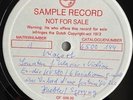
1912 SIGNED EUGENE YSAYE Violin Gabriel FAURE BERCEUSE Columbia 36519 x
$
30


Favourite Auctions
To save auctions to your favourites, please login
If you don't have an account, please register
Description
A series of great early Opera performances: From 1902 G&Ts to 40s wartime German records:
One of the great Violinsts of the 19th century here in one of his rare recordings:
Eugene Ysaye Violin SIGNED in the dead wax
(?Camille de Creus, piano accompaniment - not stated on label)
Gabriel Faure Berceuse
, recorded 12/30/1912
12" 78 rpm record
Condition:
EXCELLENT MINUS unworn light rubs , plays quiet w light crackle
EugFne Ysa e (July 16, 1858 û May 12, 1931) was a Belgian violinist, composer and conductor. His brother was pianist and composer ThTo Ysa e (1865û1918).
BiographyBorn in LiFge, Belgium, Ysa e began violin lessons aged four with his father, and later studied with Joseph Massart, Henryk Wieniawski, and Henri Vieuxtemps. This places him in the Franco-Belgian school of violin playing, which dates back to the development of the modern violin bow by Frantois Tourte.
After his graduation, Ysa e was the principal violin of the Benjamin Bilse beer-hall orchestra, which later developed into the Berlin Philharmonic. Many musicians of note and influence came regularly to hear this orchestra and Ysa e in particular, among whom figured Joseph Joachim, Franz Liszt, Clara Schumann, and Artur Rubinstein, who asked that Ysa e be released from his contract to accompany him on tour.
When Ysa e was twenty-seven years old, he was recommended as a soloist for one of the Concerts Colonne in Paris, which was the start of his great success as a concert artist. The next year, Ysa e received a professorship at the Brussels Conservatoire in his native Belgium. This began his career as a teacher, which was to remain one of his main occupations after leaving the Conservatoire in 1898 and into his last years. Among his more respected pupils are Josef Gingold, former concertmaster of the Cleveland Orchestra and Professor at Indiana University, the viola virtuoso William Primrose, the violin virtuoso Nathan Milstein (who primarily studied with Piotr Stolyarsky), Louis Persinger, Alberto Bachmann, Mathieu Crickboom, Jascha Brodsky, and Aldo Ferarasi.
During his tenure as professor at the Conservatoire, Ysa e continued to tour an ever-broadening section of the world, including all of Europe, Russia, and the United States. Despite health concerns, particularly regarding the condition of his hands, Ysa e was at his best when performing, and many prominent composers dedicated major works to him, including Claude Debussy, Camille Saint-Sadns, CTsar Franck, and Ernest Chausson.
In 1886 he established the Ysa e Quartet, which premiered Debussy's String Quartet.
As his physical ailments grew more prohibitive, Ysa e turned more to teaching, conducting and an early love, composition. Among his most famous works are the six Sonatas for Solo Violin op. 27, the unaccompanied Sonata for cello, op 28, one Sonata for Two Violins, eight PoFmes for various instruments (one or two violins, violin and cello, string quartet) and orchestra (PoFme TlTgiaque, PoFme de l'Extase, Chant d'hiver, PoFme nocturne, among others), pieces for string orchestra without basses (including PoFme de l'Exil), two string trios, a quintet, and an opera, Peter the Miner, written near the end of his life in the Walloon dialect.
Ysa e had been offered the post of music director of the New York Philharmonic in 1898, but declined it due to his busy solo performance schedule. In 1917, he was elected an honorary member of Phi Mu Alpha Sinfonia, the national fraternity for men in music, at the New England Conservatory of Music in Boston. In 1918, he accepted the music director's position with the Cincinnati Symphony Orchestra, where he remained until 1922 and with which he made several recordings.
Finally, in 1931, suffering from the extreme ravages of diabetes that had necessitated the amputation of his left foot, EugFne Ysa e died and was interred in the Ixelles Cemetery in Brussels.
[edit] Performing career
Ysa e with violinAs a performer, Ysa e was compelling and highly original. Pablo Casals claimed never to have heard a violinist play in tune before Ysa e, and Carl Flesch called him "the most outstanding and individual violinist I have ever heard in my life."
Ysa e was the possessor of a large and flexible tone, influenced by a considerable variety of vibrato ù from no vibrato at all to very intense. He said, "Don't always vibrate, but always be vibrating". His modus operandi was, in his own words: "Nothing which wouldn't have for goal emotion, poesy, heart."
Possibly the most distinctive feature of Ysa e's interpretations was his masterful rubato. Ysa e's rubato is something apart; "Whenever he stole time from one note, he faithfully paid it back within four bars," said the conductor Sir Henry Wood, allowing his accompanist to maintain strict tempo under his free cantilena. This kind of rubato fits the description of FrTdTric Chopin's rubato.
Although Ysa e was a great interpreter of late Romantics and early modern composers ù Max Bruch, Camille Saint-Sadns, and Cesar Franck, who said he was their greatest interpreter[citation needed] ù he was admired for his Bach and Beethoven interpretations. His technique was brilliant and finely honed, and in this respect he is the first modern violinist, whose technique was without the shortcomings of some earlier artists.
An international violin competition in Brussels was created in his memory: in 1951, this became the violin section of the Queen Elisabeth Music Competition.
price rating