1915 1st Compl MOZART Symphony 40 G Min ANTON HORNER French Horn VICTOR 35482 x
$
35


Favourite Auctions
To save auctions to your favourites, please login
If you don't have an account, please register
Description
I am currently selling a series of great Richard Wagener and classic European 78 rpm orchestral recordings on all the great European labels:
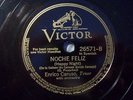
1915 Victor's First attempt of a complete recording of Mozarts Symphony No 40 G Minor note that the records are not sequential: Victor 35482 and 35489on two records, one movement on each side, suitably arranged by Theodore Moses Tobani and ably conducted by Walter B. Rogers
With soloists of the Philadelphia Anton and Joseph Horner, French horns
Horner, Anton
(Bohemia, now Czech 1877-1971)
brother of Joseph Horner
Horner, Joseph P.
(Bohemia, now Czech 1882-1944) said to be a suicide. brother of Anton Horner
Symphony in G minor K. 550,
Theodore Moses Tobani (arranger)
Wolfgang Amadeus Mozart (composer)
Victor Concert Orchestra (Musical group)
Walter B. Rogers (conductor)
3/8/1915 Camden, New Jersey
complete as recorded 2x12" 78 rpm record
Condition: EXCELLENT close to pristine faint scuffs, plays EXCEPTIONALLY quiet great sound rare ticksA GREAT COPY
Witzemann, John Kurtz, Jr. (Pennsylvania 1882- ) violin (also a member of the Henry Gordon Thunder Orchestra 1899-1900, later a Philadelphia theater musician)
Taught at the Broad Street Conservatory of Music - Philadelphia. Witzemann was also the leader of a series of popular concerts given at the Academy of Music during his Philadelphia Orchestra tenure, possibly modeled after the Boston Pops.
1900-1917
Cook, F. Wilson violin 1906-1924
Anton Horner (1877-1971)
Anton Horner founded a distinctively American style of horn playing, and his impact is still with us today. He is credited with having introduced the double horn in the US and having introduced the use of an assistant first horn. He is quoted as saying, "God made some people Horn players; others are not so fortunate."
Horner was born in Austria in 1877; in 1885 he immigrated with his family to the US and settled in Philadelphia. His father was a violinist, and Horner studied violin with him from age 8 to 13. After his father died in 1890, the family returned to Austria. In 1891 he entered the Leipzig Conservatory as a violin student. At the insistence of his great uncle, Josef Semmler, a hornist and music teacher, he took on the horn as his second instrument, studying with Friedrich Gumpert. After a year, he made horn his primary instrument.
Horner returned to Philadelphia upon graduation in 1894 and worked in the Walnut Street Theater and various other jobs. In 1899 Victor Herbert appointed him first horn of the Pittsburgh Orchestra. In the 1900 summer season he played on a European tour with Pittsburgh, and in 1901 as first horn of the Sousa Band. In 1901 he was joined by his brother, Joseph (1882-1944), who had played the previous season as the original second horn of the new Philadelphia Orchestra.
Horner auditioned for the Philadelphia Orchestra in 1902 and was appointed first horn by Fritz Scheel. He was joined again by his brother, who remained second horn until his retirement in 1938. Horner appeared as soloist with the orchestra a number of times; his last solo appearance was in 1928 in the Mozart Sinfonia Concertante. During his years with the Philadelphia Orchestra, he also played with a number of other chamber groups and orchestras, including the Bethlehem Bach Festival and the Baltimore Symphony's first series of concerts. Horner shared first horn duties during the 1929-30 season, and the following season moved to third horn, where he remained until his retirement in 1946.
Horner taught at the Curtis Institute of Music from its founding in 1924 until 1942, and his students (James Chambers, Marc Fischer, Mason Jones, Arthur and Harry Berv, and many others) have performed in orchestras worldwide. In the first years, the faculty played the principal parts in the school orchestra, so students heard and watched their teachers. Horner had his students stand in their lessons to aid breathing. He would sing rather than play to demonstrate, saving his embouchure for evening concerts.
While still at the Pittsburgh Symphony, Horner saw an advertisement for the Kruspe double horn and ordered one, beginning a long association with Kruspe. This first instrument was the Gumpert model double (designed by Edmund Gumpert, Friedrich's nephew). Starting in 1902, Horner had horns built to his specifications (the Horner Model), which he imported and sold until World War II. This design was copied by several other makers, the most notable being the Conn 8D.
Horner's major publication (still available today) is Primary Studies for the French Horn.
Horner was an original member of the IHS, and was elected an Honorary Member in 1971. A tribute appears in the May 1972 issue of The Horn Call and a reminiscence by one of his students in the April 1990 issue.
price rating