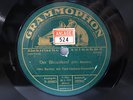
1917 MARIA IVOGUN Coloratura Nocturne von Chopin in E Flat ODEON 76975 Ivogün .
$
30


Favourite Auctions
To save auctions to your favourites, please login
If you don't have an account, please register
Description
A series of great OPERA Records from early G&Ts to World War II recordings on 78 rpm Victrola Records
Click this link for more great Opera and Vocal Records in my other listings!
Maria Ivoguen
Although Maria Ivognn is not well known to current opera lovers (in the US) she continues to be highly esteemed by critics and professionals. During her singing career, Richard Strauss and Bruno Walter held her in high regard. In his recently published book, Singers of the Century , J. B. Steane devotes an entire chapter to her.
When asked recently about who possessed "the most beautiful voice," I remembered Ivognn's voice even though I hadn't listened to a recording done by her in over twenty years.One of the most exciting of German high sopranos, and the unforgettable Zerbinetta of Ariadne:
in one of her first Berlin Odeon recordings in a wondrous arrangenment
Soprano Maria Ivogün (1891-1987) / Nocturne in E Flat (Chopin) / Recorded: 1917 in Berlin --
Please see top of the page for condition
Maria Ivognn (18 November 1891, Budapest - 3 October 1987, Beatenberg, Switzerland) was a distinguished soprano singer of Hungarian origin. She was especially an outstanding interpreter of the works of Mozart: her recording of the aria of the Queen of the Night (Die Zauberfl÷te) became legendary.
Biography and artistic career
Maria Ivognn was born Ilse Kempner. Her father was the Austro-Hungarian Colonel Pßl Kempner. She created her professional name by contracting the maiden name of her mother, the Austrian operetta singer Ida von Gnnther. Probably through the second marriage of her mother to a Swiss man, she spent the greater part of her childhood and youth in Znrich. From 1909 (other sources say since 1907) she began to study singing at the Music Academy in Vienna with Irene Schlemmer-Ambros, and theatre with Professors Frauscher and Stoll.
When the young soprano sang in 1913 at the Vienna Hofoper, she was overlooked. However the house conductor there, Bruno Walter recognised her outstanding talent and engaged the artist for his new workplace at the Royal Hofoper in Munich. She gave her debut in Munich in the role of Mimi in Puccini's La bohFme. Three years later, in 1916, she sang the Zerbinetta in the re-worked version of Ariadne auf Naxos in Vienna at the express wish of the composer Richard Strauss. In the same year she replaced an indisposed singer as Queen of the Night in Mozart's Die Zauberfl÷te, a role for which Maria Ivognn was very highly regarded and with which she laid the foundation of her success.
By 1916 Ivognn was reckoned among the best female singers in Europe and had roles in operas such as Fidelio (Marzelline), Cos8 fan tutte, Le nozze di Figaro and many others. Moreover she became well known as Zerbinetta in Richard StraussÆ Ariadne auf Naxos.
In 1917 the title of Royal Bavarian KammersSngerin was bestowed upon her. In the same year she sang the boy-role of Ighino in the original production of Hans Pfitzner's Palestrina opposite the tenor Karl Erb in the title-role, whom she married in 1921. As artists, with their style of singing, the couple excited the press and the public to frenetic storms of enthusiasm.
In two further important original productions in Munich, Ivognn took on leading roles: in Der Ring des Polykrates of the then barely 19-year-old Erich Wolfgang Korngold (1st performance 28 March 1916) she sang Laura, and in Walter BraunfelsÆs Die V÷gel (1st performance 4 December 1920) she took the part of the Nightingale. In the theatrical season of 1925/1926 the singer, whose artistic name was taken from the opening syllables of her mother's maiden name, followed Bruno Walter to the State Opera in Berlin. She remained there as a member of the regular company until 1932.
In 1932 Maria Ivognn was divorced from Karl Erb, and in 1933 she married their pianist-accompanist Michael Raucheisen.
The highly celebrated soprano made countless concert-tours and guest opera appearances both within Germany and beyond. She appeared above all at La Scala, Milan, the Vienna State Opera, Covent Garden, London, the Chicago Opera and at the Metropolitan Opera New York. When she fell ill with an eye-illness she ended her operatic career in 1932 and in 1934 her career as a singer of lieder.
From 1948 to 1950 Maria Ivognn taught at the Music High School in Vienna, and finally she became professor at the Hochschule in Berlin.
She spent her twilight years in Switzerland, virtually blind. The singer's last resting place was at the side of her second husband Michael Raucheisen in the city cemetery of Rain, Switzerland.
[edit] Work
The soprano Maria Ivognn is considered today to have been one of the best and most distinguished female opera singers of the twentieth century. In the period between the two world wars she gave very good account of operatic standards in Germany, through the whole of Europe. Very many recorded performances (also with the Erb, her first husband) are to be included among her artistic achievements.
Maria Ivognn worked as the teacher and mentor of many distinguished female singers of opera and entertainment music. Among her students are numbered above all the opera singers Elisabeth Schwarzkopf, Rita Streich, Renate Holm and Helga Kosta. But also the theatrical singer Gitta Lind, much loved in the 1950s, was her student.
price rating