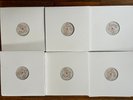
1923 Arthur CATTERALL Violin WILLIAM MURDOCH PIANO BEETHOVEN KREUTZER SONATA 78
$
40


Favourite Auctions
To save auctions to your favourites, please login
If you don't have an account, please register
Description
Please wait for me to send you an invoice. DO NOT USE EBAY CHECKOUT if you want the lowest possible postage.
Welcome to my auctions of great records
This is my FINAL WEEK of 2 weeks of great auctions – I WILL PACK AND BILL YOUR RECORDS after the close of these auctions on MARCH 12. KINDLY ALLOW UP TO 48hrs for packing and billing to get you the exact postage.
PLEASE DO NOT PAY before I send you an invoice. It will take me up to 48 hours to pack your records, but this is the ONLY WAY to get you the LOWEST POSTAGE. If you pay before I sent you an invoice, the EBAY system will charge you a HIGHER POSTAGE for shipping.
A series of great Violin, Piano and Orchestra records on rare labels, from 1902 Monarch to 1940 War Germany recordings.
Beethoven "KREUTZER" Sonata
Arthur Catterall (violin)
William Murdoch (piano)
Recorded on June 7, 1923, in Columbia's Petty France Studios, London, on 78-rpm
on 2x US VIVA TONAL 12" Columbia records
Condition:
EXCELLENT PRISTINE, best possible pressing , plays EXCEPTIONALLY QUIET
A CHOICE COPY
Arthur Catterall (25 May 1883 – 28 November 1943) was an English concert violinist, orchestral leader and conductor, one of the best-known English classical violinists of the first half of the twentieth century.
Arthur Catterall was born in Preston, Lancashire, the son of John Catterall, a painter and his wife Elizabeth, a cotton weaver. He was an extremely gifted musician in childhood. He first played the violin in public at a concert in Preston when he was 6 years old. He played the Mendelssohn violin concerto in Manchester at the age of 9.[1] Catterall received his elementary education under the Jesuits at St Ignatius Roman Catholic School, Preston until 1893 when he was accepted as a Boarder at St Bede's College, Manchester,[2] during this time he also studied at the Royal Manchester College of Music under Willy Hess in 1894 and under Adolph Brodsky in 1895. Catterall graduated from St Bede's at the age of 16 in 1898.
In 1902, at the age of 18, he was invited to Bayreuth by Hans Richter and played at all of Cosima Wagner's musical evenings in that season. He appeared at a Hallé Orchestra concert in 1903 playing Tchaikovsky's concerto.[3]
Orchestral leader[edit]
In 1909 Catterall became leader of the promenade concerts at the Queen's Hall.[4] In 1911 he acquired the violin made by Jean Baptiste Vuillaume, c. 1843, which had belonged to Ferdinand David.[5] In 1907 he was appointed Professor of violin at the Royal Manchester College of Music (a post he held for many years)[4] and became leader of the Hallé Orchestra, where he remained until 1925. In 1913 he obtained the 'Baillot-Pommereau' 1694 instrument by Antonio Stradivarius,[6] and in September of that year performed the Violin Concerto BV 243 of Ferruccio Busoni with the Queen's Hall Orchestra under Henry Wood.[7] He later gave the English premiere, also at a prom, of the (1911–1912) Violin concerto of Samuel Coleridge-Taylor, which had been dedicated to Maud Powell.[8]
Chamber music[edit]
In addition to his orchestral and teaching work, Catterall was active in chamber music throughout his career. In 1915 Frederick Delius wrote a Sonata for violin and piano for Catterall and the pianist R.J. Forbes.[9] He led the Catterall Players, an ensemble for chamber performance, which performed the Elgar quintet in 1921.[10] He had connections with the London Chamber Music Players (led by Albert Sammons), with the pianist William Murdoch (pianist) and 'cellist W. H. Squire, and founded and in 1910 founded and led a string quartet under his own name as the Catterall Quartet. In this John S. Bridge played 2nd violin,[11] Frank S. Park (viola) and Johan C. Hock (cello).[4] Hans Keller described their work as 'imaginative'.[12] From 1926 to 1931 Laurance Turner was second violin in the quartet.[13]
The quartet made recordings for His Master's Voice in the early 1920s, including Beethoven's op 18 nos 1 (1922–1923) and 2 (1923–1924), Arensky 2nd Quartet op 35a, and the Brahms Quartet no 1 (June 1923).[14] They also recorded Beethoven op 130 at full length by the acoustic process, but this remained unissued.[15] Catterall also played in a Trio called The Manchester Trio.[16]
At the same time Catterall was recording for Columbia Records as a soloist in complete versions of Mozart's Concerto no 5 in A minor K219, and Bach's concerto for two violins with John S. Bridge, both under the direction of Hamilton Harty, c. 1924. The quartet also transferred to recording for Columbia. He recorded the Brahms violin sonata in D minor with Murdoch in November 1923. He also recorded by the electrical microphone process after 1925. In the 1933 Columbia catalogue the standard recording of Tchaikovsky's Trio no 2, op 50 (on 12 sides) was by Catterall, Murdoch and Squire.[17]
Move to London[edit]
After many years teaching at the Manchester College, Catterall became Professor at the Royal Academy of Music in London.[18] Among his pupils were Harry Blech, Walter Appleyard, Eugene Genin, Arthur Leavins, Laurance Turner, Gloria Pashley, and also Olive Zorian (1916–1965) (founder and leader of the Zorian Quartet which pioneered works by Michael Tippett in 1943–44 and those of Britten soon afterwards). After leaving the Hallé orchestra he concentrated on solo work, performing for example the Beethoven concerto under Thomas Beecham with the London Symphony Orchestra in March 1927.[19] He also developed as a conductor, taking the third concert of the 1929 Delius Festival at the Queen's Hall (Eventyr, Cynara, Piano concerto, Arabesk and Appalachia).[20]
In 1929, Catterall became the founding leader of the BBC Symphony Orchestra, though the proms were at first led by his assistant violin Charles Woodhouse. When the orchestra first appeared in full strength (115 players), on 22 October 1930, at the Queen's Hall in its inaugural concert with the Flying Dutchman overture, Brahms' Fourth Symphony, the Saint-Saëns cello concerto (with Guilhermina Suggia) and Ravel's Symphonic Fragments from Daphnis et Chloé, under Adrian Boult, Catterall led the orchestra.[21]
In 1932, Granville Bantock dedicated his second violin sonata to Catterall (the first having been to Albert Sammons).[22] Catterall retired from his position with the BBC Orchestra in 1936, to devote his time to solo work and teaching. He formed another chamber orchestra for young string players, The Catterall String Orchestra, led from 1940 to 1943 by Audrey Catterall (b. 1917).[23]
He remained busy into the first years of the war, still a champion of contemporary composers. He performed the Brahms double concerto (with cellist Thelma Reiss) and gave the English premiere of Felix Weingartner's Sinfonietta (with Reiss and violist Bernard Shore) under Weingartner's baton at a Royal Philharmonic concert in February 1939.[24] He was memorably associated with the cellist Antonia Butler in a prom performance at the Queen's Hall of the Brahms double concerto in August 1940. After an air-raid warning was heard and the audience was obliged to remain indoors, the musicians improvised an all-night concert.[25] The work of the Catterall Quartet (with Audrey Catterall as second violin)[13] continued, for on 5 February 1942 it gave the first performance of the String Quartet in G minor ('Kenilworth'), op 99, by Armstrong Gibbs at Windermere.[26] On 8 July 1942 he gave the world premiere of the Violin concerto dedicated to him by E.J. Moeran, under Henry Wood,[27] and repeated his performance, with Wood, for the Royal Philharmonic concert of 5 December 1942.[28]
He died in London in November 1943: Moeran was present at the death or soon after.[29] An Arthur Catterall Cup for violin or viola concerto performance is competed for in the Feis Ceoil.
William David Murdoch (10 February 1888 – 9 September 1942) was an Australian pianist, composer and author.
Murdoch was born at Sandhurst (now Bendigo, Victoria), the son of Andrew Murdoch, an engineer, and his wife Annie, née Esler. At 11 years of age William began piano lessons and soon won several solo competitions. In 1903 he was awarded the first Bendigo Austral scholarship. This entitled him to three years' tuition at the University of Melbourne conservatorium of music, where he continued his studies under William Adolphus Laver, later Ormond Professor of Music. In 1906 Murdoch won the (Sir William John) Clarke scholarship which entitled him to three years' tuition at the Royal College of Music, London. As the scholarship was not large enough to fully provide for the young man, it was agreed that he should receive the balance of his Austral scholarship, and a further amount was raised from a concert and subscriptions at Bendigo. Murdoch spent four happy years at the London college and made great progress, under the guidance of Danish pianist and teacher, Frits Hartvigson.
[edit]Career
Murdoch's first public recital at London towards the end of 1910 was very successful, and in 1912 he toured Australia with Louise Kirkby Lunn. He remained there in 1913 and toured with Dame Clara Butt and Kennerley Rumford. He was now a fine player with a sparkling technique, especially successful in his interpretation of the work of Chopin and Debussy. He toured the United States and Canada during 1914, and for some time was with the band of the Grenadier Guards in France during the war. On 5 August 1915 Murdoch married Ellen Josephine Tuckfield in London.
Murdoch gave recitals in Scandinavia in 1918 and in the following year began his long association with the violinist Albert Sammons, which developed into the formation of the "Chamber Music Players". These two with Lionel Tertis and Lauri Kennedy did some remarkable ensemble playing. In 1919 he participated in the premieres of Sir Edward Elgar's Violin Sonata in E minor and Piano Quintet in A minor.
Murdoch contributed the article on "Pianoforte Music from 1880" to A Dictionary of Modern Music and Musicians, published in 1924, and in 1929 he again visited Australia and toured with Harold Williams. In 1933 Murdoch published a volume on Brahms, in which he analysed all his work for the piano, and in 1934 appeared Chopin: His Life, an interesting record in which much new material was made use of. He had intended to include a comprehensive study of Chopin's works in a later volume, but this had not appeared when Murdoch died at Holmbury St Mary, Surrey, on 9 September 1942. Murdoch's first wife died; he subsequently married divorcee Dorothy Violet Lang, née Mascall, on 21 March 1921, and after she divorced him, married Antonia Dorothea Meek, née Simon, on 25 November 1925. Murdoch left a widow, two sons and two daughters.
[edit]Style
Murdoch's arrangements of organ works by Bach for the piano were very good, and he also composed a number of songs and pieces for the piano. He was steeped in music from his childhood. When he first appeared he had a brilliant technique to which the years added the warmth of temperament and sensitiveness of thought, needed for the expression of a fine musician. He was especially renowned as one of the great ensemble players of his time. The critic William James Turner wrote in 1916: Even when we get to the best pianists it is rarely, if ever, that we find a combination of exceptional technical mastery with tone-power, delicacy of touch, brilliance, command of colour, sensitiveness of phrasing, variety of feeling, imagination and vital passion. Mr. Murdoch possesses all these qualities to a high degree (ADB).
More Great Records on sale right now:
http://shop.ebay.com/carsten_sf/m.html
http://shop.ebay.com/carsten_sf/m.html
====
A Quick NOTE ON GRADING AND SHIPPING:
As you can see from my feedback, I try hard to earn your POSITIVE FEEDBACK and FIVE STAR RATINGS.
If for any reason your transaction was NOT SATISFACTORY, pls contact me and I will work something out with you. YOU WILL NEVER HAVE A REASON TO GIVE ME A NEGATIVE RATING or a LOW STAR RATING.
Quick note on grading:
The Grade (Excellent to Fair, I don't give Mint) refers to the WEAR of the record. Any other defects are stated separately
When I listen to a record, I may also give it an aural grade (again E to F), and make a SUBJECTIVE judgment of the pressing quality for hiss and surface noise.
"SUPERQUIET" is basically noiseless, like a vinyl pressing.
"VERY QUIET" is an quiet record for a given pressing.
"Quiet" is a record that is a great example without undue noise for a give pressing.
These judgments are SUBJECTIVE and will depend one the styli, phonograph etc. you use on your own equipment.
If you win multiple items, pls send me an INVOICE REQUEST to calculate the correct postage. Ebay check out will not give you the multiple item discount!
Records will be packed safely between corrugated cardboard in a sturdy box with plenty of padding for safe shipment.
Shipment is usually Media Mail, unless another service is requested. Shipping is at your risk, I will be happy to insure items at your cost.
I charge actual postage plus a small fee for packing materials
As always, I guarantee your satisfaction. If you don't like the item, just return it, and I will refund the full purchase price.
If you are in the San Francisco area, I encourage pick-up in person.
US Domestic Shipping:
Here is a guideline for US Media Mail Shipping:
Prices below are for regular 78 rpm records. Up to about 5 records, I will ship Edison Discs for the same rates. Albums from Album Sets count as 1 record. Above that and for international shipments, it will be actual weight plus a small packing charge (1-3$ depending on size of shipment)
1 record: 4.50 – 5.00$
2 records: 5.75$
5 records: 7.50$
10 records: 9.50$
MANY MORE RECORDS: Don't worry. I safely ship 40 - 50 pounds of records double boxed in moving boxes, and even then Media Mail will probably not exceed 30$.
Please send me a message if you would like to lower your shipping rates!
International Buyers:
I am very happy to ship records worldwide.
Please use the EBAY shipping cost only as a guideline. My actual charges are usually lower
International shipping: approx postage 1x10"=$25: 1x12"=$35: 10"Album 4 Rec=50$: 12" Album 2 Rec=50$
HOWEVER in most cases I can get you SIGNIFICANT savings by using other services. Pls contact me for a quote.
About 30% less to Canada.
Pls contact me for a shipping estimate, or send me an invoice request after close of auction.
AND AGAIN -THANK YOU FOR YOUR INTEREST
As you can see from my feedback, I take great care in presenting, grading and shipping your items. I really want you to be happy with the purchase. If you feel that anything is wrong with the item or the shipping, contact me and we will work it out !!!
As always, I would appreciate any suggestions and corrections from you, pls contact me with any question.
Thank you very much, and good luck bidding !!!
price rating