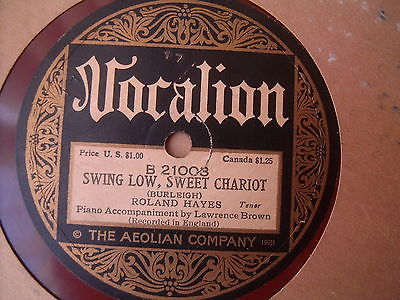
1923 ROLAND HAYES BLACK Tenor Swing Low Sweet Chariot/ Steal Away 78
$
31


Favourite Auctions
To save auctions to your favourites, please login
If you don't have an account, please register
Description
WEEK 2 of 3 weeks of great auctions - A whole range of great records, pls have a look at the banner below the
Item Description. More good stuff to come.
I will be happy to hold your items until the end of these auctions, and pack them in one economic parcel
Shipping prices have gone up again, I am trying my best to keep your shipping as affordable as before.
For International Buyers - I have great rates for international shipping, especially large parcels to Japan and Western Europe, but of course I will ship WORLDWIDE.
IF YOU WIN MULTIPLE ITEMS DO NOT USE EBAY CHECK OUT in order for me to get you low combined postage. Send me an invoice request instead.
US Tenor in one of Beethoven's most sublime songs:
in his first commercial recordings made in London 1923
Swing Low Sweet Chariot/ Steal Away
Lawrence Brown Piano
10" 78rpm record
Condition Record: EXCELLENT MINUS/ VG++, light scratches on Steal , plays very quiet E ,rare ticks on steal
A SUPERB COPY
Hayes in 1954, photo by Carl Van Vechten
Roland Hayes (June 3, 1887 – January 1, 1977) was an American lyric tenor. He is considered the first African-American male concert artist to receive wide acclaim both at home and internationally. Critics lauded his abilities and linguistic skills with songs in French, German and Italian.
Contents [hide]
Hayes was born in Curryville, Georgia, near Calhoun, on June 3, 1887, to Fanny and William Hayes. Roland’s parents were tenant farmers on the plantation where his mother had once been a slave. Roland’s father, who was his first music teacher, often took him hunting and taught him to appreciate the musical sounds of nature. When Hayes was eleven his father died, and his mother moved the family to Chattanooga, Tennessee. William Hayes claimed to have some Cherokee ancestry, while his maternal great-grandfather, Aba Ougi (also known as Charles) was a chieftain from Côte d'Ivoire. Aba Ougi was captured and shipped to America in 1790.[1] At Mt. Zion Baptist Church in Curryville (Founded by Roland’s mother[2]) is where Roland first heard the music he would cherish forever, Negro Spirituals. It was Roland’s job to learn new spirituals from the elders and teach them to the congregation.
At the age of twelve Roland discovered a recording of the Italian tenor Enrico Caruso. Hearing the renowned tenor revealed a world of European classical music. Hayes trained with Arthur Calhoun, an organist and choir director, in Chattanooga. Roland began studying music at Fisk University in Nashville in 1905 although he only had a 6th grade education. Hayes’s mother thought he was wasting money because she believed that African-Americans could not make a living from singing.[citation needed] As a student he began publicly performing, touring with the Fisk Jubilee Singers in 1911. He furthered his studies in Boston with Arthur Hubbard, who agreed to give him lessons only if Hayes came to his house instead of his studio. He did not want Roland to embarrass him by appearing at his studio with his white students. During his period studying with Hubbard he worked as a messenger for the Hancock Life Insurance Company to support himself.
[edit]Early career
Hayes performed his own musical arrangements in recitals from 1916–1919, touring from coast to coast. For his first recital he was unable to find a sponsor so he used two hundred dollars of his own money to rent Jordan Hall for his classical recital. To earn money he went on a tour of black churches and colleges in the South. In 1917 he announced his second concert, which would be held in Boston’s Symphony Hall. On November 15, 1917, every seat in the hall was sold and Hayes’s concert was a success both musically and financially but the music industry was still not considering him a top classical performer[3][page needed]. He sang at Walter Craig's Pre-Lenten Recitals[4] and several Carnegie Hall concerts. He performed with the Philadelphia Concert Orchestra, and at the Atlanta Colored Music Festivals and at the Washington Conservatory concerts. In 1917, he toured with the Hayes Trio which he formed with baritone William Richardson and pianist William Lawrence.
In April 1920 he traveled to Europe. He began lessons with Sir George Henschel, who was the first conductor of the Boston Symphony Orchestra, and gave his first recital in London’s Aeolian Hall in May 1920 with pianist Lawrence Brown as his accompanist. Soon Hayes was singing in capital cities across Europe and was quite famous. Almost a year after his arrival in Europe, Hayes had a concert at London’s Wigmore Hall. The next day, he received a summons from King George V and Queen Mary to give a command performance at Buckingham Palace. He returned to the United States in 1923. He made his official debut on 16 November 1923 in Boston's Symphony Hall singing Berlioz, Mozart and spirituals, conducted by Pierre Monteux, which received critical acclaim. He was the first African-American soloist to appear with the Boston Symphony Orchestra.[5] He was awarded the Spingarn Medal in 1924.
[edit]Late career
Hayes finally secured professional management with the Boston Symphony Orchestra Concert Company. He was reportedly making $100,000 a year at this point in his career. In Boston he also worked as a voice teacher. One of his pupils was the Canadian soprano Frances James. He published musical scores for a collection of spirituals in 1948 as My Songs: Aframerican Religious Folk Songs Arranged and Interpreted.
In 1932, while in Los Angeles for a Hollywood Bowl performance, he married Alzada Mann. One year later they had a daughter, Afrika.[6] The family moved into a home in Brookline, Massachusetts. Hayes continued to perform until the age of eighty-five when he gave his last concert at the Longy School of Music in Cambridge, Massachusetts. He died five years later on January 1, 1977.
[edit]Racial Reception
Even when Hayes became a successful musician he faced the same prejudices as most African-Americans at the time. In his Germany tour on 1923, some people protested against his concert in Berlin. A newspaper writer criticized him as “an American Negro who has come to Berlin to defile the name of the German poets and composers.”[citation needed] The night of the concert Roland faced an angry audience who mocked him for ten minutes. Hayes stood still until they stopped and then he began singing Schubert’s "Du bist die Ruh". Hayes’s remarkable voice and musical talent won over the German audience and his concert was a success.[citation needed]
The Chicago Defender (National edition) Jul 25, 1942 paper reported a case in witch Hayes' wife and daughter were thrown out of a Rome, Georgia shoe store for sitting in the white-only section, Hayes confronted the store owner. The police then arrested both Hayes, whom they beat, and his wife. Hayes and his family eventually left Georgia.[3][citation needed]
On many of his concerts Hayes would attempt to abandon the use of segregated seating. At a concert in Atlanta, Georgia[when?] Hayes had the main floor of the auditorium as well as the boxes and first balcony halved between the races. The galleries were reserved for colored students at a special rate. No whites were allowed in them except the ones chaperoning the students.[citation needed]
Hayes taught at Black Mountain College for the 1945 Summer institute where his public concert was, according to Martin Duberman, "one of the great moments in Black Mountain's history" (215).[citation needed] After this concerts, in which unsegregated seating went well, the school had its first full time black student and full time member of the faculty.[7]
Quick NOTE ON GRADING AND SHIPPING:
As you can see from my feedback, I try hard to earn your POSITIVE FEEDBACK and FIVE STAR RATINGS.
If for any reason your transaction was NOT SATISFACTORY, pls contact me and I will work something out with you. YOU WILL NEVER HAVE A REASON TO GIVE ME A NEGATIVE RATING or a LOW STAR RATING.
Quick note on grading:
The Grade (Excellent to Fair, I don't give Mint) refers to the WEAR of the record. Any other defects are stated separately, when prefaced with "HOWEVER" or "BUT" they will be significant.
When I listen to a record, I may also give it an aural grade (again E to F), and make a SUBJECTIVE judgment of the pressing quality for hiss and surface noise.
"SUPERQUIET" is basically noiseless, like a vinyl pressing.
"VERY QUIET" is an exceptionally quiet record for a given pressing.
"Quiet" is a record that is a great example without undue noise for a given pressing.
These judgments are SUBJECTIVE and will depend one the styli, phonograph etc. you use on your own equipment.
Pls check my other auctions for more great records and phonograph items:
http://shop.ebay.com/carsten_sf/m.html
http://shop.ebay.com/carsten_sf/m.html
====
Multiple item shipping: I am happy to combine items for shipment in one parcel.
If you win multiple items, pls send me an INVOICE REQUEST to calculate the correct postage. Ebay check out will not give you the multiple item discount!
Records will be packed safely between corrugated cardboard in a sturdy box with plenty of padding for safe shipment.
Shipment is usually Media Mail, unless another service is requested. Shipping is at your risk, I will be happy to insure items at your cost.
I charge actual postage plus a small fee for packing materials
As always, I guarantee your satisfaction. If you don't like the item, just return it, and I will refund the full purchase price.
If you are in the San Francisco area, I encourage pick-up in person.
US Domestic Shipping:
Here is a guideline for US Media Mail Shipping:
Prices below are for regular 78 rpm records. Up to about 5 records, I will ship Edison Discs for the same rates. Estimate count for Album Sets as number of records plus 1 record. I have a great track record for sending LARGE PARCELS of records safely
1 record: 4.75$
2 records: 5.75$
5 records: 7.50$
10 records: 9.50$
MANY MORE RECORDS: Don't worry. I safely ship 40 - 50 pounds of records double boxed in moving boxes, and even then Media Mail will probably not exceed 30$.
The numbers above include the 9% Ebay fee on shipments.
Pls ignore the automatically calculated prices on the ebay site, as I will weigh every parcel and charge based on actual weight.
Please send me a message if you would like to lower your shipping rates!
International Buyers:
All'attenzione degli acquirenti italiani:
ATTENTION TO ITALIAN BUYERS:
Due to rare problems with delivery in ITALY, I will NOT GUARANTEE delivery of parcels sent by US Postal Service First Class and Priority Mail. If you prefer secure delivery, I will be happy to quote you either Registered Mail or shipment by FEDEX
I am very happy to ship records worldwide.
One record usually ships for 20 - 25$ worldwide, 14 - 19$ to Canada
Pls contact me for a shipping estimate, or send me an invoice request after close of auction.
For very large parcels, I have very economic shipping rates, much lower than US MAIL, especially to Japan, Western Europe and Taiwan.
AND AGAIN -THANK YOU FOR YOUR INTEREST
As you can see from my feedback, I take great care in presenting, grading and shipping your items. I really want you to be happy with the purchase. If you feel that anything is wrong with the item or the shipping, contact me and we will work it out !!!
Pls contact me with your country, home town and postal code before bidding for an estimate.
=====
As always, I would appreciate any suggestions and corrections from you, pls contact me with any question.
Thank you very much, and good luck bidding !!!
price rating