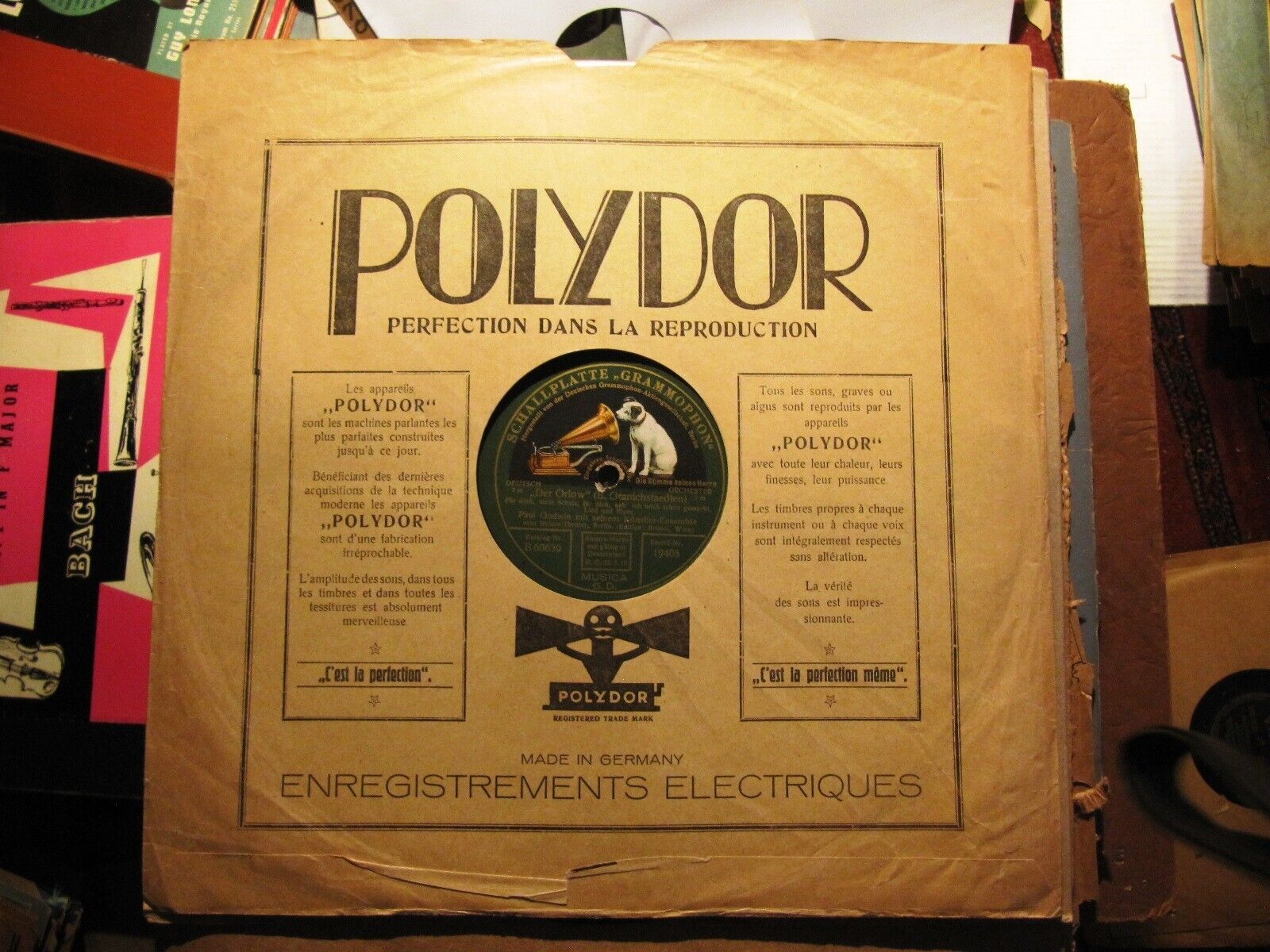
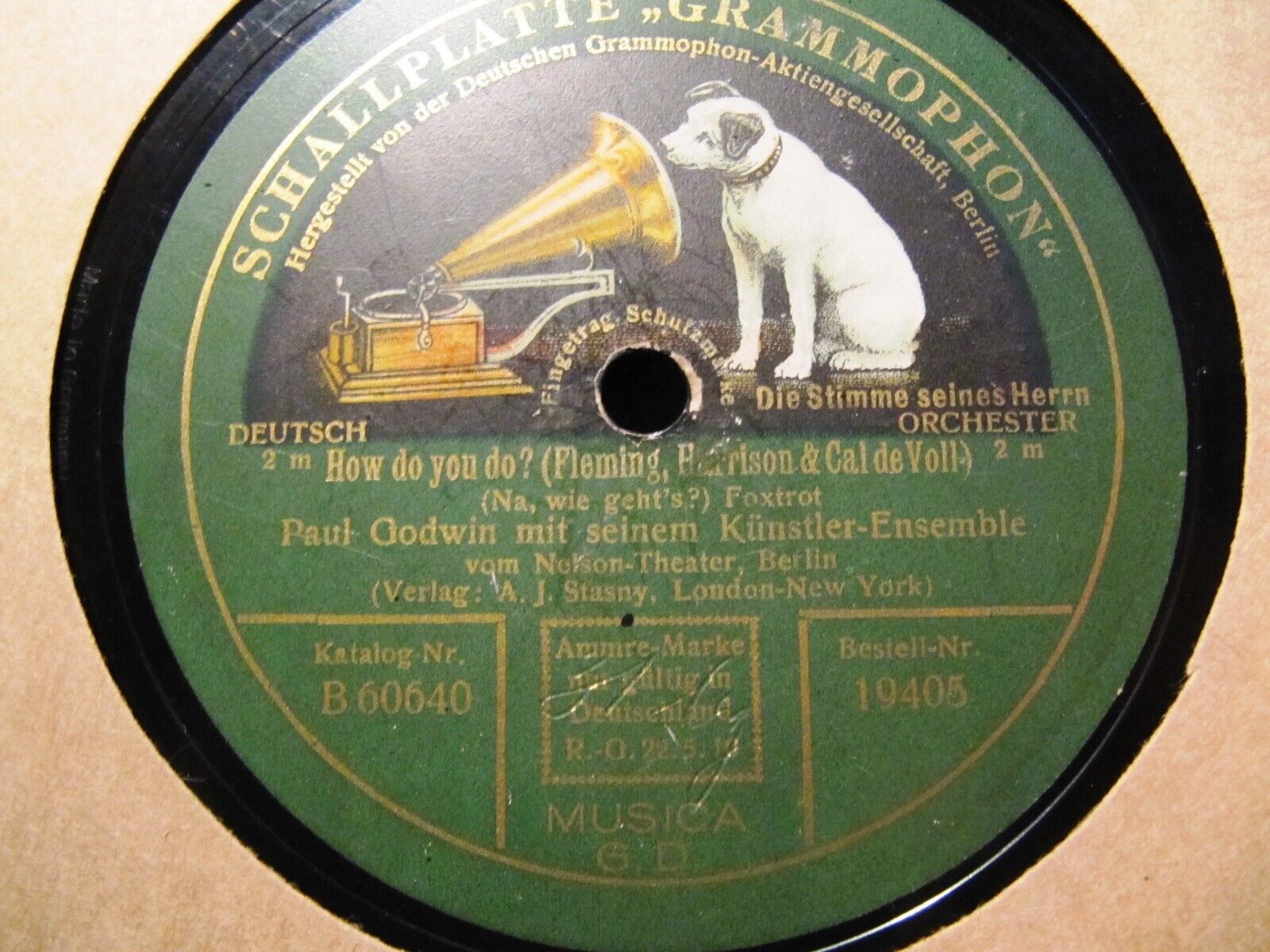
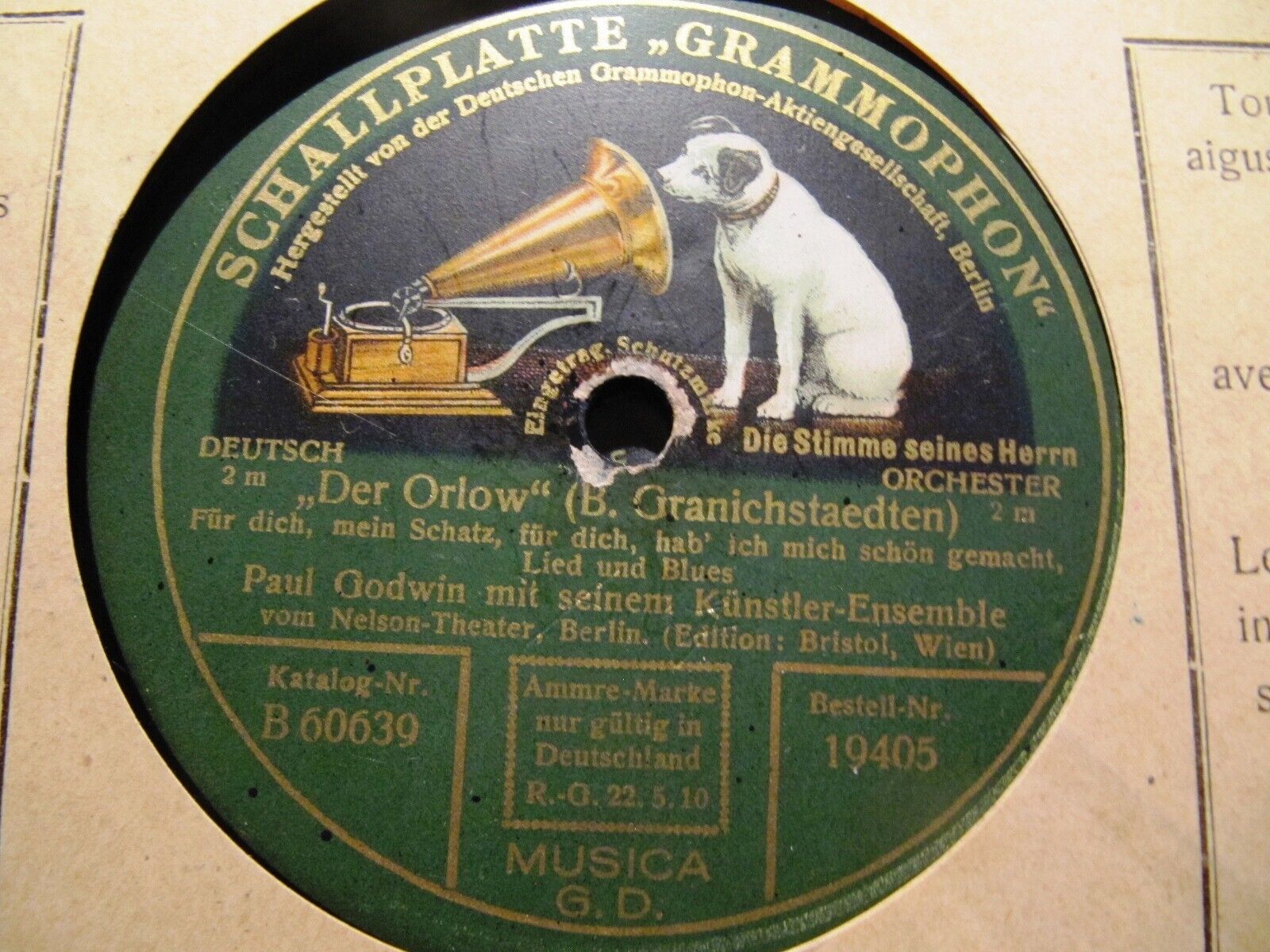
1925 GERMAN BLUES Paul Godwin Künstler Ensemble BERLIN Der Orlow HOW DO YOU DO?
$
30


Favourite Auctions
To save auctions to your favourites, please login
If you don't have an account, please register
Description
A series of great Orchestra Records by great conductors on 78 rpm records
Click on this link to see more great Conductors and Orchestral Records!
Jewish Band Leader Paul Godwin (Pinchas Goldfein) Orchestra BERLIN , which also did light classical medleys like Marek Weber or Edith Lorand
Here in two snappy Dance Medleys, one is called "Lied und Blues" from the 1925 hit show
"Der Orlow"
Artist: Paul Godwin mit seinem Künstler-Ensemble
Label: Deutsche Grammophon 19405
Date: 1925
Track Artist Title Composer Rating
A Paul Godwin mit seinem Künstler-Ensemble "Lied und Blues" Für dich, mein Schatz, für dich, hab' ich mich schön gemacht ("Der Orlow") B. Granichstaedten
B Paul Godwin mit seinem Künstler-Ensemble How Do You Do ? (Na, Wie Geht's ?) FOX TROT Fleming, Harrison, Cal De Voll
Please see top of the page for condition
Der Orlow by Bruno Granichstaedten and Ernst Marischka was premiered on April 3, 1925 in Vienna, at the Theater an der Wien.
After his debut work in 1908, Bruno Granichstaedten's greatest successes were Bub oder Mädel, the operettas On the Order of the Empress (1915) and Der Orlow (1925).
In addition, he created music for three sound films and some songs and chansons. His music was typically Viennese in the early years, but after the First World War the influence of popular American music can be clearly heard, especially in terms of rhythmic design.
However, this was not conducive to his artistic success, as it meant that his work lost some of its independence.
1925 Hit operetta of by Bruno Granichstaedten and Ernst Marischka which was turned into a movie in 1927.
Grand Duke Alexander Alexandrovich was robbed of a magnificent diamond, the “Orlov”, when he had to flee Russia from the Bolsheviks. In the West he has made a living as a pilot in an airplane factory run by two oddballs, Messrs. John Walsh and Jolly Jefferson. The Grand Duke takes a liking to his compatriot Nadja Nadjakowska, a sophisticated and seductive dancer who also ended up here from Russia.
One of the two aircraft manufacturers doesn't find this funny at all, since he himself shows interest in the lady, while his partner has to deal with a rather ugly admirer, his secretary Dolly Marbanks. Finally, another Russian appears, the fake Grand Duke Alexander, who once stole the fat bling from the real high nobility. As is usual in an operetta, everything works out for the best in the end: Everyone gets the woman who suits them, like Alexander Alexandrovich gets his Nadja, or who he deserves (like one of the airplane manufacturers who now blossomed into real beauty Dolly). But the long-fingered Russian exile and false grand duke has to return the precious stone and goes to prison.
Paul Godwin (1902 – 1982) was a violinist and the leader of a popular German dance orchestra in the 1920s-30s.
He was born on March 28, 1902, in Sosnowitz (Russian Empire; now Poland), his real name was Pinchas Goldfein. Early recordings on the POLYPHON label gave the name "Tanz-Orchester Goldfein". He studied the violin at the Warsaw Conservatory under Stanislaw Barcewicz.[1]
At the age of 20 he formed his own dance band in Berlin. Between 1926 and 1933 his orchestra Tanz-Orchester Paul Godwin recorded a countless number of records for European labels, mostly for Berliner Gramophone. Many recording singers were backed by his orchestra at that time. His band performed current hits and longtime favorites of various styles: foxtrots, waltzes, tangos, polkas. Occasionally Paul Godwin recorded classical pieces, with his full orchestra as well as the "Paul Godwin-Trio" or "Paul Godwin Quartet". Due to the variety of their repertoire, his orchestra recorded under various monikers: Tanz-Orchester Godwin, Paul Godwin's Jazz Symphoniker, Paul Godwin-Ensemble, Paul Godwin & sein Weekend-Orchester etc. In 1929-1933 he turned to cinema and provided many UFA motion pictures with hugely popular soundtracks.
Paul Godwin and his orchestras were enormously popular in Europe at the time: the recent report stated that within the ten-year period (1923–1933) nine millions of his records were sold.
In early 1933 Paul Godwin moved to the Netherlands where he remained for the rest of his life. After the war Godwin formed a classical violin trio with which he performed until the 1970s. He died on December 9, 1982 in Driebergen in the Netherlands.
price rating