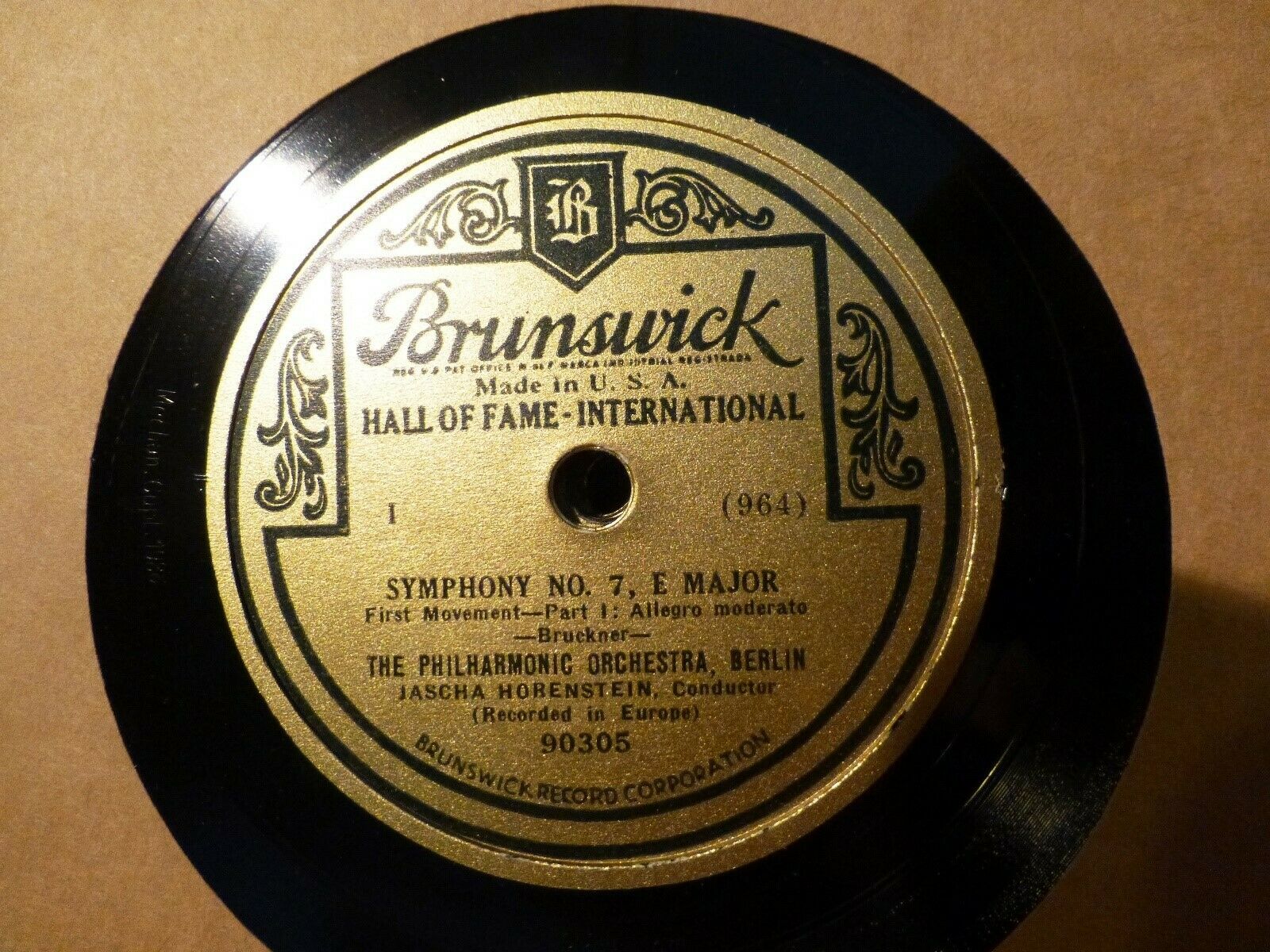
1928 JASCHA HORENSTEIN first REC Anton Bruckner Symphony No 7 E Major Berlin Phi
$
70


Favourite Auctions
To save auctions to your favourites, please login
If you don't have an account, please register
Description
1928 DEBUT RECORDING Of 29 Year old JASCHA HORENSTEIN, and what a DEBUT: The first recording of Bruckner's famous Symphony No 7, with the DEATH OF RICHARD WAGNER composed in the Slow Movement.
THIS IS THE FIRST Electric recording of ANY Symphony by Bruckner
Jascha Horenstein and the Berlin Philharmonic Orchestra on the Great 7x 12" Deutsche Grammophon issued by US BRUNSWICK in generic Album sides 3/4 and 7/8 are Brunswick laminated pressing
Condition:
EXCELLENT close to pristine faint scuffs, plays very quiet lightest hiss. The laminated sides are almost superquiet
Album like new
Horenstein's taut, dramatic, unindulging playing is impressive. He captures the essence of Bruckner, not plodding, but moving the drama through the vast edifice of this symphony forward.
Symphony No. 7 in E major was the most beloved of Bruckner's symphonies with audiences of the time, and is still popular. It was written 1881-1883 and revised in 1885. During the time that Bruckner began work on this Symphony, he was aware that Wagner's death was imminent, and so the Adagio is slow mournful music for Wagner, and for the first time in Bruckner's oeuvre, the Wagner tuba is included in the orchestra.
The famous entry of the C-Sharp Minor motive in the slow movement is the point where Bruckner received word of the Death of Wagner in Venice, 1883, as expressed in Bruckner's letter to Felix Mottl: "I felt very sad. For the thought of the Master would soon die had occurred to me, and at that moment the C sharp minor theme of the Adagio came to me."
As an interesting note to the Bruckner Version Problem, Horenstein is NOT using the standard 1885 Edition, a 1885 version with some modifications by Bruckner under the influence of Schalk, Loewe, and Nikisch Ed. Albert Gutmann [1885]
This, of course makes this recording unique, as today the standard critical 1885 Edition is used.
Anton Bruckner faced a far crueler fate. At the height of his power, he spent his final years in a desperate struggle to craft a final masterpiece that would both epitomize his ideals and extend his art into a new realm, but died in 1896 unable to achieve it. The destiny of the portion that would become his Symphony # 9 fell to others. At first compromised by the misguided efforts of well-meaning friends, ultimately it would be rescued and enriched through the diverse inspirations of a later generation of interpreters.
His peasant roots, strict upbringing and teaching career led Bruckner to be highly deferential and modest, with a deep respect for authority and an equally acute dread of criticism. Yet, he craved recognition. When colleagues implored him to simplify his work in the hope of getting it performed, Bruckner readily agreed, both accepting their "help" and undertaking broad revisions of his own, through cuts, rescoring and conventional harmony, so as to conform to the brighter colors and overt drama of the emerging Wagnerian style. Consequently, the little notice his symphonies garnered during his lifetime was based on bowdlerized versions. (Significantly, the 1927 printing of Grove's Dictionary of Music and Musicians dismisses Bruckner with a single paragraph (one page later devoting eight to his contemporary Alfred Bruneau), and derided his "inordinate leaning toward the manner of Wagner." The balance is redressed in the 2001 edition û Bruckner gets 28 pages to Bruneau's 2.) Later advocates debate the superiority of the composer's initial concepts versus his subsequent reflections which, after all, could represent genuine attempts at refinement and growth rather than corruption under pressure.
Some great quotes about Bruckner
"They want me to write differently. Certainly I could, but I must not. God has chosen me from thousands and given me, of all people, this talent. It is to Him that I must give account. How then would I stand there before Almighty God, if I followed the others and not Him?"
"In the war waged in Vienna between the factions of Wagner and Brahms, Bruckner strayed into the battlefield and became the only casualty."
"Why did they burn Brnnnhilde at the end?"
"Bruckner: half simpleton, half God."
"a German writer has said that he was half a Caesar and half a village schoolmaster; such men are, in art or life, difficult to place."
price rating