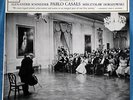
1929 FRANCIS POULENC & DARIUS MILHAUD PIANO Croiza78
$
50


Favourite Auctions
To save auctions to your favourites, please login
If you don't have an account, please register
Description
I will be running 3 weeks of great auctions, and would be happy to hold your items and bill you at the end of the cycle (April 10) for one combined shipment.
I AM HAPPY COMBINE MULTIPLE ITEMS in one shipment for a low postage rate.
IMPORTANT: IF YOU WIN MULTIPLE ITEMS DO NOT USE EBAY CHECK OUT.
Send me an invoice request instead to get the low combined postage rate.
I am currently selling a series of great Richard Wagner and classic European 78 rpm orchestral recordings on all the great European labels:
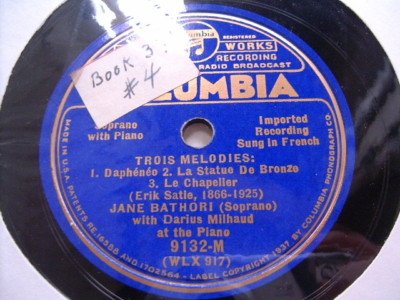
French Soprano Jane Bathory is an eminent French Soprano.
She was hired by Toscanini in 1902 and sang in the premiere of GERMANIA opposite the young Enrico Caruso
JANE BATHORIE w Darius MILHAUD at piano:
Eric Satie Three Songs:Daphenee, La Statu de Bronze, Le Chapellier/
CLAIRE Croiza FRANCIS POULENC at the piano:
Poulenc Bestiaire - 6 songs characterizing animals
12" 78 rpm record superb US COLUMBIA VIVA TONAL PRESSING
Condition: EXCELLENT Plays SUPERQUIET
Claire Croiza in 1921
from www.marstonrecords.com
It may come as a surprise to some (it did to me) that Claire Croiza, universally acknowledged as one of the high priestesses of French art song, dedicated the first half of her career to opera. It is difficult to imagine what this suave, perfectly modulated and intimate voice might have sounded like as La Cieca in Ponchielli’s La Gioconda, or especially as Clytemnestra in Strauss’s Elektra. During this period, the range and diversity of her repertory were almost breath-taking—from the standard mezzo roles to a dozen theatrical and world premieres, from Monteverdi to Wagner. It was not until after World War I that Croiza essentially forsook the opera house and, becoming a champion of modern French music, dedicated herself almost exclusively to the recital hall.
Claire Croiza was born Claire O’Connolly in Paris on 14 September 1882, the youngest of three children of Colonel John Townsend O’Connolly, an expatriate American, and his Italian wife. References cite various versions of Croiza’s family name: Connolly, Conolly, and O’Connolly, the last given by Betty Bannerman (British Institute of Recorded Sound Bulletin, no. 1, Summer 1956). Bannerman was a student and intimate friend of Croiza during the last 20 years of the singer’s life and, for that reason alone, I have accepted her version.
Croiza took private singing lessons in Paris with the Mlles. Revello and Mathon who, when they felt Croiza was ready, sent her to Jean de Reszke. After a short period of study, he arranged an audition for her with the opera at Nancy. She was immediately engaged and made her debut in de Lara’s Messaline in 1905. Her success at Nancy led to her engagement by Camille Chevillard for the Paris creation of the Angel in Elgar’s Dream of Gerontius in a special performance of the Concerts Lamoureux at the Trocadéro in 1906.
Immediately following her successes in France, she was engaged by the Théâtre Royal de La Monnaie in Brussels, making her debut there on 11 September 1906 as Delilah in Samson et Dalila with Laurent Swolfs and Jules Layolle.
On 27 December she sang Dido in Berlioz’s Les Troyens à Carthage with Léon Laffitte, Ramon Blanchart, Hippolyte Belhomme and Armand Crabbé (fourteen performances). For the next eight years, she was one of La Monnaie’s leading mezzos, appearing as Dalila, Orphée, Charlotte (Werther), Carmen, Erda (Siegfried) and Leonor (La Favorite). But even more remarkable was the number of premieres in which she participated: on 23 November 1907 she sang Persephone in the La Monnaie premiere of Massenet’s Ariane (twenty-three performances); on 14 February 1908 Toinette in the house premiere of Leroux’s Le Chemineau (seventeen performances); on 27 February 1909 the title role in the world premiere of Edgard Tinel’s Katharina (seventeen performances); on 7 March 1910 Lisbeth in the world premiere of Pierre de Bréville’s Eros Vainqueur (eight performances); on 10 April 1910 Alays in the world premiere of Cesare Galeotti’s La Dorise (three performances); on 26 April 1910 Clytemnestra in a major revival of Gluck’s Iphigénie en Aulis (five performances); on 26 May 1910 Clytemnestra in the La Monnaie premiere of Strauss’s Elektra (four performances); and on 1 December 1913 the title role in the first La Monnaie production of Fauré’s Pénélope (ten performances).
It was not until 1908 that she made her debut at the Paris Opéra in a limited engagement beginning 26 August, as Delilah in Samson et Dalila. On 21 February 1909 at the Concerts Lamoureux, she appeared in a concert performance of Das Rheingold (L’Or du Rhin) as one of the Rhine maidens with Ernest Van Dyck as Loge, Juste Nivette as Wotan and Charlotte Lormont as Woglinde, under the direction of Camille Chevillard. On 21 November 1910, she appeared again at the Concerts Lamoureux, creating for Paris de Bréville’s Eros Vainqueur and also performing the death of Dido from Berlioz’s Les Troyens.
Croiza made her debut at Monte Carlo on 28 March 1911 in two performances as La Cieca in Ponchielli’s La Gioconda, with Félia Litvinne as Gioconda, Mally Borga as Laura, Fernando Carpi as Enzo, Titta Ruffo as Barnaba, and Robert Marvini as Alvise, Pomé conducting.
In early 1912, she participated in a gala concert as a farewell to the Comédie Française of the unfortunate but well-loved actor Charles Le Bargy, with Sarah Bernhardt, Maria Kousnezoff, Georgette Leblanc, Léon David, Georges Enesco, Yvette Guilbert, Max Dearly, Sacha Guitry and, from the House of Molière itself, Julia Bartet, Cécile Sorel, Berthe Fayolle, Jean Mounet-Sully, Georges Berr, and many others.
On Good Friday 1912 at the Concerts Lamoureux, she gave the French premiere of Lorenzo Perosi’s Transitus animae, an oratorio for female solo and chorus, under the composer’s direction. At the Théâtre des Arts in Paris on 5 February 1913 she sang in a concert performance of Monteverdi’s L’Incoronazione de Poppea, arranged and conducted by Vincent d’Indy, and on 1 May the first act of Gluck’s Orphée with Lucy Vauthrin as Amour, conducted by Jacques Rouché.
At the Paris Conservatory in Novem ber 1913 she sang the premiere of Lili Boulanger’s Prix de Rome cantata Faust et Hélène with Henri Albers as Méphistophèlés and David Devriès as Faust, and six days later repeated the work at the Concerts Colonne with Alexis Ghasne as Méphistophèlés and Devriès under Gabriel Pierné. At this same performance she also created “Cor au crépuscule” and “Promenade” from Alfred Bruneau’s orchestral song set Chants de la vie.
Her debut at the Opéra-Comique took place in 1914 as Charlotte in Werther and, later, the title role in Orphée. She remained there through 1915. On 6 January 1916 she again appeared at the Paris Opéra in the creation of Les Virtuosi de Mazarin, composer unknown.
On 12 March 1916 she returned to Monte Carlo and sang Massenet’s Thérèse with Charles Fontaine and Alfred Maguenat and, in her final appearance there on 6 April 1918, Lully’s Armide with Gauley Texier, Léon Campagnola and Robert Couzinou, both productions under Léon Jehin’s direction.
During World War I she gave herself unstintingly to the war effort, appearing in concerts throughout Belgium, France, Switzerland and in Genoa, Italy for the Red Cross, sharing a number of these with Eugène Ysaye. For her war work she received from King Albert of Belgium the Order of Leopold and was the first woman so decorated. After the war she performed the first staged performance in Paris of Debussy’s La demoiselle élue and many other works of Debussy, including Le martyr de St.-Sébastien. In 1923 she created Caplet’s “Le miroir de Jésus” for string quintet, harp and 3 female voices, again under the composer’s direction.
In the early 1920s Jacques Copeau, director of the Théâtre du Vieux-Colombier, asked Croiza to give a series of recitals of poetry and music written to the verse of Paul Verlaine. She also began her first public classes at the Ecole Normale de la Musique in the Boulevard Malesherbes and in the same period, gave numerous recitals at the Salle Erard under the title “Une Anthologie de la musique française.” It was in one of these recitals on 28 February 1924 that she created Roussel’s 2 poèmes de Ronsard. On the death of Gabriel Fauré in 1924, the Opéra-Comique mounted his opera Pénélope, which Croiza sang under the direction of Désiré Inghelbrecht. Later, at a venue called “La Petite Scène,” she performed Monteverdi’s Il Ritorno d’Ulisse. That year she also made her first of three appearances on the British concert platform.
There are numerous erroneous references stating that Croiza created Arthur Honegger’s Judith at Monte Carlo in 1926. On 13 June 1925 at the Théâtre au Jorat at Mézières, Switzerland, Croiza had created Honegger’s incidental music to René Morax’s play (numbered H.57A in Harry Heilbreich’s L’Oeuvre d’Arthur Honegger and subtitled “Drame biblique”). After the success of the play, Honegger decided to expand his incidental music into a full opera. The opera (H.57B subtitled “Opéra sérieux”) was accepted by Raoul Gunsbourg, director of the Monte Carlo Opera. Croiza was engaged to perform the new work but, when Gunsbourg saw her, he decided she was too old for the role and demanded Morax find a younger singer. Two months before the premiere Croiza learned that she was about to be replaced and, ignorant of Gunsbourg’s decision, took out her wrath on the unfortunate Morax. On 21 December 1925, she wrote Morax:
My poor René. I think that what you have done in bringing a singer for Arthur to hear in connection with Judith and without letting me know is unspeakable. I will meet you today at his house at five o’clock. You will have to reach a decision about me. You have offended me deeply and I certainly will not forget it.
The work premiered on 13 February 1926 with Jeanne Bonavia, a young soprano who came and went without notice, Tilkin Servais and Julian Lafont. Honegger then wrote a third version of Judith (H.57C subtitled “Action musicale”), which premiered in Rotterdam on 16 June 1927. This version returned in format to the original “Drame biblique,” utilizing both spoken dialogue and singing. Croiza sang the French premiere of this version at Toulouse on 20 January 1928, Honegger conducting. It is this version of Judith that Croiza recorded with the Antwerp forces, performing both the singing role of Judith and the spoken role of “Le récitant” and not, as so many reference works state, the “Opéra sérieux.”
In January 1928 she returned to London for two recitals and during the ensuing years returned to England four or five times a year, appearing in recitals and on the radio. At the Salle Gaveau on 18 April 1929, she created Roussel’s “Jazz dans la nuit.” She had also sung the premiere of Roussel’s Deux mélodies, Op. 20 in Paris on 9 December, 1928. In 1934 she became a professor at the Paris Conservatory and at about the same time, at the Geneva Conservatory. In Paris she taught Janine Micheau, Suzanne Juyol, Camille Mauranne, Gérard Sousay, Jacques Jansen and many others.
Betty Bannerman, who had first met Croiza in 1928 and had become a student and later a close friend, wrote that in 1939, because of the start of WWII, “We begged her to remain with us, but she felt she must return to her own home and to her class at the Conservatoire. The privations of war—she lost over four stone in weight—and the mental anguish she suffered undoubtedly caused the fatal illness that overtook her ten years ago.” Claire Croiza died in Paris on 15 May 1948.
Croiza made her first recordings in 1927 after she had been singing twenty-two years. The voice in 1927 was in fine condition and there was very little change in it by 1936 when she made her last recordings. Not only do Croiza’s recordings provide some very beautiful singing and exquisite artistry, they are virtually all documents of historical stature.
Croiza’s records, by the nature of the music she recorded, are all scarce. Three of them (Columbia D13032, D13033 and D13034) are probably among the most elusive recordings in the world, vying with many of the fabled acoustical rarities made twenty-five years earlier. D13032 and D13034 appear to exist in single copies now in private collections, while two copies of D13033 are known to survive, one in a private collection, the other in an institutional archive. There are three known unpublished sides, copies of which have never surfaced: A un jeune gentilhomme (Roussel), Le jardin mouillé (Roussel), and Ballet (Poulenc).
In order to avoid confusion, it must be noted that two of Croiza’s recordings were issued in different couplings: D13082 was originally published in 1929, coupling Honegger’s Automne with his Sirène songs; the same numbered recording was republished in about 1933, the Sirène songs coupled with Roussel’s Les amoureux séparés. Similarly, D15241, containing selections from Honegger’s Judith, was issued in two different couplings, the first bearing matrices [W]52017, Cantique de victoire, and WLBX59, Interlude et cantique des vierges, the second, matrices [W]52017 and [W]LX717, Retour de Judith et Cantique de la bataille. The U.S. Columbia issue used the first coupling only: [W]LX717 was never published in America.
Croiza’s recordings from Honegger’s Judith and Milhaud’s L’Orestie are also problematical. Some were made in Paris (1928), others in Brussels in at least two different recording sessions (1929 and 1930), despite the fact that all were labeled as accompanied by the Antwerp Coecilia Chorus and Nouveaux Concerts Orchestra under Louis de Vocht. Because of this disparity, the recordings from Judith have been transferred here in score order.
Columbia’s “L” (ten-inch) and “LX” (twelve-inch) matrix series were first used in London in 1924 for French-language recordings, then exclusively in France and Belgium from 1924 to 1933. The “W” prefix was used as a licensing mark to indicate an electrical recording made by the Western Electric process, but was frequently omitted from pressings and labels, as the Croiza recordings attest. A bracketed “W” designates this omission in the listings.
Lumen, either officially or unofficially connected with the French Catholic Church, began recording operations in 1932 and issued a vast amount of religious, quasi-religious, and liturgical music, as well as hundreds of recordings of folk and children’s music, all of an uplifting nature, related to “les Scouts” and other Catholic children’s organizations.
Pls check my other auctions for more great records and phonograph items:
http://shop.ebay.com/carsten_sf/m.html
http://shop.ebay.com/carsten_sf/m.html
====
I am having three consecutive weeks of auctions.
I am happy to hold your items and bill you at the end of the auction cycle (April 10).
Pls send me a note if you would like me to hold records
Multiple item shipping: I am happy to combine items for shipment in one parcel.
If you win multiple items, pls send me an INVOICE REQUEST to calculate the correct postage. Ebay check out will not give you the multiple item discount!
Records will be packed safely between corrugated cardboard in a sturdy box with plenty of padding for safe shipment.
Shipment is usually Media Mail, unless another service is requested. Shipping is at your risk, I will be happy to insure items at your cost.
I charge actual postage plus a small fee for packing materials
As always, I guarantee your satisfaction. If you don't like the item, just return it, and I will refund the full purchase price.
If you are in the San Francisco area, I encourage pick-up in person.
US Domestic Shipping:
Here is a rough guideline for US Media Mail Shipping:
Prices below are for regular 78 rpm records. Up to about 5 records, I will ship Edison Discs for the same rates. Above that and for international shipments, it will be actual weight plus a small packing charge (1-2$)
1 record: 4$
2 records: 5$
5 records: 6$
10 records: 8$
International Buyers:
I am very happy to ship records worldwide.
Prices below are for regular 78 rpm records. For Edison Discs in international shipments, it will charge for the actual weight plus a small packing charge (1-2$) - for small quantities, it will not be much different from the charge for regular 78s.
Pls contact me for a shipping estimate, or send me an invoice request after close of auction.
Be aware that US Postal Rates can be high. Here are some examples.
Your best bet is the Large Priority box, everything that fits into a 12"x12"x5 1/2" box up to 20 pounds ships for 60$ (35$ Canada) worldwide.
However, I can get competitive rates from FedEx and the US Postal service for any kind of parcel weight
Germany (is pretty much the same for most countries, incl Japan and Western Europe)
1 record = 2 lbs 20$
4 lbs = 35$
20 lbs in 12x12" box 60$
Canada
1 record = 2 lbs 10$
4 lbs = 18$
20 lbs in 12x12" box ((12" albums won't fit)= 35$
I may be able to get some slightly better FedEx rates.
Pls email with your address for an estimate.
To estimate your shipment, pls go to
http://www.usps.com/tools/calculatepostage/welcome.htm?from=home_header&page=calculatepostage
My zip code is 94107.
Assume 1 pound per record plus 1 pound for packing.
Pls contact me with your country, home town and postal code before bidding for an estimate.
=====
As always, I would appreciate any suggestions and corrections from you, pls contact me with any question.
Thank you very much, and good luck bidding !!!