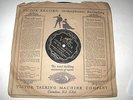
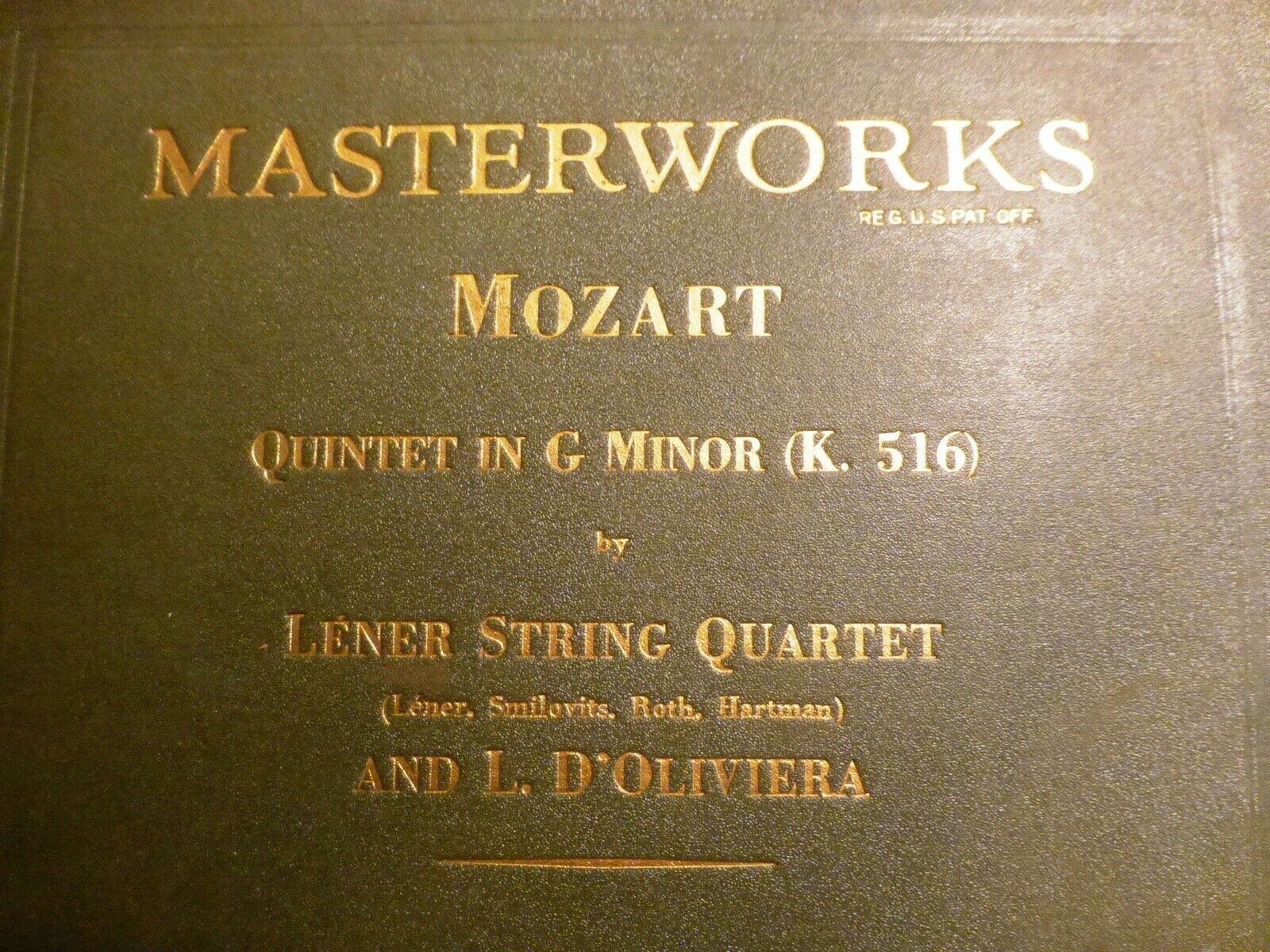
1929 L. D'Oliviera LENER STRING QUARTET Mozart Quintet G Minor K 516 Set 150 x
$
50


Favourite Auctions
To save auctions to your favourites, please login
If you don't have an account, please register
Description
A series of great classical orchestral and instrumental performances by major conductors, composers and instrumentalists.
One of the great recordings by the Léner Quartett plays Mozart : Mozart: Quintet in G minor K516, with L. d'Oliveira, viola
QUINTET IN G MINOR for Strings K. 516 (Mozart)
D’Oliviera (2nd viola); Lener String Quartet
(Lener; Roth; Hartmann; Smilovits)
8 Sides., Set 150
67838-D - 67841-D
recorded in 1929
4 x12" Columbia 78 rpm records with original album Set 124 and booklet
Condition:EXCELLENT rubs, side 1/2 E- unworn but rubs, fine scratches, rim chip NAP, plays EXCEPTIONALLY quiet rare tick, album great, top and bottom of spine a little frayed
A GREAT COPY
The Léner String Quartet was founded by violinist Janos (or Jeno) Léner (1894 - 1948) in 1918 at the Budapest Academy of Music. The Léner Quartet was one among several world-class chamber ensembles that were created under the watchful eye of virtuoso and pedagogue Jeno Hubay. In addition to Jeno Léner himself, the Léner Quartet included second violinist Jozsef Smilovits, violist Sándor Roth, and cellist Imre Hartmann. While they were usually billed as "The Léner Quartet of Budapest," the group was mainly based out of London from 1922 through 1939, and made their American debut in 1929. The Léner Quartet traveled around the world, concertizing, working directly with famous composers (such as Ottorino Respighi), and conducting workshops with aspiring chamber musicians. Personnel remained the same until the ensemble broke up in 1942. Janos Léner revived the group with different members in 1945, but his untimely death at age 54 in 1948 brought the Léner Quartet's illustrious history as a performing ensemble to a close. The Léner Quartet may have been the major string quartet active in commercial recording during the prime years of the 78rpm era. Beginning with acoustic records made in London in 1923, it ultimately produced some 450 sides and in many cases, was responsible for making the first-recorded performances of familiar string quartet works.
With the Beethoven centenary of 1927, the Léner Quartet instituted the first recorded cycle of the Beethoven string quartets; while depression economics halted their progress at 14 quartets (out of 16) in 1933, the Léner Quartet recordings became widely recognized as the established standard for these works. These were not superseded until the appearance of the Budapest Quartet's recordings of the full Beethoven cycle in the years following World War II. In addition to the works of Beethoven, the Léner Quartet also recorded works of Haydn, Mozart, Brahms, and Debussy, among others, and made ensemble appearances with soloists such as Dennis Brain, Aubrey Brain, and Leon Goossens. So highly regarded were their releases that a lengthy exegesis on the Léner Quartet's recording of Beethoven's String Quartet No. 15 in A minor is used as an element in the climactic scene of Aldous Huxley's novel Point Counter Point (1928).
Jeno Léner died on the very eve of the introduction of the long-playing record, which greatly aided the dissemination of chamber music of all kinds, and in particular helped promote the popularity of the Budapest Quartet, another ensemble initially nurtured under Hubay. By 1950, the Léner Quartet recordings, mostly made in the 1920s, must have seemed ancient by comparison as the group favored a broad, fat string tone more readily associated with arch-Romantic performance practice. Nonetheless, this is precisely why some of the Léner Quartet recordings are being revived on CD more than 50 years after they were largely regarded as obsolete artifacts belonging to a bygone era. While the Léner Quartet's approach to Classical-era literature may seem a bit too precious, the recordings of the late Beethoven quartets and works by Brahms, Dvorák, and similar repertoire directly comes from the heart of the late-Romantic idiom. This group of recordings within the extensive body of work left by the Léner Quartet represent an authoritative interpretive viewpoint on late-Romantic quartet literature and warrant revival.
There was a time when only the violin and 'cello were regularly given leave from the orchestra to appear as solo instruments _ or in chamber music. With Dennis Brain and Lionel Tertis the "Great Instrumentalists" series has already reminded us of how two of these pioneers played in those earlier days as well as in more recent ones; now Leon Goossens is added to the list.
The choice cannot conceivably be faulted. It is not, of course, true that before Goossens there was never an artist among oboeplayers; but it is, I think, true that it was not until a generation or so after Goossens began his work that we came to expect that every proper oboe-player should be a flexible artist, not only gentle and precise in appropriate music but also flamboyantly romantic —here was the oboe's new sound—in music from the other shelf.
The new sound was offered by Goossens, it need hardly be pointed out, as an addition to superlative technique and artistry in the normal sense, not as an alternative to them. Even so, in 1939 AR could still write when originally reviewing the Schumann Romances that "not everyone likes the characteristic tremolo of Leon Goossens's oboe-playing, but it is surely ideally adapted to the romantic melancholy of these little pieces". And so, surely, it is; and to much else both in the oboe repertory and on this present disc.
Léon Jean Goossens CBE, FRCM (June 12, 1897 - February 13, 1988) was a British oboist. He was born in Liverpool and studied at the Royal College of Music. His father was violinist and conductor Eugène Goossens, his brother the conductor and composer Eugène Aynsley Goossens and his sister the harpist Sidonie Goossens.
During the early and middle parts of the 20th century, he was the premiere oboe player in the world. He joined the Queen's Hall Orchestra (conducted by Henry J. Wood) at the age of 15 and was later (1932) engaged by Sir Thomas Beecham for the newly-founded London Philharmonic Orchestra, but he also enjoyed a rich solo and chamber-music career. He became famous for a unique pleasing sound no other oboist could match. Oboists of the past had tended to be divided between the French school (elegant but thin and reedy in tone) and the German (full and rounded but rather clumsy, with little or no vibrato), but Goossens brought together the best qualities of both styles.
Goossens commissioned a number of works for the oboe from such distinguished composers as Sir Edward Elgar, Ralph Vaughan Williams and Rutland Boughton and collaborated extensively with other prominent soloists such as Yehudi Menuhin. Amongst his many pupils were the oboists Evelyn Barbirolli and Joyance Boughton, daughter of Rutland Boughton
He was awarded a CBE in 1950 and made a Fellow of the Royal College of Music in 1962.
price rating