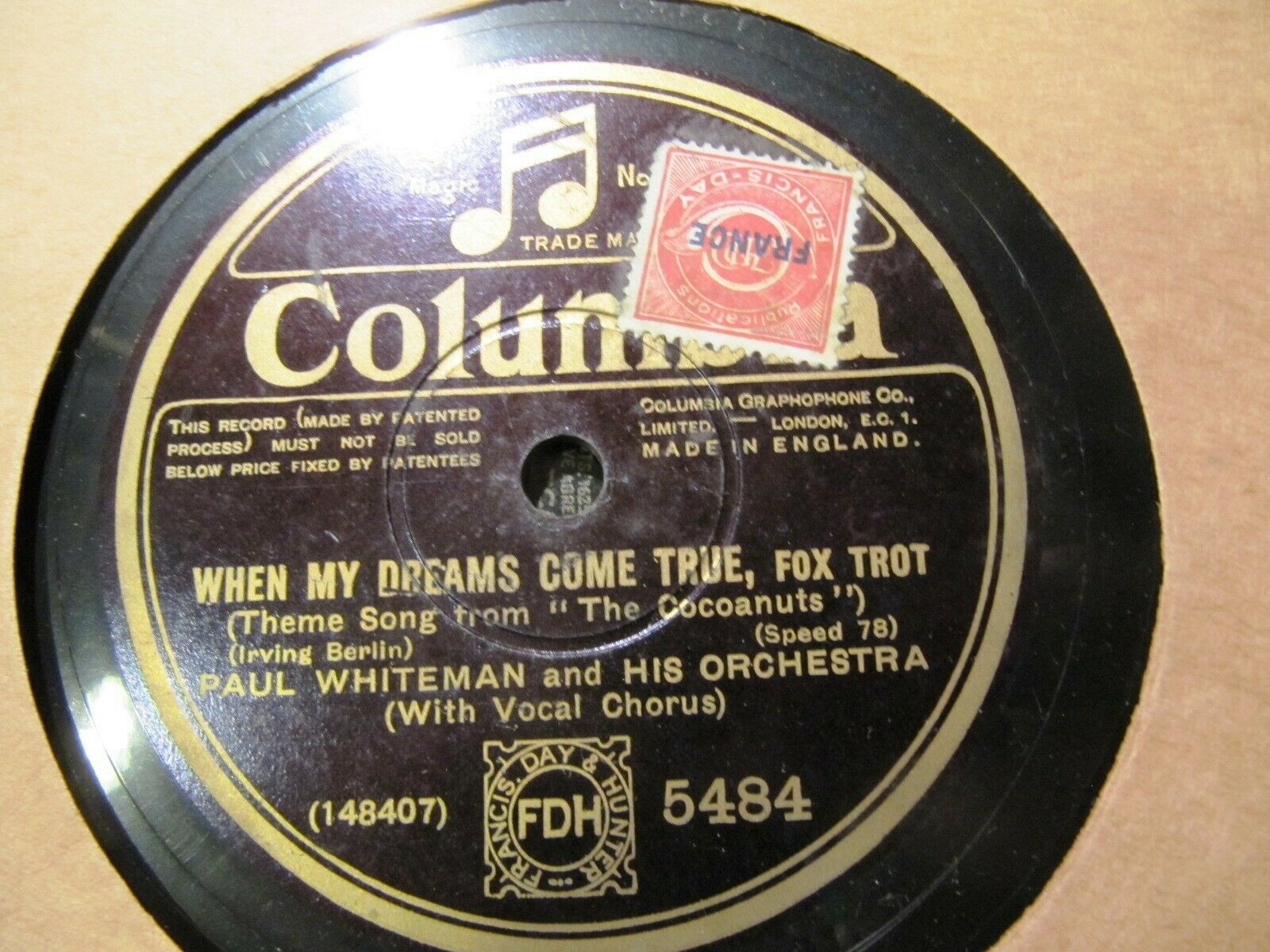
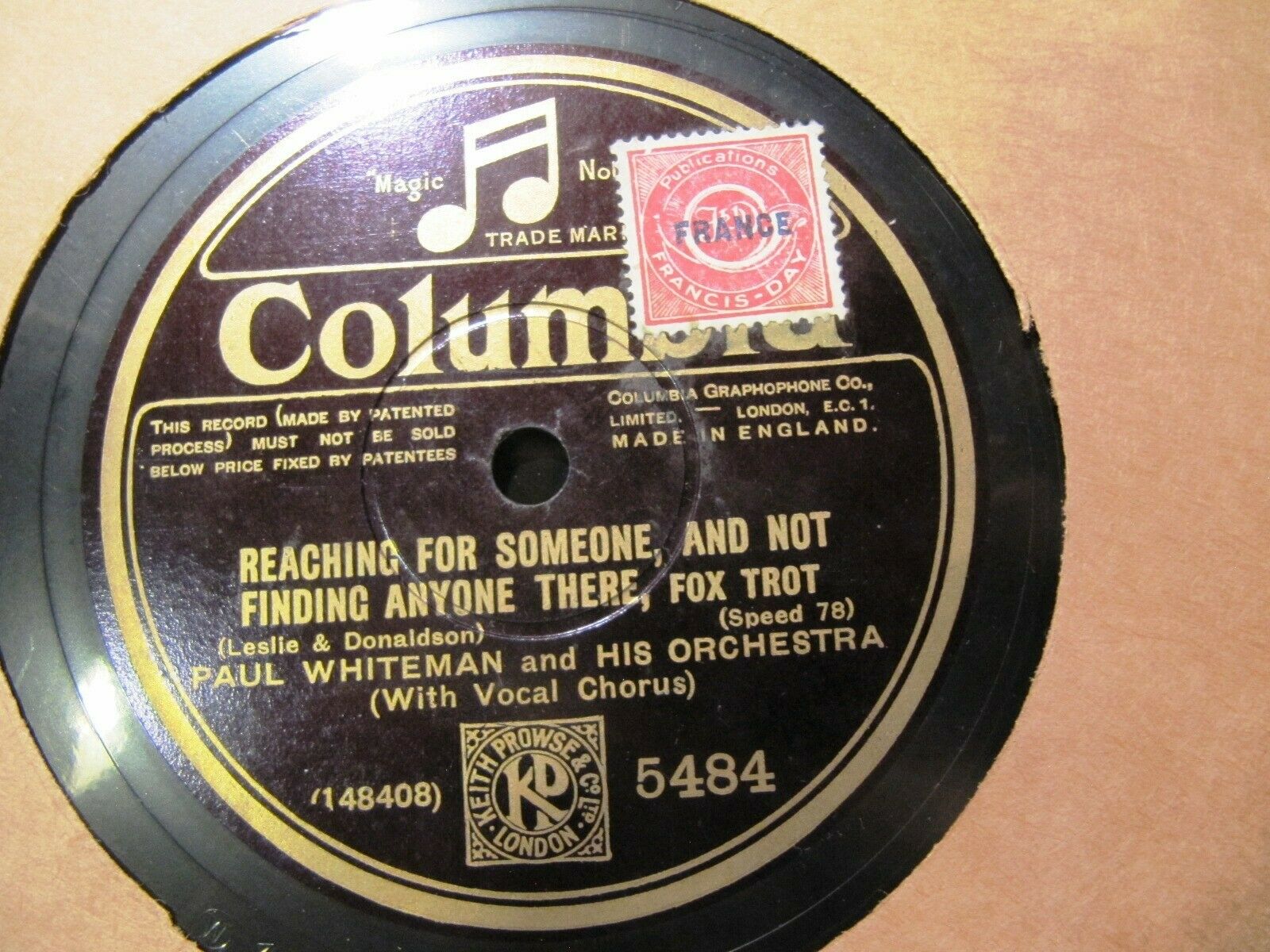
1929 MARX BROTHERS COCOANUTS When my dreams come tru BIX Beiderbecke Bing Tram
$
70


Favourite Auctions
To save auctions to your favourites, please login
If you don't have an account, please register
Description
A series of great JAZZ Records from early Ragtime to Beb-Bop on 78 rpm Victrola Records
More great Jazz and Vocal Records in my other listings!
Hit song from the First Marx Brother's Feature 1929 COCOANUTS
When my dreams come true on great
cover version by the Paul WHITEMAN BAND (Marx Brothers are NOT on this record)
Paul Whiteman and his orchestra in two great fox trots with hot solos by Bix and Tram:
108- May 3, 1929 COLUMBIA
Columbia, New York
PAUL WHITEMAN AND HIS ORCHESTRA
Charles Margulis, Harry Goldfield (tp); Bix Beiderbecke, Andy Secrest (c); Boyce Cullen, Bill Rank, Wilbur Hall, Jack Fulton (tb); Frank Trumbauer, Chester Hazlett, Irving Friedman, Roy Maier, Bernie Daly, Charles Strickfaden (reeds); Kurt Dieterle, Mischa Russell, John Bouman, Charles Gaylord (vln); Roy Bargy (p); Lennie Hayton (cel); Mike Pingitore (bj); Mike Trafficante (sb); Min Leibrook (tu); George Marsh (dm); Jack Fulton (voc):
W 148407-4 When My Dreams Come True
(Irving Berlin-arr: Bargy)
solos : Margulis (16) – Tram, as (8) – Secrest (8) – Bargy (4) – Strickfaden, bar (4) – Bargy (4) – Strickfaden (4) – Fulton, voc (32) – Hazlett, bcl (16) – Tram, as (8).
Same personnel, but without Lennie Hayton (cel) ; Bing Crosby (voc) replaces Jack Fulton:
W 148408-4 Reachin’ For Someone (And not finding anyone there)
(Donaldson-Leslie-arr : Challis)
solos : Rank, tb (8) – Tram (16+8) – Crosby, voc (32) – Bix (8).
Bix Beiderbecke, Andy Secrest (c); Charles Margulis (tp); Bill Rank (tb); Frank Trumbauer (Cms); Chester Hazlett, Bernie Daly (as); Irving Friedman (cl/ts); Charles Strickfaden (ts); Kurt Dieterle, Mischa Russell, Charles Gaylord (vln); Roy Bargy (p); Mike Pingitore (bj); Mike Trafficante (sb); Min Leibrook (tu); George Marsh (dm):
Please see top of the page for condition
Paul Whiteman and his Orchestra was the most popular band of the 1920s and represented the apex of jazz to the general public. Over the years, critics and some musicians like Eddie Condon, have not had kind words to say about the band and have tended to represent Whiteman as a bad influence on the music in his attempts to "Make a lady out of Jazz". The title of "The King Of Jazz" which Whiteman was billed as seems somewhat politically incorrect these days, but in the 1920s he dominated the scene and hired the best White hot musicians like Bix Beiderbecke, Frankie Trumbauer, Eddie Lang, Joe Venuti, Jack Teagarden and many more to play in his band. Paul Whiteman greatly enriched American music by commissioning George Gershwin to write Rhapsody In Blue which became his orchestra's signature tune. He also "discovered" Bing Crosby and featured him in Paul Whiteman's Rhythm Boys, and gave the career of Hoagy Carmichael a boost, by recording several of Hoagy's songs early in his career. Jazz singer Mildred Bailey also rose to fame in the orchestra in the 1930s. So, what was it that has led Whiteman's name to be dragged through the mud in the annals of Jazz history? Paul Whiteman being the most popular Jazz band leader of the Jazz Age is blamed for the racism in America that denied African-American musicians the credit that they deserved in the history of Jazz. If there is such a thing as the "King of Jazz" the title belongs to Louis Armstrong, although that may not have been clear to most people in the 1920s. Whiteman is also criticized for not hiring African-American musicians to play in his band, but this argument ignores the commercial realities of the period. Paul Whiteman was clearly not a racist. He commissioned Duke Ellington to write for his modern music series, recorded with Paul Robeson and Billie Holiday, and hired Don Redman as an arranger in the 1930s and was generally held in high regards as a person by musicians both Black and White. The worst that can be leveled at Whiteman was that he was a businessman. Despite that, Whiteman made some very good Jazz records in the 1920s such as San, Washboard Blues, Mississippi Mud, Whiteman Stomp, Wang Wang Blues and I'm Coming, Virginia. His interest in making symphonic Jazz led the way for generations of Jazz musicians as diverse as Miles Davis, Gil Evans, The Modern Jazz Quartet and Winton Marsalis, who may not directly cite Whiteman as an influence, but have certainly walked down the path that he blazed at points in their careers.
price rating