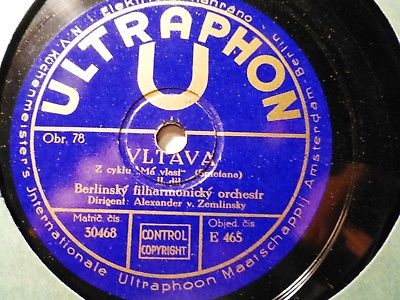
1930 ALEXANDER von ZEMLINSKY Berlin Philharmonic SMETANA Die Moldau SCHWANDA 78
$
29


Favourite Auctions
To save auctions to your favourites, please login
If you don't have an account, please register
Description
Please wait for me to send you an invoice. DO NOT USE EBAY CHECKOUT if you want the lowest possible postage.
Welcome to my auctions of great records
This is my FIRST WEEK of 2 weeks of great auctions – I WILL PACK AND BILL YOUR RECORDS after the close on MAY 13.
Pls ignore international postage displayed in Ebay, rates are too high
Please wait for me to send you an invoice. DO NOT USE EBAY CHECKOUT if you want the lowest possible postage.
A series of great Violin, Piano and Orchestra records on rare labels, from 1902 Monarch to 1940 War Germany recordings.
Great Vienna composer and brother in law to Gustav Mahler with the BERLIN Opera orch on one of his RARE RECORDINGS
ALEXANDER von ZEMLINSKY Berlin Philharmonic SMETANA Die Moldau 3 sides/
Jaromir Weinberger SCHWANDA Der Dudelsackpfeifer - Polka
Czech ULTRAPHONE 2x 12" record 78 rpm
Condition: EXCELLENT minus, clean and shiny rare light scratch, scuffs on 1/2
Plays E very quiet lightest crackle
A SUPERB COPY
Alexander Zemlinsky or Alexander von Zemlinsky (October 14, 1871 û March 15, 1942) was an Austrian composer, conductor, and teacher.
Biography
[edit] Early life
Zemlinsky was born in Vienna to a highly multicultural family. Zemlinsky's grandfather, Anton Semlinski, immigrated from Zsolna, Hungary to Austria and married an Austrian woman.[1] Both were from staunchly Roman Catholic families, and Alexander's father, Adolf, was reared as a Catholic. Alexander's mother was born in Sarajevo to a Sephardic Jewish father and a Bosnian Muslim mother. Alexander's entire family converted to the religion of his grandfather, Judaism, and Zemlinsky was born and raised Jewish. His father added an aristocratic "von" to his name, though neither he nor his forebears were ennobled. He also began spelling his surname with a "Z."[2]
Alexander studied the piano from a young age. He played the organ in his synagogue on holidays, and was admitted to the Vienna Conservatory in 1884. He studied piano with Anton Door, winning the school's piano prize in 1890. He continued his studies until 1892, studying theory with Robert Fuchs and composition with Johann Nepomuk Fuchs and Anton Bruckner.[3] At this time he began writing music.
Zemlinsky had a valuable supporter in Johannes Brahms. In 1893, On the invitation of Zemlinsky's teacher Johann Nepomuk Fuchs, Brahms attended a performance of Zemlinsky's Symphony in D minor. Soon after that, Brahms attended a performance of one of Zemlinky's quartets by the Hellmesberger Quartet. Brahms, impressed with Zemlinsky's music, recommended the younger composer's Clarinet Trio (1896) to the Simrock company for publication.[4]
Zemlinsky also met Arnold Schoenberg when the latter joined Polyhymnia, an orchestra in which he played cello and helped found in 1895. The two became close friends--and later mutual admirers and brothers in law when Schoenberg married his sister Mathilde. Zemlinsky gave Schoenberg lessons in counterpoint, thus becoming the only formal music teacher Schoenberg would have.
In 1897 Zemlinsky's Symphony No. 2 (chronologically the third he had written, and sometimes numbered as such) was a success when premiered in Vienna. His reputation as a composer was further helped when Gustav Mahler conducted the premiere of his opera Es war einmal... (Once Upon a Time) at the Hofoper in 1900. In 1899 Zemlinsky secured the post of Kapellmeister at Vienna's Carltheater.
[edit] Middle years
In 1900, Zemlinsky met and fell in love with Alma Schindler, one of his composition students. She reciprocated his feelings initially; however, Alma felt a great deal of pressure from close friends and family to end the relationship. They were primarily concerned with Zemlinsky's lack of an international reputation and by an unappealing physical appearance. She broke off the relationship with Zemlinsky and subsequently married composer Gustav Mahler in 1902. Zemlinsky married Ida Guttmann in 1907, but the marriage was an unhappy one. Following Ida's death in 1929, Zemlinsky married Luise Sachsel in 1930, a woman twenty-nine years his junior, and to whom he had given singing lessons since 1914. This was a much happier relationship, lasting until Zemlinsky's death.
[edit] Last years
In 1906 Zemlinsky was appointed first Kapellmeister of the new Vienna Volksoper. From 1911 to 1927, he was conductor at Deutsches Landestheater in Prague, premiering Schoenberg's Erwartung in 1924. Zemlinsky then moved to Berlin, where he taught and worked under Otto Klemperer as a conductor at the Kroll Opera. With the rise of the Nazi Party, he fled to Vienna in 1933, where he held no official post, instead concentrating on composing and making the occasional appearance as guest conductor. In 1938 he moved to the United States and settled in New York City. While fellow TmigrT Schoenberg was celebrated and feted in the Los Angeles of the 1930s and 40s -- teaching at UCLA and USC and gaining a new generation of acolytes -- Zemlinsky was neglected and virtually unknown in his adopted country. He fell ill, suffering a series of strokes, and ceased composing. Zemlinsky died in Larchmont, New York of pneumonia.
[edit] Music
Zemlinsky's best-known work is the Lyric Symphony (1923), a seven-movement piece for soprano, baritone and orchestra, set to poems by the Bengali poet Rabindranath Tagore (in German translation), which Zemlinsky compared in a letter to his publisher to Mahler's Das Lied von der Erde (though the first part of Schoenberg's Gurrelieder is also a clear influence). The work in turn influenced Alban Berg's Lyric Suite, which quotes from it and is dedicated to Zemlinsky.
Other orchestral works include the large-scale symphonic poem Die Seejungfrau (The Mermaid). This work, premiered in 1905 in the same concert as Schoenberg's Pelleas und Melisande, was considered 'lost' until 1984, since when it has become one of Zemlinsky's most frequently performed scores. A three-movement Sinfonietta written in 1934, admired by Schoenberg and Berg, is written in a style comparable to contemporary works by Paul Hindemith and Kurt Weill.
Other works include eight operas (including Eine Florentinische Trag÷die (1915-16) and the semi-autobiographical Der Zwerg (The Dwarf, 1919-21), both after Oscar Wilde); chamber music (including four string quartets) and the ballet Der Triumph der Zeit (1901). He also composed three psalm settings for chorus and orchestra and numerous song cycles, both with piano and with orchestra, of which the Sechs GesSnge op. 13 to texts by Maurice Maeterlinck is the best-known.
The influence of Brahms is evoked in Zemlinsky's early works (prompting encouragement from Brahms himself), while later works adopt the kind of extended harmonies that Wagner had introduced whilst also drawing influence from Mahler. In contrast to his friend Schoenberg, he never wrote atonal music, and never used the twelve-tone technique. However, late works such as the Symphonische GesSnge, Sinfonietta and third and fourth string quartets move away from post-Romanticism towards a leaner, harder-edged idiom that incorporates elements of Neue Sachlichkeit, Neo-Classicism and even jazz.
As a conductor, Zemlinsky was admired by, among others, Kurt Weill and Stravinsky, not only for his notable interpretations of Mozart, but also for his advocacy of Mahler, Schoenberg and much other contemporary music. As a teacher, his pupils included Erich Wolfgang Korngold, Hans Krasa and Karl Weigl.
<
More Great Records on sale right now:
http://shop.ebay.com/carsten_sf/m.html
http://shop.ebay.com/carsten_sf/m.html
====
A Quick NOTE ON GRADING AND SHIPPING:
As you can see from my feedback, I try hard to earn your POSITIVE FEEDBACK and FIVE STAR RATINGS.
If for any reason your transaction was NOT SATISFACTORY, pls contact me and I will work something out with you. YOU WILL NEVER HAVE A REASON TO GIVE ME A NEGATIVE RATING or a LOW STAR RATING.
Quick note on grading:
The Grade (Excellent to Fair, I don't give Mint) refers to the WEAR of the record. Any other defects are stated separately
When I listen to a record, I may also give it an aural grade (again E to F), and make a SUBJECTIVE judgment of the pressing quality for hiss and surface noise.
"SUPERQUIET" is basically noiseless, like a vinyl pressing.
"VERY QUIET" is an exceptionally quiet record for a given pressing.
"Quiet" is a record that is a great example without undue noise for a give pressing.
These judgments are SUBJECTIVE and will depend one the styli, phonograph etc. you use on your own equipment.
Multiple item shipping: I am happy to combine items for shipment in one parcel.
If you win multiple items, pls send me an INVOICE REQUEST to calculate the correct postage. Ebay check out will not give you the multiple item discount!
Records will be packed safely between corrugated cardboard in a sturdy box with plenty of padding for safe shipment.
Shipment is usually Media Mail, unless another service is requested. Shipping is at your risk, I will be happy to insure items at your cost.
I charge actual postage plus a small fee for packing materials
As always, I guarantee your satisfaction. If you don't like the item, just return it, and I will refund the full purchase price.
If you are in the San Francisco area, I encourage pick-up in person.
US Domestic Shipping:
Here is a guideline for US Media Mail Shipping:
Prices below are for regular 78 rpm records. Up to about 5 records, I will ship Edison Discs for the same rates. Albums from Album Sets count as 1 record. Above that and for international shipments, it will be actual weight plus a small packing charge (1-3$ depending on size of shipment)
1 record: 4.75 – 5.00$
2 records: 5.75$
5 records: 7.50$
10 records: 9.50$
MANY MORE RECORDS: Don't worry. I safely ship 40 - 50 pounds of records double boxed in moving boxes, and even then Media Mail will probably not exceed 30$.
Please send me a message if you would like to lower your shipping rates!
International Buyers:
I am very happy to ship records worldwide.
Please use the EBAY shipping cost only as a guideline. My actual charges are usually lower
One record usually ships for 25 – 28$ for 10" 35$ for most 12" records (Less for Canada).
I can get SIGNIFICANTLY LOWER rates from FedEx and the US Postal service for any kind of parcel weight, and will make use of all the cost-saving shipment methods
Pls contact me for a shipping estimate, or send me an invoice request after close of auction.
AND AGAIN -THANK YOU FOR YOUR INTEREST
As you can see from my feedback, I take great care in presenting, grading and shipping your items. I really want you to be happy with the purchase. If you feel that anything is wrong with the item or the shipping, contact me and we will work it out !!!
As always, I would appreciate any suggestions and corrections from you, pls contact me with any question.
Thank you very much, and good luck bidding !!!
price rating