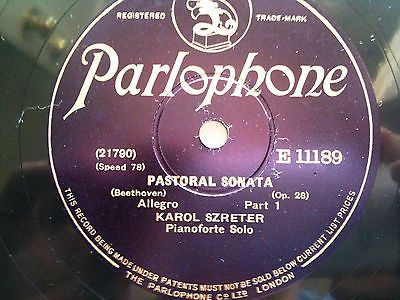
1931 KAROL SZRETER Berlin Piano Beethoven Pastoral Sonata Op 28 Complete 78
$
34


Favourite Auctions
To save auctions to your favourites, please login
If you don't have an account, please register
Description
Welcome to my auctions of great records
WEEK 2 of 3 weeks of great auctions – this is the SECOND week of three weeks of great records.
As a default, I will not send you an invoice until the end of my sales cycle on September 27 – that way you can see my next listings and you can combine your wins into one parcel for a low postage.
International shipping: approx postage 1x10"=$25: 1x12"=$28: 10"Album 4 Rec=45$: 12" Album 2 Rec=45$
About 30% to Canada. Pls ignore international postage displayed in Ebay, rates are too high
Please wait for me to send you an invoice. DO NOT USE EBAY CHECKOUT if you want the lowest possible postage.
A series of great classical orchestral and instrumental performances by major conductors, composers and instrumentalists.
Great POLISH pianist KAROL SZETER here rare complete recording of
Ludwig van Beethoven
Piano Sonata No. 15 in D major ("Pastoral"), Op. 28
This set rarely survives intact because of the combination of 1x12" record and 2x 10" records
recorded Berlin, Carl Lindström AG, SO.33, Schlesische Straße 26
1931.04.17 Fri
complete on 3x 78 rpm records
Condition:
Excellent close to pristine, plays very quiet
Compared to the groundbreaking sonatas of Op. 27, Beethoven's Piano Sonata in D major, Op. 28, is something of a retrospective work in terms of form: clearly, the composer still had something to say in the "standard" four-movement scheme of his earlier sonatas. A remarkable feature of this work is that each movement establishes its own insistent, dominating rhythm at its outset. The first measure of the opening Allegro, for example, is simply three quarter notes on the tonic note D, a figure that both establishes the work's 3/4 meter and commences the first subject. The flowing, carefree second subject, based on the same rhythmic pattern, derives from a series of rocking chords in both hands. The overall effect is one of cheerful contentment, though the development builds to a considerably dramatic climax.
The second movement, Andante is a not-very-slow slow movement in ABA song form. Here, Beethoven creates a serious, lyrical theme in D minor from a series of chords over an insistent left hand in sixteenth notes. The middle section, in the major mode, alternates syncopated chords with descending right-hand triplets, material that makes a plaintive minor-mode return in the coda.
The Allegro vivace Scherzo, again in 3/4, rises from a sardonic series of descending single notes, one to a measure and an octave apart, after which the right hand jumps both above and below the left with the theme. The Trio section, reviving the minor mode, is a series of rocking triplet figures.
Like the first movement, the Allegro, ma non troppo finale at once establishes a rhythm and commences with the main theme. The movement is in 6/8; the alternation of quarter note and eighth note rhythms provides a syncopated "rambling" feel. Beethoven finds fresh variants for every repeat of this theme, all the way to the brilliant coda.
Born 1898 in Lodz
Died March 20, 1933 in Berlin
Country: Poland
Biography
Pianist Karol Szreter started out a child prodigy, making his first public appearance in his native Poland at about the age of 9. At age 13 he was awarded a scholarship to study piano at the St. Petersburg Conservatoire and he remained there until the outbreak of World War I. Afterwards Szreter completed his studies in Berlin with the great Egon Petri. While a meeting between Szreter and Petri's mentor Ferruccio Busoni has not been established as a matter of fact, it is more than likely that there was contact somewhere along the line, and Szreter's recorded performances bear certain recognizable pianistic traits that are held in common within the "Busoni Circle." At war's end Szreter began his career in earnest with a series of successful concerts given in Central and Eastern Europe.
Szreter recorded prolifically, beginning with acoustic records made for the German Vox label in the early 1920s. Around 1925 Szreter struck up a relationship with the German branch of the Parlophone label, and this firm would continue to engage Szreter's talents for the rest of his days. Parlophone is a pop label, and the vast majority of Szreter's many recordings would consist of popular melodies, usually backed by an orchestra. However, the upside of this arrangement was that on occasion Szreter was provided far more latitude to record serious literature than was allowed most of his contemporaries, even in comparison to labels more keenly focused on classical repertoire. In 1926, Szreter made the first electrical recording of Beethoven's Piano Concerto No. 4, and by 1930 had recorded three of Beethoven's sonatas and a complete Schumann Carnaval, Op. 9.
In 1930 Szreter made his first concert appearances in Britain, where his recordings had been well-received by both public and critics alike, and his concert tour was to be no disappointment. "Szreter's sense of tone gradation is of the subtlest," exclaimed a writer in the Daily Telegraph, "his rhythms as unfailing as his control of climaxes." In 1933 Parlophone planned to make Szreter the linchpin of a series of recordings of Brahms' chamber works in honor of the composer's centenary. But this series was barely underway when Szreter lost his lifelong battle with leukemia at the age of about 34.
price rating





![Various Artists - The Royal Tenenbaums (Original Soundtrack) [New Vinyl LP] Colo](https://www.popsike.mobi/php/thumbnail.php?url=https://www.popsike.pics/pix/20251120/366004933295.jpg)