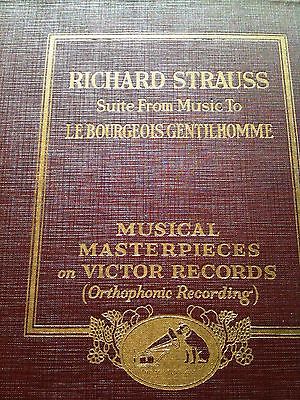
1933 CLEMENS KRAUSS Otto SCHULHOF PIANO Richard Strauss Bourgeois Gentilhomme 78
$
40


Favourite Auctions
To save auctions to your favourites, please login
If you don't have an account, please register
Description
Welcome to my auctions of great records
This is my FINAL WEEK of 3 weeks of great auctions – I WILL PACK AND BILL YOUR RECORDS after the close on September 27.
PLEASE DO NOT PAY before I send you an invoice. It will take me up to 48 hours to pack your records, but this is the ONLY WAY to get you the LOWEST POSTAGE. If you pay before I sent you an invoice, the EBAY system will charge you a HIGHER POSTAGE for shipping.
International shipping: approx postage 1x10"=$25: 1x12"=$28: 10"Album 4 Rec=45$: 12" Album 2 Rec=45$
About 30% less to Canada. Pls ignore international postage displayed in Ebay, rates are too high
Please wait for me to send you an invoice. DO NOT USE EBAY CHECKOUT if you want the lowest possible postage.
A series of great classical orchestral and instrumental performances by major conductors, composers and instrumentalists.
The great German Conductor and collaborator of Richard Strauss, Clemens Krauss, here at his short tenure at the Vienna State opera (1929 - 1934, he was bribed away to Berlin), playing with the opera house orchestra, the Vienna Philharmonic,
Der Bürger als Edelmann (Le bourgeois gentilhomme), suite from the ballet for orchestra, Op. 60-IIIa (TrV 228c)
by Richard Strauss; Clemens Krauss; Otto Schulhof piano ; Wiener Philharmoniker
Der Bürger als Edelmann (Le bourgeois gentilhomme), suite from the ballet for orchestra, Op. 60-IIIa (TrV 228c)
by Richard Strauss; Clemens Krauss; Otto Schulhof piano ; Wiener Philharmoniker
Le bourgeois gentilhomme, Op. 60, is an orchestral suite written by Richard Strauss between 1911 and 1917. The original idea of Hugo von Hofmannsthal was to revive Molière's 1670 play Le Bourgeois gentilhomme, simplify the plot and introduce a commedia dell'arte troupe, add some incidental music and conclude matters with a one-act opera Ariadne auf Naxos.
The combination of play and opera was premiered in Stuttgart on 25 October 1912, but it was immediately apparent that it was too long and too expensive to mount, and that also much of the potential audience for the play was uninterested in the opera, and vice versa. Strauss and Hofmannsthal set to work on separating the two works. A prologue was written for the opera to explain the presence of the comedians and the opera was premiered in its revised form independent of the play in 1916. The play was also revised, Hofmannsthal replacing the opera with an ending closer to Molière's original and Strauss providing additional incidental music in 1917. Strauss created an orchestral suite from most of the music which was published in 1917. The premiere of the orchestral suite took place in Vienna on 31 January 1920, under the baton of the composer.
4x12" original issue scroll label 78 rpm record w orthophonic album M 101 w patterned sleeves
Condition:
EXCELLENT pristine, album close to new, spine somewhat dark, small roughing top of spine
Otto Schulhof (born March 9, 1889 in Vienna; † 16 April 1958 Vienna) was an Austrian concert pianist, accompanist, composer and teacher at the Vienna Music Academy.
Otto Schulhof attended the "Realschule Radetzkystraße" in the 3rd district. [1] He graduated in 1907 trained as a concert pianist at the Conservatory of the Society of Friends of Music in Vienna now and 1911, the composition studies at the K. k. Academy of Music and Performing Arts. He appeared as a soloist as a pianist. Schulhof composed piano pieces, chamber music, ballets and songs. He transcribed themes of Johann Strauss II and led this repeated itself on.
In February 1914 he accompanied the prodigy Jascha Heifetz in a concert with the Vienna Tonkünstler. [2] Schulhof was accompanist to many great soloists, the cellist Senta Benesch [3] and the violinist Fritz Kreisler, Bronis?aw Huberman and Jan Kubelik. He was accompanist of singer Lotte Lehmann, Leo Slezak and Alfred Piccaver. But Schulhof accompanied numerous dances of modernity in the Vienna Konzerthaus, including by Grete Wiesenthal, Tilly Losch and Toni Birkmeyer, Ellen Tels and the "Dances of vice, of horror and ecstasy" of Anita Berber and Sebastian Droste.
Pablo Casals, whose partner he was on tour, and he took 1930 cello sonata op. 69 and the Cello Sonata Op. 102.1 by Ludwig van Beethoven on record on.
Schulhof was a professor of chamber music and Instrumentalkorrepetition at the Vienna Music Academy. Among his students were Hans Kann and Paul Badura-Skoda. After the connection of Austria in 1938 he was dismissed by the National Socialists of the Chair and supported by performance ban. [4] From 1945 to 1954 he was back in office. In 1949 he accompanied the violinist Erika Morini at her first concert after the period of National Socialism in Vienna. [5]
Schulhof received 1907 Silver Medal of the Society GDM 1910 State Prize for Composition and in 1949 the Medal of Honour of the Austrian capital Vienna.
Clemens Heinrich Krauss (March 31, 1893 – May 16, 1954) was a Austrian conductor and opera intendant, particularly associated with the music of Richard Strauss.
Biography
Krauss was born in Vienna, Austria to Clementine Krauss, out of wedlock, taking her name. His mother was a leading actress and singer, and is related to nineteenth-century soprano, Gabrielle Krauss (1842-1904). His father was a figure in the Austrian Imperial Court.
As a boy, Krauss was a chorister in the Hofkapelle (Imperial Choir). He attended the Vienna Conservatory, graduating in 1912. He studied composition with Hermann Grädener and theory with Richard Heuberger. After graduation he was chorus master in the Brno Theater (1912-1913). There he made his conducting debut in 1913. The great Romanian soprano Viorica Ursuleac, with whom he often performed, was his wife.
[edit] Career
Krauss made the rounds of regional centers, conducting in Riga (1913-1914), Nürnberg (1915), and Sczeczin (1916-1921). The latter appointment gave him ample opportunity to travel to Berlin to hear Arthur Nikisch conduct the Berlin Philharmonic, a major influence. Krauss's next post was back in Austria, where he became director of the opera and symphony concerts in Graz. In 1922 he joined the conducting staff of the Vienna State Opera and teacher of the conducting class at the State Academy of Germany. In 1923 he became conductor of the Vienna Tonkünstler Concerts until 1927, and Intendant of the opera in Frankfurt am Main and director of the Museum Concerts in 1924, until 1929.
Krauss visited the United States in 1929, conducting in Philadelphia and with the New York Philharmonic. Also in 1929 he became director of the Vienna State Opera. Its orchestra, in its independent concert form as the Vienna Philharmonic, appointed him its music director in 1930. He was a regular conductor at the Salzburg Festival from 1926 to 1934. In 1930 he conducted Alban Berg's Wozzeck.
In 1933 and 1934 Kraussgave up his Vienna positions, becoming director of the Berlin State Opera in 1935 after Erich Kleiber resigned in protest over Nazi rule. In 1933 he took over the preparations for the premieres of Strauss' Arabella when the conductor Fritz Busch (another non-Jewish anti-Nazi) left. In 1937 he was appointed Intendant of the Nationaltheater München, following the resignation there of Hans Knappertsbusch. He became a close friend of Richard Strauss, for whom he wrote the libretto to the opera Capriccio which he premiered in Munich in 1942. Also, he conducted the premieres of Strauss's operas Friedenstag and Die Liebe der Danae.
After the Munich opera house was bombed, shutting it down, Krauss returned to conduct the Vienna Philharmonic until it closed shortly before the end of the War (1944-1945). After the War, Allied officials investigated his pro-Nazi activities and because of them forbade him from appearing in public until 1947. They also found that he had frequently acted to assist a number of individual Jews escape the Third Reich machine. When his ban was lifted he resumed frequently conducting the Vienna Philharmonic, including its famous New Year's Day concerts.
Following Krauss's rehabilitation he conducted at Covent Garden in London from 1951 and the Bayreuth Festival in 1953 . He died during a visit to Mexico City, and is now buried along with his wife, who died in 1985, in Ehrwald, Austria.
More Great Records on sale right now:
http://shop.ebay.com/carsten_sf/m.html
http://shop.ebay.com/carsten_sf/m.html
====
A Quick NOTE ON GRADING AND SHIPPING:
As you can see from my feedback, I try hard to earn your POSITIVE FEEDBACK and FIVE STAR RATINGS.
If for any reason your transaction was NOT SATISFACTORY, pls contact me and I will work something out with you. YOU WILL NEVER HAVE A REASON TO GIVE ME A NEGATIVE RATING or a LOW STAR RATING.
Quick note on grading:
The Grade (Excellent to Fair, I don't give Mint) refers to the WEAR of the record. Any other defects are stated separately
When I listen to a record, I may also give it an aural grade (again E to F), and make a SUBJECTIVE judgment of the pressing quality for hiss and surface noise.
"SUPERQUIET" is basically noiseless, like a vinyl pressing.
"VERY QUIET" is an exceptionally quiet record for a given pressing.
"Quiet" is a record that is a great example without undue noise for a give pressing.
These judgments are SUBJECTIVE and will depend one the styli, phonograph etc. you use on your own equipment.
Pls check my other auctions for more great records and phonograph items:
Multiple item shipping: I am happy to combine items for shipment in one parcel.
If you win multiple items, pls send me an INVOICE REQUEST to calculate the correct postage. Ebay check out will not give you the multiple item discount!
Records will be packed safely between corrugated cardboard in a sturdy box with plenty of padding for safe shipment.
Shipment is usually Media Mail, unless another service is requested. Shipping is at your risk, I will be happy to insure items at your cost.
I charge actual postage plus a small fee for packing materials
As always, I guarantee your satisfaction. If you don't like the item, just return it, and I will refund the full purchase price.
If you are in the San Francisco area, I encourage pick-up in person.
US Domestic Shipping:
Here is a guideline for US Media Mail Shipping:
Prices below are for regular 78 rpm records. Up to about 5 records, I will ship Edison Discs for the same rates. Albums from Album Sets count as 1 record. Above that and for international shipments, it will be actual weight plus a small packing charge (1-3$ depending on size of shipment)
1 record: 4.50 – 5.00$
2 records: 5.75$
5 records: 7.50$
10 records: 9.50$
MANY MORE RECORDS: Don't worry. I safely ship 40 - 50 pounds of records double boxed in moving boxes, and even then Media Mail will probably not exceed 30$.
Please send me a message if you would like to lower your shipping rates!
International Buyers:
All'attenzione degli acquirenti italiani:
ATTENTION TO ITALIAN BUYERS:
Due to rare problems with delivery in ITALY, I will NOT GUARANTEE delivery of parcels sent by US Postal Service First Class and Priority Mail. If you prefer secure delivery, I will be happy to quote you either Registered Mail or shipment by FEDEX
I am very happy to ship records worldwide.
Please use the EBAY shipping cost only as a guideline. My actual charges are usually lower
One record usually ships for 25 – 28$ (Less for Canada).
I can get competitive rates from FedEx and the US Postal service for any kind of parcel weight, and will make use of all the cost-saving shipment methods
Pls contact me for a shipping estimate, or send me an invoice request after close of auction.
AND AGAIN -THANK YOU FOR YOUR INTEREST
As you can see from my feedback, I take great care in presenting, grading and shipping your items. I really want you to be happy with the purchase. If you feel that anything is wrong with the item or the shipping, contact me and we will work it out !!!
As always, I would appreciate any suggestions and corrections from you, pls contact me with any question.
Thank you very much, and good luck bidding !!!






![Passion: Music for The Last Temptation of Christ [3 x 45 RPM Vinyl LP 180 Gram]](https://www.popsike.mobi/php/thumbnail.php?url=https://www.popsike.pics/pix/20200226/193359390648.jpg)