1937 LILIAN HARVEY Willy FRITSCH German Movie Sieben Ohrfeigen CHINAMANN ODEON
$
45


Favourite Auctions
To save auctions to your favourites, please login
If you don't have an account, please register
Description
A series of great German, Swiss and Austrian Marches, Scandinavian Accordion, Folk Band, Humor and Popular recordings
Check out more German and Scandinavian recordings for sale by clicking the link below
More great German and Scandinavian Records in my other listings!
The highest grossing Movie Stars of German UFA LILIAN HARVEY and Willy FRITSCH in two songs from their famous 1937 MOvie The Seven Slaps
Lilian Harvey (born Helene Lilian Muriel Pape, 19 January 1906[citation needed] – 27 July 1968[1]) was an Anglo-German actress and singer, long based in Germany, where she is best known for her role as Christel Weinzinger in Erik Charell's 1931 film Der Kongreß tanzt.
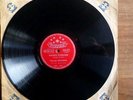
Lilian Harvey - Willy Fritsch – Ich Tanze Mit Dir In Den Himmel Hinein / Chinamann ...
Odeon – O-25 903
Formato:
Shellac, 10", 78 RPM
País: Germany
Publicado: 1937
Estilo: Schlager
A Ich Tanze Mit Dir In Den Himmel Hinein
B Chinamann ...
Conductor – Friedrich Schröder
Lyrics By – H. F. Beckmann*
Music By – Friedr. Schröder*
Orchestra – Odeon-Tanzorchester*
a. d. Ufa-Tonfilm "Sieben Ohrfeigen"
Please see top of the page for condition
Seven Slaps (German: Sieben Ohrfeigen) is a 1937 German comedy film directed by Paul Martin and starring Lilian Harvey, Willy Fritsch and Alfred Abel. Like the earlier Lucky Kids, which had the same director and stars, it was an attempt to create a German version of screwball comedy. While the previous film had a New York setting, this takes place in London.[1]
The film's sets were designed by Erich Kettelhut.
It was loosely remade in 1970 as Slap in the Face.
Lilian Harvey (born Helene Lilian Muriel Pape, 19 January 1906[citation needed] – 27 July 1968[1]) was an Anglo-German actress and singer, long based in Germany, where she is best known for her role as Christel Weinzinger in Erik Charell's 1931 film Der Kongreß tanzt.
Early life
Harvey was born in 1906, in Crouch End, North London. Her mother, Ethel Marion (Laughton), was English, and her father, Walter Bruno Pape, was a German businessman. At the beginning of World War I the family found itself in Magdeburg, and as they were unwilling and unable to return to England, Harvey was sent to live with an aunt at Solothurn in Switzerland. After the war, the Papes lived in Berlin, where Lilian took her high-school diploma (Abitur) in 1923. She began her career by attending the dance and voice school of the Berlin State Opera and assumed her grandmother's maiden name (Harvey) as her professional surname.
Career
Lilian Harvey, photographed by Alexander Binder. Ross Verlag. Collection EYE Film Institute Netherlands.
Lilian Harvey, photographed by Alexander Binder. Ross Verlag. Collection EYE Film Institute Netherlands.
After an engagement as a revue dancer in Vienna in 1924, Harvey received her first movie role as the young Jewish girl "Ruth" in the Austrian film The Curse directed by Robert Land. Subsequently, she starred in many silent films. In 1925, she was cast in her first leading role in the film Passion by Richard Eichberg, side by side with Otto Gebühr.
Because of her training as a singer, Harvey was able to pursue a successful acting career during the initial talkie era of the early 1930s. Her first movie with Willy Fritsch was the operetta film Chaste Susanne in 1926. Harvey and Fritsch became the "dream couple" of German movies in the early 1930s with the romantic love story Waltz of Love; she was called the "sweetest girl in the world" by the press, after a song featured in the film. She and Fritsch starred in a total of 11 movies together, among them the criminal comedy Hokuspokus (1930) after a play by Curt Goetz, directed by Gustav Ucicky, which became a box office success. An English version (The Temporary Widow) was filmed simultaneously, starring Lilian Harvey and Laurence Olivier, who thereby made his film debut. She also appeared in the musical film The Three from the Filling Station of the same year, which also became a major success and gave the young actor Heinz Rühmann his break. During this period she became the muse of the composer Charles Koechlin who, in his sixties, wrote numerous pieces in her honour; initially flattered, she soon became disturbed by his apparent obsession with her.[2]
In 1931, Harvey played the leading part in the film Der Kongreß tanzt (The Congress Dances); her song Das gibt's nur einmal written by Werner R. Heymann became a most popular melody. Her subsequent movies were filmed in English and French versions, so Harvey became known outside of Germany. She was invited to Hollywood and made four movies for the Fox Film Corporation, but these were not as successful as her German films. She eventually abandoned George White's Scandals, leading executives to cast Alice Faye in the part, and Faye became an overnight sensation. After leaving Hollywood she appeared in a British film Invitation to the Waltz. In 1935, Lilian Harvey returned to Germany.
Emigration from Germany
Berlin memorial plaque in Wilmersdorf
As she was still in touch with her Jewish colleagues, Harvey was placed under close observation by the Gestapo.[citation needed] Nevertheless she pushed the career of her protégé, director Paul Martin, performing in his screwball comedy Lucky Kids (1936) and further successful movies for the UFA until 1939, such as Seven Slaps, the biographical film Fanny Elssler (1937) together with Willy Birgel and Capriccio; as well as Frau am Steuer in 1939.
In June 1937 Harvey had helped the choreographer Jens Keith, prosecuted under the homosexual acts Paragraph 175, by posting a bail for him. Released from custody, Keith escaped to Paris; this led to a stern interrogation by the Nazi authorities. He subsequently returned to Berlin and UfA. In spring 1939, Harvey left Germany and her real-estate fortune, which was confiscated[citation needed]; she was to be deprived of her German citizenship in 1943 because she had performed for French troops.[citation needed]
Harvey went to live at her residence in Juan-les-Pins in Vichy France. In France she made two movies in 1940 – Serenade and Miquette (her last), both directed by Jean Boyer. After the occupation of southern France by German forces in November 1942, Harvey emigrated to the USA spending most of the time in Los Angeles working as a volunteer nurse, but also went on tour performing in Noël Coward's Blithe Spirit.[citation needed]
After World War II
Lilian Harvey (1963)
After the war, Harvey moved to Paris. In the following years, she travelled as a singer through Scandinavia and Egypt. In 1949, she returned to West Germany giving several concerts. Harvey retired to the resort town of Antibes on the French Riviera, where she operated a souvenir shop and raised edible snails.
price rating








![Various Artists - NOW – Yearbook 1978 [3LP Coloured Vinyl]](https://www.popsike.mobi/php/thumbnail.php?url=https://www.popsike.pics/pix/20250315/167379217047.jpg)