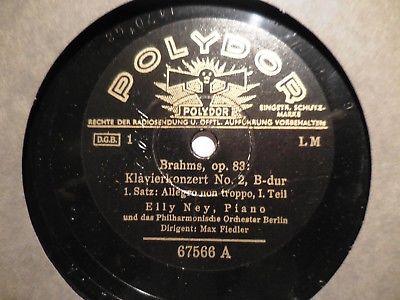
1939 ELLY NEY Brahms Piano Concerto 3 B Major Op 82 Max Fiedler Berlin Phil 78
$
130


Favourite Auctions
To save auctions to your favourites, please login
If you don't have an account, please register
Description
Please wait for me to send you an invoice. DO NOT USE EBAY CHECKOUT if you want the lowest possible postage.
Welcome to my auctions of great records
This is my FIRST WEEK of 2 weeks of great auctions –– I can hold your records and bill you after the close of the second week on Nov 11..
PLEASE DO NOT PAY before I send you an invoice. It will take me up to 48 hours to pack your records, but this is the ONLY WAY to get you the LOWEST POSTAGE. If you pay before I sent you an invoice, the EBAY system will charge you a HIGHER POSTAGE for shipping.
International shipping: approx postage 1x10"=$25: 1x12"=$35: 10"Album 4 Rec=50$: 12" Album 2 Rec=50$
HOWEVER in most cases I can get you SIGNIFICANT savings by using other services. Pls contact me for a quote.
About 30% less to Canada. Pls ignore international postage displayed in Ebay, rates are too high
Please wait for me to send you an invoice. DO NOT USE EBAY CHECKOUT if you want the lowest possible postage.
A series of great classical orchestral and instrumental performances by major conductors, composers and instrumentalists.
High Priestess of the Cult of Beethoven, she was famous for channelling the spirit of Beethoven to her concerts by reading the wretched Heiligenstaedter Testament (she also does it on Record).
1941 MOZART SESQUI CENTENNIAL ISSUE
Elly Ney plays Brahms Piano Concerto 3 B Major Op 82
Max Fiedler conducting the Berlin Philharmonic
Condition: EXCELLENT, faint scuffs plays very very quiet rare ticks
A CHOICE COPY
Orig Polydor issue 6x12" label 78 rpm record no album
Max Fiedler (1859-1939) is the only conductor on record who knew Brahms over a lengthy period (Weingartner performed in front of Brahms only shortly before the composer's death). So what we have here are genuine historical artifacts of how a major conductor performed Brahms during the composer's lifetime. These transfers are the best I have heard.
These interpretations are highly ‘romantic’ in style, with numerous ‘luftpausen’ and tempo shifts - Fiedler has no reluctance to slow down and ‘smell the roses’ when the mood seizes him. In many respects, this mode of Brahms conducting is an early precursor to the highly ‘personal’ readings of Furtwangler, Abendroth, and to a certain extent, Knappertsbusch. It is certainly miles apart from the strict rectitude of Weingartner and the steady, but highly nuanced pulse of Fritz Busch. The latter was a pupil of Fritz Steinbach, who was said to be Brahms' favorite conductor of the composer's symphonies.
The second symphony recorded here has a warmth and poetry that rank it, for me, among the finest interpretations ever, along with Furtwangler (his 1952 Berlin Phil. reading), Busch, and Schuricht (with the VPO)….
In the 2nd Piano concerto, Fiedler provides some of the most purely beautiful orchestral playing ever heard. To my ears, only Furtwangler (with Fischer) and Knappertsbusch (with Curzon) are in the same league….while not a virtuoso, Ney does play with great feeling and is well-attuned to Fiedler's conducting.…
This is a fine set for collectors. It provides a useful perspective on interpretive styles that prevailed during Brahms' lifetime.”
- Jeffrey Lipscomb
“Like his near contemporary Fritz Steinbach, whose conducting the composer specially approved, Max Fiedler was a famous Brahmsian. Alas, Steinbach died in 1916 at the age of 61, leaving behind him disciples (Toscanini, among others) but no recordings. Fiedler, by contrast, [left] behind revered recordings of the Second and Fourth Symphonies, recordings which have long been of absorbing interest to students of Brahms interpretation as well as to students of late 19th-century performance practice. In this sense, no Brahms library can properly be said to be complete without them…. the interest of these performances lies first and foremost - not to mention finally and most importantly - in the tempos: in the way they are chosen, established, and shrewdly modified by Fiedler in the course of performances which so interestingly live, move and have their being. There are other points of interest. The nature of the use of string portamentos: in the case of Fiedler and the Berlin Philharmonic, the selective and highly discriminating use of it. But it is tempo which is of paramount interest. Ironically, it is this which enables one to give the present set a qualified welcome.”
- Richard Osborne, GRAMOPNONE, Nov., 2000
Elly Ney was a disciple of both Theodor Leschetizky and of Emil von Sauer. Leschetizky was one of the most important piano teachers that have ever existed, among his former pupils one can mention Alexander Brailowsky, Mark Hambourg, Ignaz Jan Paderewski, Arthur Schnabel, Benno Moisewitch and Horzowski. Ney was a pianist with a rare sensibilty and she was highly reveared in Europe counting among her admirers Wilhelm Kempff. After WWII her career somehow decayed, but the recordings included in this CD's show her at her best, unfortunatelly the sound quality is limited since they date form the 1930's. If you are looking for a good sound quality stay away from this CD, but if you want to hear performances from a pianist of rare sensibility you will not be dissapointed. The Strauss' Burleske was the first recording ever made of this work, and the Beethoven and Mozart concertos are really excellent. The Beethoven concerto and the Burleske are accompanied by orchestras conducted by Willem van Hoogstraten, who not only was Ney's husband but an interesting musician as well. Hoogstraten was for more that ten years conductor of the Portland Orchestra and for two seasons (1923-1925) co-conductor of the New York Philharmonic with his countryman Willem Mengelberg.
From The Diary of Elisabeth Schumann
N.Y. 4.12.21. 12 o’clock at night
Lunch at Mrs Untermyer’s—3 o’clock Bodanzky’s orchestral concert, delightful Mendelssohn symphony; in the evening Strauss’s concert (orchestral) in the Hippodrome—wonderful Lohengrin prelude—Elly Ney burlesque—disappointing—after that together in the Plaza Hotel. Strauss talked very animatedly about [Hans von] Bülow—‘from whom I learnt conducting.’
The Burleske in D minor is a composition for piano and orchestra by Richard Strauss in 1885-86, when he was 21.
Contents [hide]
[edit] Background[edit] Original title and dedicationThe work's original title was Scherzo in D minor, and it was written for Hans von Bülow, who had appointed Strauss assistant conductor of the Meiningen Orchestra.[1] However, von Bülow considered it a "complicated piece of nonsense" and refused to learn it. He said the piano part was "Lisztian" and "unplayable", particularly for a pianist with a small handspan (Strauss says that von Bülow could barely reach an octave).[2] Strauss rehearsed the work with the Meiningen Orchestra, conducting and playing the solo part himself, but then set it aside. He wrote to von Bülow: "... given an outstanding (!) pianist, and a first-rate (!) conductor, perhaps the whole thing will not turn out to be the unalloyed nonsense I took it for after the first rehearsal. After the first run-through, I was totally discouraged ...".[1]
[edit] Renaming, rededication and premiereIn 1889, Strauss became acquainted with Eugen d'Albert, who liked the work, although he suggested some cuts and changes to the piano part.[3] Strauss rededicated the revised work to d'Albert, who premiered it under its new title Burleske, at a convention of the General German Music Association[2] at Eisenach on 21 June 1890, in the same concert as the premiere of Strauss's Death and Transfiguration.[2][3] The word "Burleske" translates as "farce"[4] or "mockery".[1]
[edit] ReactionVon Bülow was still not impressed. In a letter to Johannes Brahms in January 1891 he wrote: "Strauss's Burleske decidedly has some genius in it, but in other respects it is horrifying."[3] Despite this, he conducted the work that month in Berlin, with Eugen d'Albert as soloist.[2]
Strauss was offered a handsome sum by a publisher for the rights to the work, but he was still not convinced of its merits, so he declined. He was no doubt influenced in his own opinion of the work by von Bülow's opinion of it. A quarter of a century later he wrote about von Bülow: "For anyone who ever heard him play Beethoven or conduct Wagner, who attended one of his piano lessons or observed him in orchestra rehearsal, he inevitably became the model of all the shining virtues of a performing artist, and his touching sympathy for me, his influence on the development of my artistic abilities, were the decisive factors in my career." [2]
[edit] PublicationHowever, in 1894 Strauss agreed to publication of the Burleske, although it took him a long time to regard it with great favour. It eventually became one of his favourite works, and he programmed it in his last concert in London with the Philharmonia Orchestra in September 1947,[2] along with Don Juan, the Symphonia Domestica and the waltzes from Der Rosenkavalier.
Strauss never allocated an opus number to the work,[1] but the opus number 11 has often come to be associated with it, although Strauss gave that number to his Horn Concerto No. 1 in E?. It appears as number 85 in the catalogue by Erich Herrmann Mueller von Asow, and number 145 in that by Franz Trenner (see List of compositions by Richard Strauss#Other works).
[edit] Other premieresThe first performance of the Burleske in the United States was by Heinrich Gebhard with the Boston Symphony Orchestra, under Wilhelm Gericke, in April 1903.[2] The first performance in Australia was by Vera Bradford in 1937, with the Melbourne Symphony Orchestra conducted by Georg Schnéevoigt. He had considered the piano part could only be managed by a male pianist, and demanded Vera Bradford be replaced; but she stood her ground, refused to defer to a male pianist, and gave an excellent performance.[5]
[edit] Structure and scoringThe piece starts with a theme introduced on timpani and answered by the orchestra. The piano then enters in a state of high excitement. A second, more lyrical Brahmsian theme, emerges, and this is followed by waltz-like measures not unlike the waltzes from Der Rosenkavalier. The work ends quietly, again on the timpani. The piece takes about 22 minutes to perform.
The piece is scored for piano solo and an orchestra of piccolo, 2 flutes, 2 oboes, 2 clarinets in B-flat, 2 bassoons, 4 horns (2 in F, 2 in D), 2 trumpets, timpani, and strings.[6]
[edit] Notable performersNotable performers who have played or recorded the Burleske include Martha Argerich, Claudio Arrau, Wilhelm Backhaus, Rudolf Buchbinder, Michel Dalberto, Malcolm Frager, Glenn Gould, Hélène Grimaud, Friedrich Gulda, Byron Janis, Jeffrey Kahane, Elly Ney (1932), Sviatoslav Richter, Rudolf Serkin, and Jean-Yves Thibaudet.
In 2001, the music was used for the ballet Burleske, choreographed for the New York City Ballet by Peter Martins.[7]
More Great Records on sale right now:
http://shop.ebay.com/carsten_sf/m.html
http://shop.ebay.com/carsten_sf/m.html
====
A Quick NOTE ON GRADING AND SHIPPING:
As you can see from my feedback, I try hard to earn your POSITIVE FEEDBACK and FIVE STAR RATINGS.
If for any reason your transaction was NOT SATISFACTORY, pls contact me and I will work something out with you. YOU WILL NEVER HAVE A REASON TO GIVE ME A NEGATIVE RATING or a LOW STAR RATING.
Quick note on grading:
The Grade (Excellent to Poor, I don't give Mint) refers to the WEAR of the record. Any other defects are stated separately
When I listen to a record, I may also give it an aural grade (again E to P), and make a SUBJECTIVE judgment of the pressing quality for hiss and surface noise.
"SUPERQUIET" is basically noiseless, like a vinyl pressing.
"VERY QUIET" is an exceptionally quiet record for a given pressing.
"Quiet" is a record that is a great example without undue noise for a give pressing.
These judgments are SUBJECTIVE and will depend one the styli, phonograph etc. you use on your own equipment.
Pls check my other auctions for more great records and phonograph items:
Multiple item shipping: I am happy to combine items for shipment in one parcel.
If you win multiple items, pls send me an INVOICE REQUEST to calculate the correct postage. Ebay check out will not give you the multiple item discount!
Records will be packed safely between corrugated cardboard in a sturdy box with plenty of padding for safe shipment.
Shipment is usually Media Mail, unless you request another service. Shipping is at your risk, I will be happy to insure items at your cost.
I charge actual postage plus a small fee for packing materials
As always, I guarantee your satisfaction. If you don't like the item, just return it, and I will refund the full purchase price.
If you are in the San Francisco area, I encourage pick-up in person.
US Domestic Shipping:
Here is a guideline for US Media Mail Shipping:
Prices below are for regular 78 rpm records. Up to about 5 records, I will ship Edison Discs for the same rates. Albums from Album Sets count as 1 record. Above that and for international shipments, it will be actual weight plus a small packing charge (1-3$ depending on size of shipment)
1 record: 4.75 – 5.00$
2 records: 6.00$
5 records: 7.50$
10 records: 10.00$
MANY MORE RECORDS: Don't worry. I safely ship 40 - 50 pounds of records double boxed in moving boxes, and even then Media Mail will probably not exceed 35$.
Please send me a message if you would like to lower your shipping rates!
I am very happy to ship records worldwide.
Please use the EBAY shipping cost only as a guideline. My actual charges are usually lower
One record usually ships for 25 – 28$ for 10" 35$ for most 12" records (Less for Canada).
I can get SIGNIFICANTLY LOWER rates from FedEx and the US Postal service for any kind of parcel weight, and will make use of all the cost-saving shipment methods
Pls contact me for a shipping estimate, or send me an invoice request after close of auction.
AND AGAIN -THANK YOU FOR YOUR INTEREST
As you can see from my feedback, I take great care in presenting, grading and shipping your items. I really want you to be happy with the purchase. If you feel that anything is wrong with the item or the shipping, contact me and we will work it out !!!
As always, I would appreciate any suggestions and corrections from you, pls contact me with any question.
Thank you very much, and good luck bidding !!!
price rating