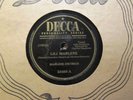
1945 Marlene DIETRICH LILI MARLEEN W War II GERMAN Soldier's Song SYMPHONY Decca
$
90


Favourite Auctions
To save auctions to your favourites, please login
If you don't have an account, please register
Description
A series of great JAZZ Records from early Ragtime to Beb-Bop on 78 rpm Victrola Records
More great Jazz and Vocal Records in my other listings!
Please see top of the page for condition
Dietrich and U.S. soldiers somewhere in France during her second USO tour (1944)
Marlene Dietrich between her stints as USO entertainer, recorded this Anthem of World War II
Actress. Singer. Spy. USO Tour Veteran. Marlene Dietrich was many things to many people, but to our service members overseas during World War II, she was a morale-boosting entertainer willing to go above and beyond – right to the front lines – to support our nation’s military. Through her USO Camp Show tours, she brightened the lives of many soldiers, sailors and airmen, and she became one of the iconic faces of women in World War II.
MARLENE DIETRICH grabbed this song from LALE ANDERSON and it became a staple of her shows ever since
Marlene Dietrich – Lili Marlene / Symphonie
Decca – 23456
1945
A Lili Marlene
Written-By – Hans Leip, Marlene Dietrich, Norbert Schultze
B Symphonie
Written-By – Alstone*, Taber*, Bernstein*
Directed By – Charles Magnante
Please see top of the page for condition
Marlene Dietrich version
In 1944, the Morale Operations Branch of the U.S. Office of Strategic Services (OSS) initiated the Muzak Project,[16] musical propaganda broadcasts designed to demoralize enemy soldiers. Marlene Dietrich, the only performer who was told her recordings would be for OSS use, recorded a number of songs in German for the project, including "Lili Marleen".[17]
Dietrich also performed "Lili Marlene", as well as many other songs, live in Europe for Allied troops, often on rickety, makeshift stages.
"Lili Marlene" became a massive success, specifically on the German language OSS MO radio station Soldatensender, where it became the station's theme song.[16] After its warm reception by the troops in Europe, the song was re-recorded and released, with the spelling "Lili Marlene" after her name, Marlene, with Charles Magnante on the accordion, citing him as the "orchestra director" for both it and the single's B-side, "Symphonie", sung in French. The single was released by Decca Records in 1945.[18] The original OSS recording of "Lili Marleen" remains unissued.
"Lili Marleen" (also spelled "Lili Marlen", "Lilli Marlene", "Lily Marlene", "Lili Marlène" among others; German pronunciation: ['l?li? ma?'le?n(?)]) is a German love song which became popular during World War II throughout Europe and the Mediterranean among both Axis and Allied troops. Written in 1915 as a poem, the song was published in 1937 and was first recorded by Lale Andersen in 1939 as "Das Mädchen unter der Laterne" ("The Girl under the Lantern").
The words were written in 1915 as a poem of three verses by Hans Leip (1893–1983), a school teacher from Hamburg who had been conscripted into the Imperial German Army.[1] Leip reportedly combined the nickname of his friend's girlfriend, Lili, with the name of another friend, Marleen, who was a nurse.[2][3] The poem was later published in 1937 as "Das Lied eines jungen Soldaten auf der Wacht" ("The Song of a Young Soldier on Watch"), with two further verses added.
It was set to music by Norbert Schultze in 1938 and recorded by Lale Andersen for the first time in 1939. In early 1942 she recorded the song in English, the lyrics translated by Norman Baillie-Stewart, a turncoat former British army officer working for German propaganda .[4] Songwriter Tommie Connor also wrote English lyrics with the title "Lily of the Lamplight" in 1944.[5] Another English translation was done by Dr. Theodore Stephanides during World War II and published in his memoir Climax in Crete in 1946.[6]
Exposure and reception
First recording of Lili Marlen, dated 2 August 1939, by Electrola Studio, Berlin. Label of one of the different variants that appeared during the war. The oldest label shows that the original song title was first called "Song of a Young Sentry".
After the occupation of Belgrade in 1941, Radio Belgrade became the German forces' radio station under the name of Soldatensender Belgrad (Soldiers' Radio Belgrade), with transmissions heard throughout Europe and the Mediterranean.
While on leave in Vienna, a lieutenant working at the station was asked to collect a pile of second-hand records from the Reich radio station.[7] Among them was "Lili Marleen" sung by Lale Andersen, which up till then had sold around 700 copies. Karl-Heinz Reintgen, the German officer in charge of the station, began playing the song on the air.[8] For lack of other recordings, Radio Belgrade played the song frequently.
At one point the Nazi government's propaganda minister, Joseph Goebbels, ordered broadcasting of the song to stop.[citation needed] Radio Belgrade received letters from Axis soldiers all over Europe asking them to play "Lili Marleen" again. Erwin Rommel, commander of the Afrika Korps, admired the song and asked Radio Belgrade to incorporate it into their broadcasts.[citation needed] Goebbels reluctantly changed his mind, and from then on the tune was used to sign-off the broadcast at 9:55 p.m.[citation needed]
The song was published in South Africa, in a wartime leaflet, with an anonymous English translation, as "Lili Marleen: The Theme Song of the Eighth Army and the 6th Armoured Division".[9]
Lale Andersen was awarded a gold disc for over one million sales (HMV - EG 6993).[10] It is thought she was awarded her copy after hostilities ended. HMV's copy was discarded during renovations to their Oxford Street store in the 1960s, but the disc was recovered and is now in a private collection.
Many Allied soldiers made a point of listening to the song at the end of the day. For example, in his memoir Eastern Approaches, Fitzroy Maclean describes the song's effect in the spring of 1942 during the Western Desert Campaign: "Husky, sensuous, nostalgic, sugar-sweet, her voice seemed to reach out to you, as she lingered over the catchy tune, the sickly sentimental words. Belgrade... The continent of Europe seemed a long way away. I wondered when I would see it again and what it would be like by the time we got there."[11]
price rating
![The Dark Side of the Moon [LP] by Pink Floyd (Vinyl, Apr-2003, EMI Music...](https://www.popsike.mobi/php/thumbnail.php?url=https://www.popsike.pics/pix/20140612/331224467743.jpg)



![Nathan Milstein [Violin] Recital With Carlo Bussotti, Piano UK Capitol Mono LP](https://www.popsike.mobi/php/thumbnail.php?url=https://www.popsike.pics/pix/20171008/311976209591.jpg)