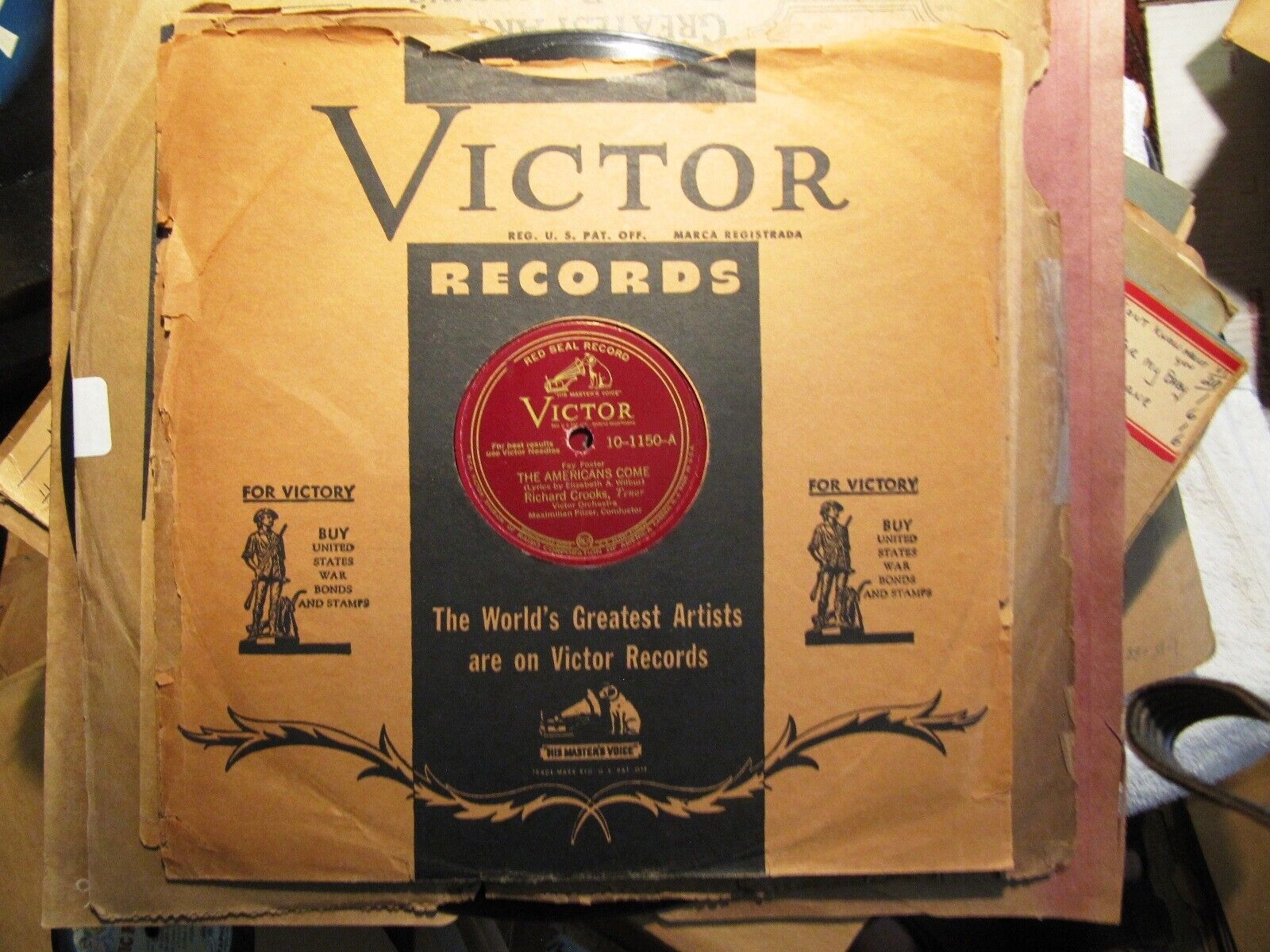
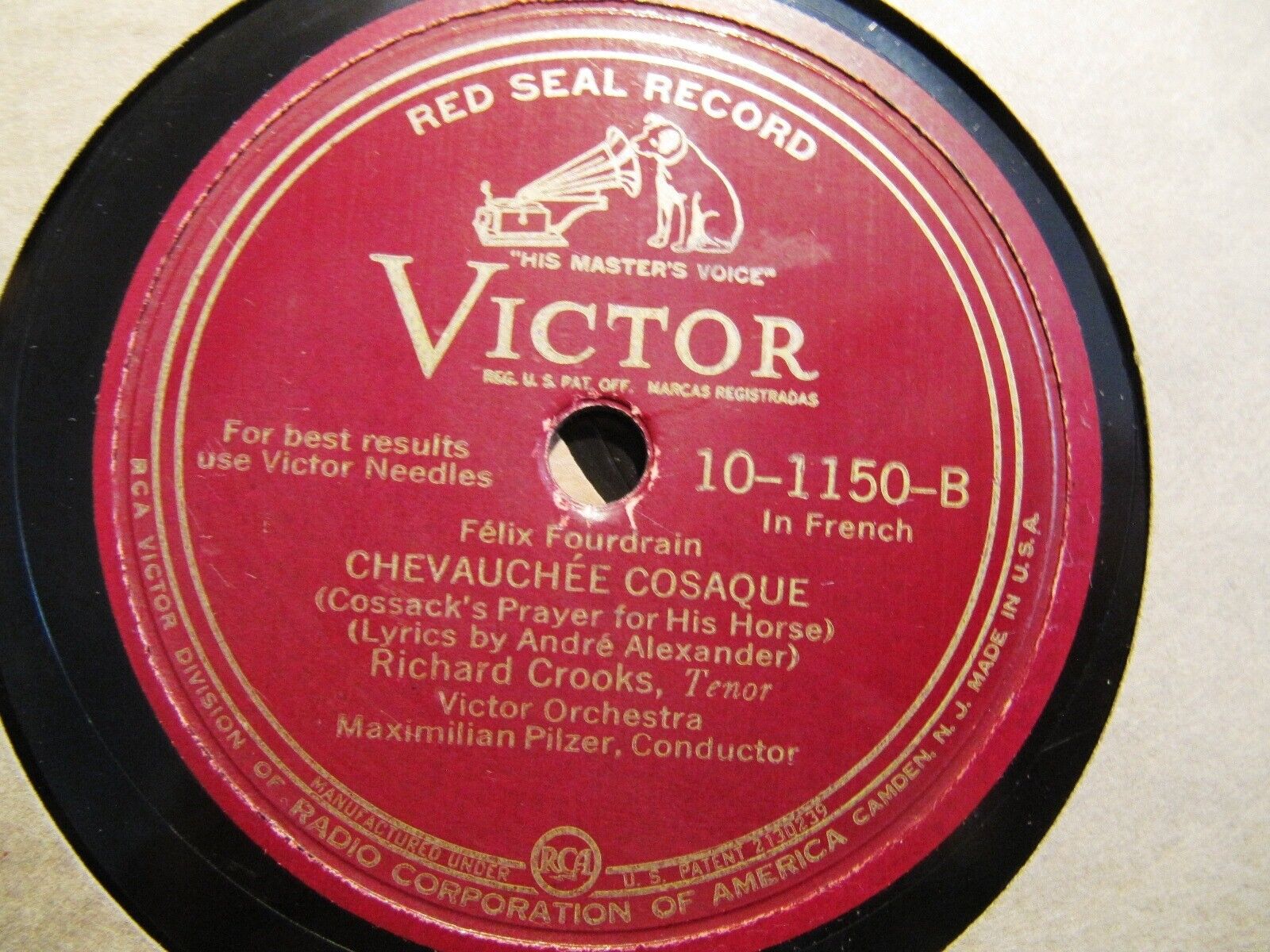
1945 W War I THE AMERICANS COME/ Russian Chevauchee Cosaque RICHARD CROOKS Tenor
$
30



Favourite Auctions
To save auctions to your favourites, please login
If you don't have an account, please register
Description
A series of great OPERA Records from early G&Ts to World War II recordings on 78 rpm Victrola Records
Click this link for more great Opera and Vocal Records in my other listings!
The young Crooks
Famous American singer RICHARD CROOKS had his operatic debut in 1927 at Hamburg
Here in two W War I songs released at the end of W War II
Foster: The Americans Come. / Fourdrain: Chevauchee Cosaque (Cossack’s Prayer for
His Horse). (Sung in French).
Richard Crooks
(tenor) with Victor Orchestra conducted by Maximilian Pilzer. 1 — 10" disc 10-1150)
Richard Crooks has selected two patriotic numbers
that were popular during World War I and sings
them in a stirring manner. His voice never sounded
better and the martial character of the music is appropriate for the times through which we are passing.
He is strongly supported by an fine orchestra under
the direction of Maximilian Pilzer.
Editor s Note: Is this the Mr. Pilzer who made
violin recordings for Victor some twenty-five years
ago?
Please see top of the page for condition
The Americans Come is about a blind Frenchman during WWI speaking to his son:
Blind Frenchman speaks to son:] "What is the cheering, my little one? Oh! that my blinded eyes could see! Â hasten, my boy, to the window run, And see what the noise in the street may be. I hear the drums and the marching feet; Look and see what it's all about! Who can it be that our people greet With cheer and laughter and joyous shout?" [Son:] "There are men, my father brown and strong And they carry a banner of wondrous hue, With a mighty tread they swing along Now I see white stars on a field of blue!" [Father:] "You say that you see white stars on blue? Look, are there stripes of red and white? It must be yes, it must be true! Oh, dear God, if I had my sight! Hasten, son, fling the window wide; Let me kiss the staff our flag swings from And salute the Stars and Stripes with pride, For, God be praised, "The Americans come!" Verse 2(French)[Un Français aveugle parle a son fils:] "Mon fils qui done acclamat'on? Par la fenêtre penches toi. Dis moi qui crie en passant Puisque mes pauvres yeux ne voient! J'entends le son de leurs tambours Les pas rythmiques des bataillons Qui donc arrive en ce séjour aux sons joyeux du peuple criant?" [Le fils:] "Des soldats, mon père, forts et fiers, Passent dans la rue en rangs serrés Ils portent haut leur jo lie banniére, ayant un fond bleu tout étoilé!" [Le père:] "Tu vois un fond bleu tout étoilé? Regardes encore! Ah puisje croire! Voistu du blanc et rouge, en raies? Oh, grand Dieu, si je pouvais voir! Hâtestoi ouvres la croisée Que j'embrasse notre tricolore Et salue le drâpeau étoilé Lou é soit Dieu, L'amérique vient!"
Félix Fourdrain (3 February 1880 - 23 October 1923) was a French organist and composer. He is chiefly known for his operas. Many of them were written in collaboration with librettists and poets Arthur Bernède and Paul de Choudens; the best of which are La Glaneuse (Grand Théâtre de Lyon, 1909), Madame Roland (Théâtre des Arts de Rouen, 1913), and Vercingétorix (Opéra de Nice, 1912). His masterpiece, La légende du Point d'Argentan, premiered at the Opéra-Comique in Paris in 1903. Born in Nice, Fourdrain had his earliest musical training at the Ecole de Musique Classique et Religieuse (L'École Niedermeyer) in Paris. He then studied with Alexandre Guilmant and Charles-Marie Widor at the Conservatoire de Paris where he was awarded a premiere prix for organ performance in 1900. He was appointed "organiste titulaire" at the Sainte-Elisabeth-de-Hongrie church in Paris and worked there between 1900 and 1905 aproximatively, publishing "Improvisations", a collection of organ compositions. He pursued further studies in music composition with Jules Massenet, who became his close friend and mentor. He also took on his own students, including Joseph-Arthur Bernier, Clotilde Coulombe, and Georges-Émile Tanguay. He died in Paris at the age of 43.
Richard Alexander Crooks (June 26, 1900 – September 29, 1972) was an American tenor and a leading singer at the New York Metropolitan Opera.[1]
BiographyHe was born on June 26, 1900 in Trenton, New Jersey.
After several busy concert seasons as an oratorio and song recital specialist, including the American premier of Mahler's Das Lied von der Erde, Crooks traveled to Germany where he made his operatic debut in Hamburg as Cavaradossi in Puccini's Tosca in 1927. After his tour in other European cities such as Berlin, Crooks returned to the United States and made his American debut in 1930 in Philadelphia. He became a star of the Metropolitan Opera, specializing in French and Italian operas. He participated in the farewell gala on March 29, 1936, for Italian soprano Lucrezia Bori, which was broadcast nationally and preserved on transcription discs.
price rating


![Nouvelle Vague [Vinyl New]](https://www.popsike.mobi/php/thumbnail.php?url=https://www.popsike.pics/pix/20161212/361852463001.jpg)