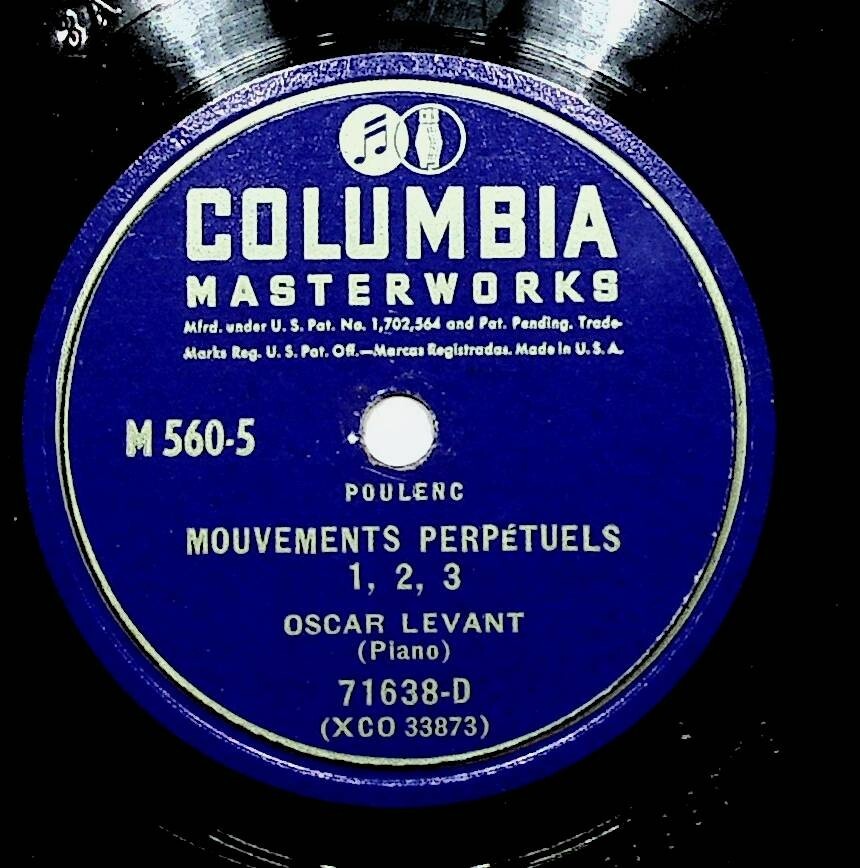
1946 Oscar Levant Plays Popular Moderns Piano Solo 12" 78 3-Record Album V+
$
14




Favourite Auctions
To save auctions to your favourites, please login
If you don't have an account, please register
Description
Combined Shipping - Add items to cart
1946 Oscar Levant Plays Popular Moderns Piano Solo 12" 78 3-Record Album V+
Record Grade Per VJM Standard: VG+
OSCAR LEVANT PLAYS POPULAR MODERNS De Falla: Fire Dance from “El Amor Brujo” Lecuona: Malaguena from Suite “Andalucia” Poulenc: Pastourelle Debussy: Golliwog’s Cake Walk from “The Children’s Corner” Debussy: Maid with the Flaxen Hair (Prelude No. 8, Book 1) Debussy: Clair de Lune from “Suite Bergamasque” Poulenc: Mouvements Perpetuels Nos. 1,2 and 3 De Falla: Miller’s Dance from “The Three-Cornered Hat” Albeniz: Tango in D Major OSCAR LEVANT, Piano COLUMBIA MASTERWORKS Set M-560 FIRE DANCE MILLER’S DANCE Manuel de Falla, dean of modern Spanish composers, was born in Cadiz in 1876. His music, unlike the reams of Spanish music written by non-Spaniards, has a certain inexplicable note of authenticity about it that reflects the true spirit of musical Spain. Among his principal works are the ballets, El Amor Brujo (Love, the Magician) and El Sombrero de Tres Picos (The Three-Cornered Hat'), both of which have attained wide popularity through their many performances by ballet com- panies and in concert. El Amor Brujo was first performed as a ballet at Madrid in 1915; it was later arranged by the composer as a suite for or- chestra with a solo for mezzo-soprano voice. The Fire Dance is a wildly whirling excerpt that has become extremely popular as a display piece for pianists. The Three-Cornered Hat was first heard in London in 1919. Three dances from this ballet were excerpted for concert use. The Miller's Dance, which is the second of these, starts off slowly and quietly, then works up to a fiery ending. MALAGUENA Ernesto Lecuona, one of the best known of all Latin American composers, occupies a unique position in the world of music, for he is one of the very few composers who are equally proficient at writing for both the concert hall and the dance hall. Bom in Havana in 1896, Lecuona studied the piano and won recognition as a child prodigy. When he was seventeen, he made the first of several appearances in the United States. Without a doubt, his most popular composition in the field of serious music is his suite of dances for piano, called Andalucia, which was published in 1930. The best-known numbers from this suite are the Andalucia (also converted into a popular song) and the Malaguena. The latter is a rhapsodic dance, which has gained wide appeal, not only in its original form but also in arrangements for two pianos and for orchestra. PASTOURELLE MOUVEMENTS PERPETUELS Francis Poulenc was born in Paris in 1899. Though he had instruction on the piano, he was largely self-taught in the field of composition. In 1917 he joined the group of French composers known as “The Six.’’ These men sought to defy the trend toward romanticism in French music, and emphasized simple, often comic, subjects. Poulenc has continued to follow the precepts of “The Six.” and his compositions, which show a certain amount of influence of Satie and Stravinsky, are mostly in the lighter vein. He writes principally either for the piano or for various combinations of wind instruments. The Pastourelle is one of Poulenc’s delightful shorter piano pieces; the Mouvements Perpetuels, composed in 1918, are brief “perpetual motions.” Oscar Levant GOLLIWOG’S CAKE WALK MAID WITH THE FLAXEN HAIR CLAIR DE LUNE These are three of the most popular of the many piano com- positions of Claude Achille Debussy (1862-1918). The piano was Debussy’s instrument, and he invented wonderful new effects that could be obtained through changes in technique in both composition_and performance The Golliwog’s Cake Walk, the final movement of Debussy’s delightful Children’s Corner Suite, is one of the earliest ex- amples of the use of the jazz idiom in concert music. Debussy belongs to that select group of composers — which also includes such varied members as Bach, Chopin and Shosta- kovich — who wrote sets of twenty-four preludes for the piano, utilizing all the major and minor keys. The Debussy Preludes are divided into two books of twelve each, and the lovely Maid with the Flaxen Hair (La fille aux cheveux de liri) is the eighth Prelude in Book I. Clair de lune, with its incomparable picture of quiet moon- light, is the third movement of the Suite Bergamasque, though it appears more frequently as an independent number. TANGO IN D MAJOR Isaac Albeniz (1860-1909) is usually acknowledged as the founder of the modern Spanish “nationalist” school of composi- tion. He was an internationally known piano virtuoso, and most of his compositions are for that instrument. During his concert tours he often played his own works. Among his early creations to gain wide acceptance was this little Tango in D Major. All of Albeniz’s music, though not actually employing folk themes, is filled with the rhythmic and melodic flavor of Spain. Notes by Paul Affelder Oscar Levant, despite the impressive list of his accomplish- ments, is still one of the youngest men ever to be established as one of the standard concert virtuosos in heavy demand throughout the country. A native of Pittsburgh, Mr. Levant began his musical studies at a very early age and rapidly devel- oped his unique gifts along very broad lines. As a result, he is today completely at home not only in the classical concert repertoire, but in the field of popular music as well. Mr. Levant has accomplished much, as all America knows. He has become one of the best-known pianists of his generation, a composer of note, the author of a best-selling book, an actor on the stage?screen, and radio His dominant talent, however,-is ~ musical, and he thinks of himself primarily as a pianist. His specialty is the interpretation of the music of his close friend, the late George Gershwin.
Thank you for your business.
Gallimoresgoods
price rating