1972 PARTRIDGE FAMILY at HOME with THEIR GREATEST HITS PROMOTIONAL COMPILATION33
$
38



Favourite Auctions
To save auctions to your favourites, please login
If you don't have an account, please register
Description
1972 PARTRIDGE FAMILY at HOME with THEIR GREATEST HITS PROMOTIONAL COMPILATION 33
Description
GREETINGS, FEEL FREE
TO
"SHOP NAKED."©
We deal in items we believe others will enjoy and want to purchase.
We are not experts.
We welcome any comments, questions, or concerns.
WE ARE TARGETING A GLOBAL MARKET PLACE.
Thanks in advance for your patronage.
Please Be sure to add WDG to your favorites list!
NOW FOR YOUR VIEWING PLEASURE…
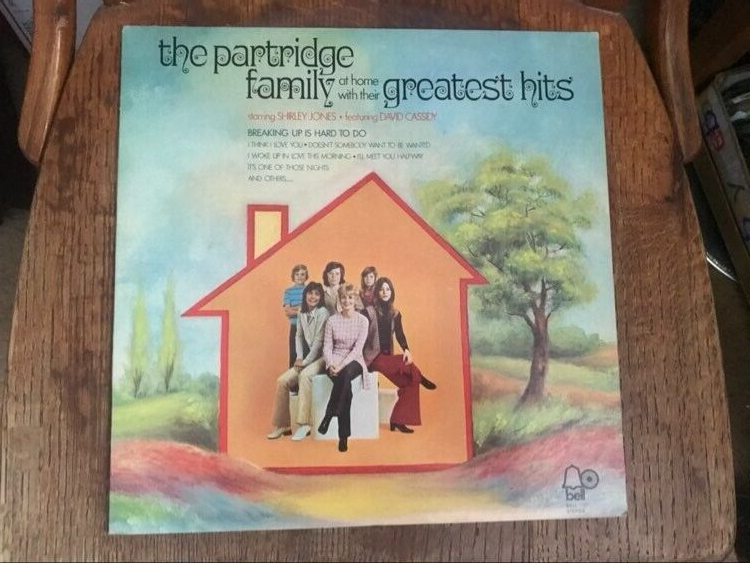
The Partridge Family – The Partridge Family At Home With Their Greatest Hits
Label: Bell Records – Bell 1107
Format: Vinyl, LP, Compilation, Promo
Country: US
Released: 1972
Genre: Pop
Style: Ballad
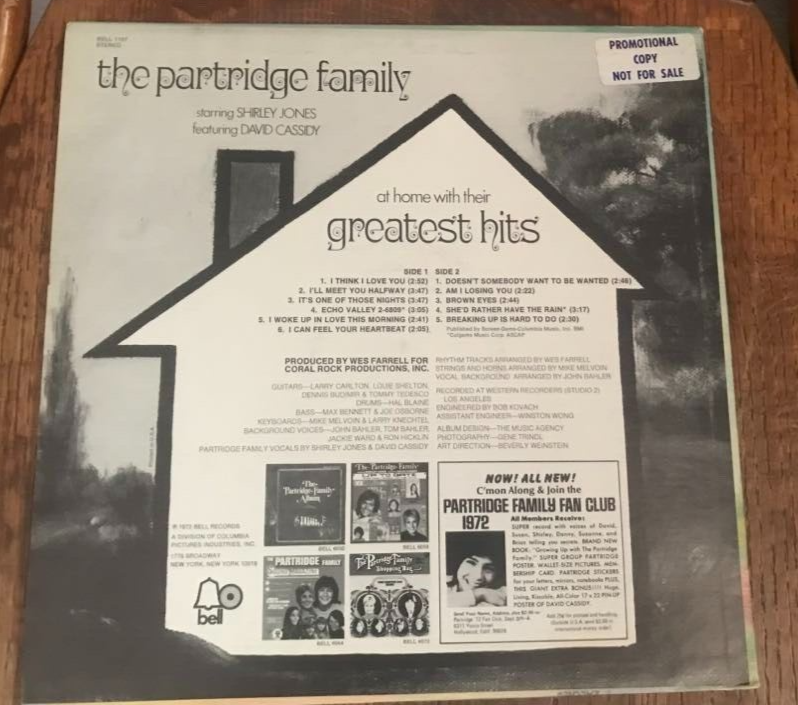
Tracklist
A1 I Think I Love You
Written-By – Tony Romeo
2:52
A2 I'll Meet You Halfway
Written-By – Gerry Goffin, Wes Farrell
3:47
A3 It's One Of Those Nights
Written-By – Tony Romeo
3:47
A4 Echo Valley 2-6809
Written-By – Kathy Cooper, Rupert Holmes
3:05
A5 I Woke Up In Love This Morning
Written-By – Irwin Levine, L. Russell Brown
2:41
A6 I Can Feel Your Heartbeat
Written-By – Jim Cretecos, Mike Appel, Wes Farrell
2:05
B1 Doesn't Somebody Want To Be Wanted
Written-By – Jim Cretecos, Mike Appel, Wes Farrell
2:46
B2 Am I Losing You
Written-By – Irwin Levine, L. Russell Brown
2:22
B3 Brown Eyes
Written-By – Danny Janssen, Wes Farrell
2:44
B4 She'd Rather Have The Rain
Written-By – Terry Cashman, T. P. West*
3:17
B5 Breaking Up Is Hard To Do
Written-By – Howard Greenfield, Neil Sedaka
2:30
Producer – Wes Farrell
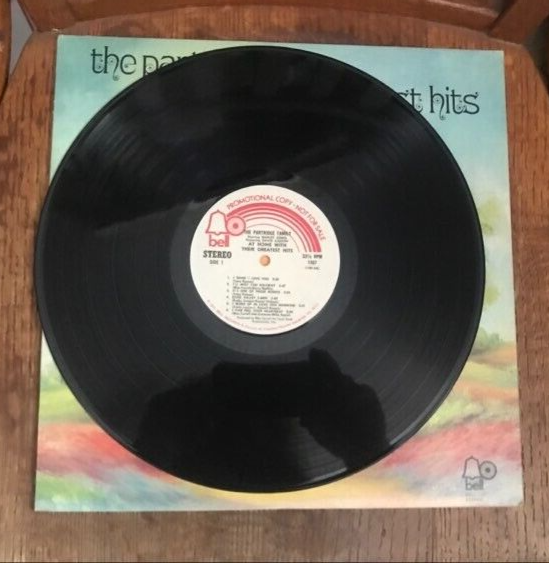
Promotional Copy Not For Sale on white labels and sticker on back cover
SOUND TESTED
BUYER APPROVED
RECORD PLAYS VG+ > EX-
COVER IS VG+ > EX-
https://www.youtube.com/watch?v=f8F55o5fBcw&ab_channel=mroldmusic1
VIDEO IS EXAMPLE ONLY, NOT ACTUAL
----------------------------------------------
The Partridge Family was an American television sitcom about a widowed mother and her five children living in San Pueblo, a small fictional town in Northern California, originally broadcast on ABC from 1970 to 1974.
History: In the pilot episode this group of musical siblings convinces their mother to help them out by singing with them as they record a pop song in their garage. Through the efforts of the 10-year-old son Danny, they find a manager who helps make the song a Top-40 hit. After some more convincing, the mother finally agrees that the family can go on tour. They acquire an old school bus, paint it and depart to Las Vegas for their first live gig at Caesars Palace.
Each subsequent episode features the band performing in various locations and types of venues. The shows would often contrast their suburban life with the adventures of a show-biz family "on the road". After the first season the show focused more on the "at home" themes and less on their touring. The series originally ran from September 25, 1970 until August 31, 1974 on the ABC television network, as part of the Friday night lineup following The Brady Bunch. It had a few subsequent runs in syndication.
Created by Bernard Slade, the series was inspired by and loosely based on The Cowsills, a real pop music family famous in the late Sixties. In fact, in its early development, the Cowsill children were actually approached by the producers to be featured on The Partridge Family, though the children rejected the offer when they learned their real-life mother and band member Barbara would not be included in the cast. Shirley Jones had already been signed as mother Shirley Partridge and star of the show. The remaining Partridge children were played by David Cassidy (Jones' real-life stepson) as her eldest son Keith, Susan Dey as Laurie, Danny Bonaduce as Danny, Jeremy Gelbwaks as Chris and Suzanne Crough as Tracy. Dave Madden played Reuben Kincaid, who was their manager and family friend. After the first season, the dark-haired Gelbwaks who played young Chris was replaced by a blond actor, Brian Forster. It was reported by teen magazines in 1971 that this was because his family simply moved away. Years later it was disclosed by cast members that young Gelbwaks had "behavior problems" on the set and got replaced after he bit one of the featured players.
A dog named "Simone" was also featured in the first season, though she was phased out of production early in the second season. Like "Tiger" on The Brady Bunch, the dog simply disappeared without an explanation.
The Partridge Family was produced for ABC by Screen Gems television, which was just finishing its run with The Monkees, another show about a fictional musical group. The company promoted the success of the show by releasing a series of albums featuring the music of the family band though most cast members did not actually play on the recordings. The Partridge Family sound was created by a group of studio singers and musicians led by producer Wes Farrell. Although David Cassidy was originally cast with the intent to lip sync with the rest of the cast, he convinced Farrell just weeks into production that he could sing well and was allowed to join the studio ensemble as the lead singer. (Several songs were made without Cassidy as lead and were featured in some of the early episodes and on the first album.) He and Shirley Jones, who sang background, were the only cast members who were actually featured on the recordings. Though it was obvious to most viewers that the cast was lip-syncing, The Partridge Family became an instant phenomenon, not only as a TV show but as a band that produced actual hit songs.
The Partridge Family's biggest hit came in 1970 with the song "I Think I Love You" (lyrics), which began climbing in September and peaked at Number 1 on the Billboard charts in December of that year. (The song was written by Tony Romeo, who had previously written several of the Cowsills' hits.) A companion LP, The Partridge Family Album, reached Number 4. Other Partridge singles, "I'll Meet You Halfway", "Doesn't Somebody Want To Be Wanted", and "I Woke Up in Love This Morning" would also chart high on Billboard. The theme songs "When We're Singing" and its successor "C'Mon, Get Happy", as well as album cuts "I Can Feel Your Heartbeat" and "Point Me In The Direction Of Albuquerque", also became popular favorites. Despite the "bubblegum" label and prefabricated nature of the "band", the Partridge Family's records sold very well.
As the show and other associated merchandising took off, David Cassidy became an overnight teen idol. Although the Partridge Family did not actually exist as a live band, Cassidy launched a solo singing career touring with his own group of musicians, performing Partridge songs as well as hits from his own albums. In the midst of his overwhelming rise to fame, Cassidy soon grew tired of the show. In the summer of 1972, he gave a very candid interview to Rolling Stone magazine in which he attempted to distance himself from the squeaky-clean image of Keith Partridge.
------------------------
In music, a single or record single is a type of release, typically a recording of fewer tracks than an LP or a CD. This can be released for sale to the public in a variety of different formats. In most cases, the single is a song that is released separately from an album, but it can still appear on an album. Often, these are the most popular songs from albums that are released separately for promotional uses such as commercial radio airplay, and in other cases a recording released as a single does not appear on an album. 45 rpm records are played on a record player or turntable. They can be played one at a time, with the records changed manually after they finish, or a stacking spindle could be used to play up to six in succession without manually changing them. The use of the spindle led to the coined "Stack O Wax" term in the 1950s.
History: The basic parameters of the music single were established in the late 19th century, when the gramophone record began to supersede phonograph cylinders in commercial music. Gramophone discs were manufactured with a range of playback speeds (from 16 rpm to 78 rpm) and in several sizes (including 12″/30 cm). By around 1910, however, the 10-inch (25 cm) 78 rpm shellac disc had become the most commonly used format.
The inherent technical limitations of the gramophone disc defined the standard format for commercial recordings in the early 20th century. The relatively crude disc cutting techniques of the time and the thickness of the needles used on record players limited the number of grooves per inch that could be inscribed on the disc surface, and a high rotation speed was necessary to achieve acceptable recording and playback fidelity. 78 rpm was chosen as the standard because of the introduction of the electrically powered synchronous turntable motor in 1925, which ran at 3600 rpm with a 46:1 gear ratio, resulting in a rotation speed of 78.26 rpm.
These factors, combined with the 10-inch songwriters and performers increasingly tailored their output to fit the new medium. The 3-minute single remained the standard into the 1960s when the availability of microgroove recording and improved mastering techniques enabled recording artists to increase the duration of their recordings. In 1968 songwriter Jimmy Webb shattered the standard 3 minute format with "MacArthur Park" which exceeds 7 minutes length. Although Webb had written million-selling songs and was a multiple Grammy winner, the song had been rejected by several labels as simply too long for the marketplace to bear. The Beatles' also challenged deliberately the long-standing 3-minute standard for pop singles with their 1968 7 minute 20 second single "Hey Jude" which according to some was extended in length in order to exceed "MacArthur Park"
Singles have been issued in various formats, including 7-inch (18 cm), 10-inch (25 cm) and 12-inch (30 cm) vinyl discs (usually playing at 45 rpm); 10-inch (25-cm) shellac discs (playing at 78 rpm); cassette, 8 and 12 cm (3- and 5-inch) CD singles and 7-inch (18 cm) plastic flexi discs. Other, less common, formats include singles on digital compact cassette, DVD, and LD, as well as many non-standard sizes of vinyl disc (5″/12 cm, 8″/20 cm, etc.).
The most common form of the vinyl single is the 45 or 7 inch, the names are derived from its play speed, 45 rpm and the standard diameter 7″ (18 cm).
The 7″ 45 rpm record was introduced in 1949 by RCA as a smaller, more durable and higher-fidelity replacement for the 78 rpm shellac discs. The first 45 rpm records were monaural, with recordings on both sides of the disc. As stereo recordings became popular in the 1960s, almost all 45 rpm records were produced in stereo by the early 1970s.
Although 7″ remained the standard size for vinyl singles, 12″ singles were introduced for use by DJs in discos in the 1970s. The longer playing time of these singles allowed the inclusion of extended dance mixes of tracks. In addition, the larger surface area of the 12″ discs allowed for wider grooves (larger amplitude) and greater separation between grooves, the latter of which results in less cross-talk. Consequently, they 'wore' better, and were less susceptible to scratches. The 12″ single is still considered a standard format for dance music, though its popularity has declined in recent years.
The sales of singles are recorded in record charts in most countries in a Top 40 format. These charts are often published in magazines and numerous television shows and radio programs count down the list. In order to be eligible for inclusion in the charts the single must meet the requirements set by the charting company, usually governing the number of songs and the total playing time of the single.
In popular music, the commercial and artistic importance of the single (as compared to the EP or album) has varied over time, technological development, and according to the audience of particular artists and genres. Singles have generally been more important to artists who sell to the youngest purchasers of music (younger teenagers and pre-teens), who tend to have more limited financial resources. Perhaps the golden age of the single was on 45's in the 1950s and early 1960s in the early years of rock music. Starting in the mid-sixties, albums became a greater focus and more important as artists created albums of uniformly high quality and coherent themes, a trend which reached its apex in the development of the concept album. Over the first decade of the 21st century, the single generally received less and less attention in the United States as albums, which on Compact Disc had virtually identical production and distribution costs but could be sold at a higher price, became most retailers' primary method of selling music. Singles continued to be produced in the UK and Australia but have declined since the mid first decade of the 21st century.
Dance music, however, has followed a different commercial pattern, and the single, especially the 12-inch vinyl single, remains a major method by which dance music is distributed.
As of 2006 the single seems to be undergoing something of a revival. Commercial music download sites reportedly sell mostly single tracks rather than whole albums, and the increase in popularity seems to have rubbed off on physical formats. Portable audio players, which make it extremely easy to load and play songs from many different artists, are claimed to be a major factor behind this trend.
A related development has been the popularity of mobile phone ringtones based on pop singles (on some modern phones, the actual single can be used as a ringtone). In September 2007, Sony BMG announced they would introduce a new type of CD single, called "ringles", for the 2007 holiday season. The format included three songs by an artist, plus a ringtone accessible from the user's computer. Sony announced plans to release 50 ringles in October and November, while Universal Music Group expected to release somewhere between 10 and 20 titles.
In a reversal of this trend, a single has been released based on a ringtone itself. The Crazy Frog ringtone, which was a cult hit in Europe in 2004, was released as a mashup with Axel F in June 2005 amid a massive publicity campaign and subsequently hit #1 on the UK charts.
-------------------------------------------------
Thanks for choosing this auction. You may email for alternate payment arrangements. We combine shipping. Please pay promptly after the auction. The item will be shipped upon receipt of funds.
WE ARE GOING GREEN, SO WE DO SOMETIMES USE CLEAN RECYCLED MATERIALS TO SHIP.
Please leave feedback when you have received the item and are satisfied. Please respond when you have received the item * If you were pleased with this transaction, please respond with all 5 stars! If you are not pleased, let us know via e-mail. Our goal is for 5-star service. We want you to be a satisfied, return customer.
Please express any concerns or questions. More pictures are available upon request. The winning bid will incur the cost of S/H INSURED FEDEX OR USPS. See rate calculator or email FOR ESTIMATE. International Bidders are Welcome but be mindful if your country is excluded from safe shipping.
Thanks for perusing THIS and ALL our auctions.
Check out our other items!
WE like the curious and odd.
BUY, BYE
Track Page Views With
Auctiva's Counter Pictures sell!
Auctiva offers Free Image Hosting and Editing. Listings get noticed with
Auctiva's Mobile Responsive Listing Templates.
price rating

![Maxinquaye (Gatefold & Insert) [180 gm vinyl], 0600753368831, Tricky](https://www.popsike.mobi/php/thumbnail.php?url=https://www.popsike.pics/pix/20150501/361285398379.jpg)