1972 WIGWAM (self-titled) PROG-PIONEERS from Finland NM SERIOUSLY RARE
$
108


Favourite Auctions
To save auctions to your favourites, please login
If you don't have an account, please register
Description
Truly one of the PIONEERS of EARLY PROGRESSIVE ROCK!!
THE SUPER-RARE-PROG
!! WIGWAM !!
LOVE RECORDS
First Pressing!!
1972 COMPLIATION
From FINLAND!!
Songs / Tracks Listing:
1. Tombstone Valentine (3:03)
2. Captain Supernatural (3:01)
3. Lost Without A Trace (2:29)
4. Fairyport (6:53)
5. Highway Code (2:53)
6. Mountain Range (3:11)
7. Geographical And Astronomical Mistakes (2:02)
8. Rockin' Ol' Galway (2:27)
9. Wishful Thinker (3:43)
10. Losing Hold (7:06)
Total Time: 36:48
- Ronnie Sterberg / drums
- Jukka Gustavson / vocals, piano, organ
- Jim Pembroke / vocals, harmonica, piano
- Pekka Pohjola / bass, violins
- Mats Huldn / bass (5-7)
- Jukka Tolonen / guitar
- Nikke Nikamo / guitar (5-7)
- WIGWAM helped to lay the FOUNDATIONof PROG!!!
Wigwam
[From Esko Lehtonen's encyclopedia of Finnish rock music (1983), p. 655-665. Translated by Timo Rauhaniemi & Claes Johansen.]
"Wigwam is perhaps the most significant Finnish rock group ever, though their true qualities were never fully realised by their own countrymen. They were one of the few bands who kept developing throughout their career, without becoming overtly intellectual.
Wigwam was also the one Finnish group that has come closest to major international success. Their problem was that they were too ahead of their time, musically and otherwise. Hence ‘undervalued’ is a word that very much describes the band.
They remained a cult group, whose records were well-regarded outside of Finland, and though they never broke through to a larger audience they retained a small, enthusiastic fan base.
The beginnings of Wigwam go back to late 1968 when Finnish pop singer Kristian asked Ronnie Österberg to become part of his backing band. Added was guitarist Vladimir ‘Nikke’ Nikamo (ex Mosaic, Roosters, Sperm) and bass player Mats Huldén (ex Frankies, System, the First). Initially, the line-up also included sax player Pekka Untovuori [sic!], but he was sack after their first gig. Soon after, the backing band decided to break away from Kristian, and in early 1969 Jim Pembroke (ex Pems, Blues Section) was asked to join instead.
The spring of 1969 saw the release of Wigwam’s first single, titled ‘Must Be The Devil’/’Greasy Kid’s Stuff’. Both songs were written by Pembroke. In June, keyboardist Jukka Gustavson (ex Hollymakers, TOJ Limited, Roosters) joined. Wigwam had heard him play with the Roosters during a tour of Northern Finland in the spring. There were now two remarkable singers and songwriters in the group. During the summer they went away to rehearse in peaceful surroundings in the Finnish countryside. Soon after they started recording their first LP.
In November work was finished on what would become, with time, a classic album of Finnish rock. The LP, titled Hard ‘n’ Horny, is split into two sections, with Side 1 written by Gustavson, and Side 2 consisting of Pembroke’s conceptual song cycle ‘Henry’s’. The uniqueness and freshness of the album still makes it an excellent listen. Gustavson’s songs express man’s emotional difficulties and moral struggle in a cold and unsympathetic world. Pembroke’s concept idea is built over different aspects of a fictional character called Henry and the world around him.
Additional participants on the album are Fritz H. Jenkins (a US double bass player), Otto Donner, DDT Jazzband, and Jukka’s sister Marjo-Riitta Gustavson (later married to Mats Huldén), who did some reciting.
The album artwork was a strange affair: two pieces of cardboard stapled together on which the group made drawings and writings (there were several talented artists in Wigwam; Gustavson, Huldén and Pembroke have all later designed numerous album covers). In total, 400 of these individually unique sleeves were made and included an 8 page illustrated booklet with lyrics. Subsequently, Love Records printed ‘real covers’ for the LP, without the booklet.
In parallel to their own gigging schedule, Wigwam also performed backing for the local performance of Hair at the Swedish Theatre in Helsinki during the autumn of 1969. In December Wigwam’s second single was released, titled ‘Luulosairas’/’Henry’s Highway Code’. It enjoyed some commercial success. ‘Luulosairas’ was written by Gustavson, who had performed the song previously in Roosters.
On 23 January 1970 the film Kesäkapina (‘Summer Revolt’) was premiered in Helsinki with music by Jim Pembroke. He also wrote the score for a Swedish TV drama called Gråttan, with Ronnie Österberg playing the leading role.
In early 1970 Wigwam released their third single, ‘Pedagogi’/’Häätö’, which was a commercial flop. The A-side was by Gustavson; Huldén wrote the flip-side. ‘Häätö’ is a peculiar composition, featuring Pembroke and Gustavson on joint lead vocals. The fiddle was played by Pekka Pohjola, who would later join Wigwam permanently in April 1970 following Huldén’s departure. Huldén left the band to concentrate on university, where he studied Aesthetics and Arabian languages. Pohjola had previously been in a group called the Boys, who had at some point shared the poster with Wigwam at as gig at the Youth Centre in Aura. There were a few performances with both Huldén and Pohjola, but the former was soon to retire from the band completely.
Shortly after, the new Wigwam line-up started work on their second album, Tombstone Valentine. During the recordings, Nikamo too left the group because of disagreements with producer Kim Fowley, who had become interested in Wigwam after reading reviewer Lester Bang’s appraisal of Hard ‘n’ Horny in Rolling Stone Magazine in January 1970 [sic!]. Bang’s had concluded that Wigwam was keeping up the spirit of the Who’s rock opera Tommyand the Beatles’ album Abbey Road. Fowley’s ambition was to shape Wigwam into ‘the New Beatles’. He invited guitarists Heikki Laurila and Jukka Tolonen to play on the album. Tolonen was already jamming with the group occasionally and was rumoured to be set to join them permanently, but this was not to happen.
Tombstone Valentine displays vividly the different musical inspirations within the group, such as the Band, the Beatles, Procol Harum and Traffic, whose songs Wigwam would play at gigs. The LP is dominated by Tolonen’s guitar, leaving the otherwise organ-based sound of the group somewhat in the background.
Though the album is quite scattered between styles and fails to give a genuine impression of the group, it is by no means a bad effort. Is it interesting to hear Pohjola’s earliest contributions to the repertoire, two fine songs. The first, titled ‘Frederick And Bill’, features some wild riffing performed by Pohjola on fiddle and Tolonen on guitar while the second, ‘1935 Lost In The Snow’, is a straight-forward, beautiful instrumental. Another pearl on the album is Pembroke’s ‘Wishful Thinker’, inspired by the Band. On the title track, likewise penned by Pembroke, additional instrumentation is performed by Heikki Laurila (banjo) and Kalevi Nyqvist (accordion). Fowley ensured that Tombstone Valentine was released on the US, albeit as a double album with the second LP containing three songs from the group’s first LP and nine tracks by Blues Section, plus one song in Finnish performed by the popular singer Kirka!
It took more than a year before the next Wigwam album saw the light of day. A double LP it was titled Fairyport and released in December 1971. Due to the group having three songwriters the content varied a lot, and again it is a stylistically scattered album.
During the summer of 1971 they had been recorded doing a live jam session at the Hämis Club in Helsinki. Titled ‘Rave-up For The Roadies’ this jam, featuring some fine guitar playing by Jukka Tolonen, fills Side 4 of the release but is completely let down by poor sound quality.
Brilliant songs written by Pembroke are sprinkled there and there over the album and thus merely appear as irrelevant diversions from the overall theme. The opener, ‘Losing Hold’, is co-written by Gustavson and Pohjola with lyrics by Pembroke and remains the pinnacle of the album. However, the most substantial composition is a four-part conceptual piece by Gustavson, featuring some profound and strongly-held philosophical views. Here, music and words form a highly intellectual entity displaying the composer’s bleak world view, elevating him to a unique level in the Finnish rock scene.
A vast number of additional musicians appear on Fairyport: Pekka Pöyry and Eero Koivistoinen (soprano saxophones), Risto Pensola and Hannu Saxelin (clarinets), Unto Haapa-aho (bass clarinet), Ilmari Varila (oboe) and Tapio Louhensalo (basoon).
After Fairyport two years would pass before the next new Wigwam album.
In the meantime, during the autumn of 1972, Love Records released a compilation LP simply called Wigwam (it was part of the label’s ‘Nice Price’ series, which can be detected from the inclusion of an ‘X’ in the catalogue no.).
In 1972, both Pembroke and Pohjola released their first solo albums, and in 1973 Wigwam started work on a new album, a task would take a full year to complete."
FOR ANY DEDICATED "PROG-FAN" THIS ALBUM IS
SERIOUSLY WONDERFUL!!
- and -
TRULY ESSENTIAL!!
(THIS IS AN ORIGINAL COPY - NOT A REISSUE)
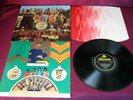
Record Cover shows some "record-ring" from storage (and high-quality Finnish cardboard, of course), EX - see photos attached.
Record Disc is pristine, NM.
(Please see my OTHER listings for more ULTRA-RARE RECORDINGS - new "wonders" added almost-daily - thanks!)
price rating