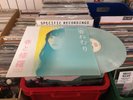
1st SELF-TITLED DEBUT - Ray Charles LP MONO Atlantic 8006 Black Label original
$
61


Favourite Auctions
To save auctions to your favourites, please login
If you don't have an account, please register
Description
LP NM
Jacket VG+ (Cut-Out Mark)
biography by Richie Unterberger Ray Charles was the musician most responsible for developing soul music. Singers like Sam Cooke and Jackie Wilson also did a great deal to pioneer the form, but Charles did even more to devise a new form of black pop by merging '50s R&B with gospel-powered vocals, adding plenty of flavor from contemporary jazz, blues, and (in the '60s) country. Then there was his singing; his style was among the most emotional and easily identifiable of any 20th century performer, up there with the likes of Elvis and Billie Holiday. He was also a superb keyboard player, arranger, and bandleader. The brilliance of his 1950s and '60s work, however, can't obscure the fact that he made few classic tracks after the mid-'60s, though he recorded often and performed until the year before his death. Blind since the age of six (from glaucoma), Charles studied composition and learned many instruments at the St. Augustine School for the Deaf and the Blind. His parents had died by his early teens, and he worked as a musician in Florida for a while before using his savings to move to Seattle in 1947. By the late '40s, he was recording in a smooth pop/R&B style derivative of Nat "King" Cole and Charles Brown. He got his first Top Ten R&B hit with "Baby, Let Me Hold Your Hand" in 1951. Charles' first recordings came in for their fair share of criticism, as they were much milder and less original than the classics that would follow, although they're actually fairly enjoyable, showing strong hints of the skills that were to flower in a few years. In the early '50s, Charles' sound started to toughen as he toured with Lowell Fulson, went to New Orleans to work with Guitar Slim (playing piano on and arranging Slim's huge R&B hit, "The Things That I Used to Do"), and got a band together for R&B star Ruth Brown. It was at Atlantic Records that Ray Charles truly found his voice, consolidating the gains of recent years and then some with "I Got a Woman," a number-two R&B hit in 1955. This is the song most frequently singled out as his pivotal performance, on which Charles first truly let go with his unmistakable gospel-ish moan, backed by a tight, bouncy horn-driven arrangement. Throughout the '50s, Charles ran off a series of R&B hits that, although they weren't called "soul" at the time, did a lot to pave the way for soul by presenting a form of R&B that was sophisticated without sacrificing any emotional grit. "This Little Girl of Mine," "Drown in My Own Tears," "Hallelujah I Love Her So," "Lonely Avenue," and "The Right Time" were all big hits. But Charles didn't really capture the pop audience until "What'd I Say," which caught the fervor of the church with its pleading vocals, as well as the spirit of rock & roll with its classic electric piano line. It was his first Top Ten pop hit, and one of his final Atlantic singles, as he left the label at the end of the '50s for ABC. One of the chief attractions of the ABC deal for Charles was a much greater degree of artistic control of his recordings. He put it to good use on early-'60s hits like "Unchain My Heart" and "Hit the Road Jack," which solidified his pop stardom with only a modicum of polish attached to the R&B he had perfected at Atlantic. In 1962, he surprised the pop world by turning his attention to country & western music, topping the charts with the "I Can't Stop Loving You" single, and making a hugely popular album (in an era in which R&B/soul LPs rarely scored high on the charts) with Modern Sounds in Country and Western Music. Perhaps it shouldn't have been so surprising; Charles had always been eclectic, recording quite a bit of straight jazz at Atlantic, with noted jazz musicians like David "Fathead" Newman and Milt Jackson. Charles remained extremely popular through the mid-'60s, scoring big hits like "Busted," "You Are My Sunshine," "Take These Chains From My Heart," and "Crying Time," although his momentum was slowed by a 1965 bust for heroin. This led to a year-long absence from performing, but he picked up where he left off with "Let's Go Get Stoned" in 1966. Yet by this time Charles was focusing increasingly less on rock and soul, in favor of pop tunes, often with string arrangements, that seemed aimed more at the easy listening audience than anyone else. Charles' influence on the rock mainstream was as apparent as ever; Joe Cocker and Steve Winwood in particular owe a great deal of their style to him, and echoes of his phrasing can be heard more subtly in the work of greats like Van Morrison. One approaches sweeping criticism of Charles with hesitation; he was an American institution, after all, and his vocal powers barely diminished over his half-century career. The fact remains, though, that his work after the late '60s on record was very disappointing. Millions of listeners yearned for a return to the all-out soul of his 1955-1965 classics, but Charles had actually never been committed to soul above all else. Like Aretha Franklin and Elvis Presley, his focus was more upon all-around pop than many realize; his love of jazz, country, and pop standards was evident, even if his more earthy offerings were the ones that truly broke ground and will stand the test of time. He dented the charts (sometimes the country ones) occasionally, and commanded devoted international concert audiences whenever he felt like it. For good or ill, he ensured his imprint upon the American mass consciousness in the 1990s by singing several ads for Diet Pepsi. He also recorded three albums during the '90s for Warner Bros., but remained most popular as a concert draw. In 2002, he released Thanks for Bringing Love Around Again on his own Crossover imprint, and the following year began recording an album of duets featuring B.B. King, Willie Nelson, Michael McDonald, and James Taylor. After hip replacement surgery in 2003, he scheduled a tour for the following summer, but was forced to cancel an appearance in March 2004. Three months later, on June 10, 2004, Ray Charles succumbed to liver disease at his home in Beverly Hills, CA. The duets album, Genius Loves Company, was released two months after his death. The biopic Ray hit screens in the fall of 2010 and was a critical and commercial success, with the actor who portrayed Charles in the move, Jamie Foxx, winning the 2005 Academy Award for Best Actor for his role. Two more posthumous albums, Genius & Friends and Ray Sings, Basie Swings, appeared in 2005 and 2006 respectively. Charles' recordings began reappearing in various facsimile editions, reissues, re-masters, and box sets as his entire recorded legacy received the attention that befits a legendary American artist. All Lps are sight gradedNote: I Do Not Grade inner sleeves, If these are Important to you then you may e-mail me)
RECORD GRADING Based On Goldmine Grading Standards:
Near Mint (NM): A nearly perfect record. There may be one or two small inaudible defects. The record should show no obvious signs of wear. A 45 RPM or EP sleeve should have no more than the most minor defects, such as almost invisible ring wear or other sights of slight handling. An LP jacket should have no creases, folds, seam splits or any other noticeable similar defect. No cut-out holes, either.
Near Mint Minus (NM-): A record that should play mint but has a few slight visible marks. The album will have as much luster as an NM, there just may be some superficial scuffs from the sleeve or very light hairlines that shouldn't be audible. An NM- album cover subjectively fits somewhere in between VG+ and NM.
Very Good Plus (VG+): A Very Good Plus record will show some signs that it was played and otherwise handled by a previous owner who took good care of it. Record surfaces may show some slight signs of wear and may have slight scuffs or very light scratches that don t significantly affect play. Slight warps that do not affect the sound are OK. The label may have some ring wear or discoloration, but it should be barely noticeable. The center hole will not have been misshapen by repeated play. 45 Picture sleeves will have some slight wear, lightly turned-up corners, or a slight seam-split. An LP jacket may have slight signs of wear also and may be marred by a cut-out hole, indentation or corner indicating it was taken out of print and sold at a discount.
Very Good (VG): Many of the defects found in a VG+ record will be more pronounced in a VG disc. Surface noise will be evident upon playing, especially in soft passages and during a song s intro and fade, but will not overpower the music otherwise. Groove wear will start to be noticeable, as will light scratches (deep enough to feel with a fingernail) that will affect the sound. Labels may be marred by writing, or have tape or stickers (or their residue) attached. The same will be true of picture sleeves or LP covers. However, it will not have all of these problems at the same time, just two or three of them.
Good (G), Good Plus (G+): Good does not mean Bad! A record in Good or Good Plus condition can be put onto a turntable and will play though without skipping. But it will have significant surface noise and scratches and visible groove wear. A jacket or sleeve will have seam splits, especially at the bottom or on the spine. Tape, writing, ring wear or other defects will start to overwhelm the subject.
Poor (P), Fair (F): Below good. imperfections will be described.
Please check out my other items for sale. (I offer shipping discounts) I'll Be adding More Daily except for Friday and Saturday.
ALLSHIPPING PRICES ARE FINAL
additional items are 1.50 per item up to 6 within USA (if you are bidding on multiple items lots I have in one listing. you pay each shipping total added together)
Priorty shipping is available e-mail for total
Please Do A One Time payment for combined shipping on all all items won. Request a Final invoice if I have not already combined them for you
NOTE: Gatefold Lps Count as 2 Lps when shipping out of the country
SHIPPING TO CANADA Multiple LP Shipping Rates In USD
1 LP 11.50
2. Lps 13.00
3 Lps 15.00
4 Lps 17.00
5 Lps 26.00
6 Lps 29.00
Multiple Shipping Rates SHIPPING TO Rest Of The World Outside USA in USD
Note: Gatefold Lps Count as 2 Lps
1 LP 17.25
2 LP 20.00
3. Lps 26.50
4 Lps 30.00
5 Lps 48.00 (price jump becuse weight usually takes it to priority mail rate)
6 Lps 51.00
7 Lps 54.00
8 LPs 58.00
9 Lps 61.00
10 Lps 64.00
11 Lps 67.00
12 Lps 70.00
The MAN has to get his cut so Texas residents must add 8.25 % Sales Tax
If you are unsure about shipping costs please do not hesitate to e-mail me.
QUESTIONS:? Please ask. That is what I am here for. (I may not get to them if you wait close to an item's ending.)
MORE PICTURES? Just ask and I'll send them to you
MEDIA MAIL: is not recommended for rare items. Priority mail is faster and safer.
I leave feedback after item arrives and it is left for me. (It's easier to keep up with that way) Please limit your feedback comments to things within the realm of my responsibility.
Thank you for reading all of this :-)
price rating