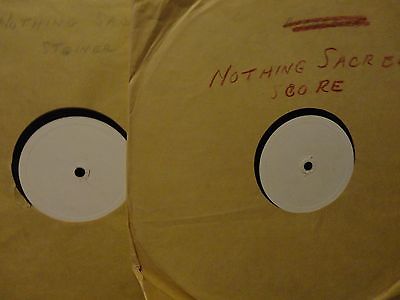
2 ACETATES MAX STEINER / NOTHING SACRED Score & Main title Production Acetates
$
50


Favourite Auctions
To save auctions to your favourites, please login
If you don't have an account, please register
Description
<div style="text-align:center"><img src="http://ti2.auctiva.com/sw/java.gif" border="0"><br><table align="center"><tr><td height="28px" valign="middle" align="center"><font face="arial" size="2"><b><a href="http://store.auctiva.com/pocketfullofmiracles">pocketfullofmiracles store</a></b></font></td><td><a style="text-decoration:none" href="http://store.auctiva.com/pocketfullofmiracles"><img src="http://ti2.auctiva.com/sw/thumbgallery.gif" border="0"></a></td></tr></table></div>
2 PRODUCTION ACETATES FOR 1937 FILM SELZNICK INTERNATONAL PICTURES NOTHING SACRED Score & Main title MAX STEINER
Dead wax: Prod 104 Nothing Sacred Score S52 S53 S54 wax no. 104-16 Dead wax: Prod 104 Nothing Sacred score S74-S79 wax no. 104-19
BOTH DISCS ARE 1 SIDED
VINYL: plays strong VG As these are 1937 discs I I played them on my Cosley play which plays 78's.
One disc runs approx. 6 minutes. The other 8. On one disc there is about 1 minute of silence.
There are numerous different takes. Starts and stops. A bell rings I assume for people to be quiet Sometimes there is a sound like tape is being rewound. Im not sure if that even had tape then so Im not sure what it is. A voice ives the take numbers. In the back ground at various times can be heard laughing. & voices which are not miked. On the "Main title" Disc someone that sounds like the conductor ives some instructions. There is g a long quiet area that goes for about a minute then someone can be heard whistling the Main title then the Music returns. THERE IS NO DIALOG JUST THE FILM MUSIC.
Although Alfred Newman & Oscar Levant also wrote music for this film I am assuming this is Max Steiner's work because it was written on the sleeve it was in.
Nothing Sacred is a 1937 Technicolor screwball comedy film made by Selznick
International Pictures and distributed by United Artists. It was directed by William
A. Wellman and produced by David O. Selznick, from a screenplay credited to Ben
Hecht, based on a story by James H. Street. Other writers, including Ring Lardner Jr.,
Budd Schulberg, Dorothy Parker, Sidney Howard, Moss Hart, George S. Kaufman and
Robert Carson also made uncredited contributions to the screenplay.
The film stars Carole Lombard and Fredric March, with a supporting cast including
Walter Connolly, Charles Winninger, Margaret Hamilton, Hattie McDaniel, Frank Fay
and Max Rosenbloom.
The lush, Gershwinesque music score was by Oscar Levant, with additional music by
Alfred Newman and Max Steiner and a swing number by Raymond Scott's Quintette.
The film was shot in Technicolor by W. Howard Greene. In 1965, the film entered
the public domain (in the USA) due to the claimants failure to renew its copyright
registration in the 28th year after publication.
Cast[edit]
Carole Lombard Margaret Hamilton as Drugstore Lady- Carole Lombard as Hazel Flagg. This was Lombard's only Technicolor film. She stated that this film was one of her personal favorites.
- Fredric March as Wally Cook
- Charles Winninger as Dr. Enoch Downer
- Walter Connolly as Oliver Stone
- Sig Ruman as Dr. Emil Eggelhoffer (as Sig Rumann)
- Frank Fay as Master of Ceremonies
- Troy Brown as Ernest Walker
- Maxie Rosenbloom as Max Levinsky. A boxing world champion, Rosenbloom gave Lombard boxing lessons to prepare her for her fight scene with Fredric March.
- Margaret Hamilton as Warsaw, Vermont Drugstore Lady
- Hattie McDaniel as Mrs. Walker
- Olin Howland as Will Bull
- Raymond Scott as Musical Leader
According to William Wellman Jr., Janet Gaynor had originally been cast as Hazel Flagg to follow up on the success of A Star is Born (1937). However, after William Wellman Sr. met Carole Lombard, he convinced Selznick to cast her.
Production[edit]
The first screwball comedy filmed in color, Nothing Sacred also represents the first use in a color film of process effects, montage and rear screen projection. Backgrounds for the rear projection were filmed on the streets of New York. Paramount Pictures and other studios refined this technique in their subsequent color features.[3]
Ben Hecht is credited with writing the screenplay in two weeks on a train. He adapted the story "Letter to the Editor" by James H. Street which had been first been published in Hearst's International-Cosmopolitan.[4] Hecht wrote a role for his friend John Barrymore in the film, but David Selznick refused to use him as Barrymore had become by then an incurable alcoholic. This caused a rift between Hecht and Selznick, and Hecht walked off the picture.[3] Budd Schulberg and Dorothy Parker were called in to write the final scenes and several others also made contributions to the screenplay, including: David O. Selznick, William Wellman, Sidney Howard, Moss Hart, George S. Kaufman and Robert Carson.
One of the reasons why this is considered one of the most celebrated screwball comedies is that underneath the humor is some of the most cynical and serious themes of corruption and dishonesty. This film, as well as The Front Page and subsequent His Girl Friday shows the extent some newspapers went to get a story.
This film (along with Selznick's A Star Is Born), despite being in the public domain, was released on DVD in 2011 by Kino Classics in transfers made from 35mm nitrate Technicolor prints preserved by the George Eastman House Motion Picture Department and authorized by the estate of David O. Selznick. Prior to this, most home video releases of both films had rather poor quality color. The Museum of Modern Art has partially restored both films to their Technicolor splendor. In 1999, Walt Disney Pictures (on behalf of ABC, holder of most of the Selznick library) had fully restored the film, but this full restoration has yet to be released on DVD or Blu-ray. Since Disney/ABC performed a full restoration, it is far superior to what has been released on home video, including the release by Kino Classics.[5]
OF COURSE I COMBINE AUCTIONS FOR THE CHEAPEST POSSIBLE SHIPPING
IN THE USA SHIPPING ON THE SECOND & USUALLY THE 3RD LP IS FREE OR VERY LITTLE MORE
NM (Near Mint): Record and cover appear virtually unmarked.
VG++: A hair under near mint may have just a very few visual marks that should not affect sound.
VG+ : Used but not abused. Will have some relatively slight audible imperfections.
VG : Many only surface lines or may a small scratch that doesn't skip .Background sound but still very enjoyable.
Cover defects will be noted.
VG-: significant background sound from various defects but music always quite audible above it.
Cover has some damage that will be noted.
100% ACCURACY IN GRADING RECORDS IS A JOB FOR SUPERMAN!
At times defects will show up differently on different players. For instance,
depending on the weight that a tone arm is set at or the quality of the stylus
what is just a pop on one player can sometimes be a skip on another
SO IF YOU HAVE A PROBLEM, BEFORE RATING ME ,
Because although I may not be Superman, I'm certainly not Lex Luther.
price rating


![[MINT] Phantom Thread Vinyl 2x LP Soundtrack Score by Jonny Greenwood 2018](https://www.popsike.mobi/php/thumbnail.php?url=https://www.popsike.pics/pix/20250316/267191393333.jpg)