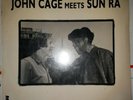
25-YEAR RETROSPECTIVE CONCERT OF THE MUSIC OF JOHN CAGE 3 LP BOX SET + BOOKLET
$
86


Favourite Auctions
To save auctions to your favourites, please login
If you don't have an account, please register
Description
Records (3), box cover, and booklet with extensive notes and sheet music are all in near mint condition. Box has very little wear, except for a little yellowing with age. Records (3) appear unplayed and look new. Booklet and sheet music also look untouched, they are somewhat yellowed with age, but otherwise undisturbed.
This three-record set documents the concert held in the town hall of New York City on May 15, 1958, where 25 years' worth of John Cage's compositions were performed, the largest such event at that point in his career. Presented chronologically, the works increasingly tested the patience of the audience, eventually prompting audible protests. Following the "conventionally" modernist "Six Short Inventions for Seven Instruments," listeners hear the delightful "First Construction in Metal," a percussion-driven piece from 1939 that bridges Edgar Varese with the composer's fascination with Balinese gamelan music, which would achieve sublime form in his compositions for prepared piano several years hence. Though almost 20 years old at the time of the concert, the amazing "Imaginary Landscape No. 1," with its high-frequency recordings, struck and stroked cymbals, and piano, must have sorely tested even the most benevolently inclined audience in 1958, but those at town hall appear to have greeted it warmly, if somewhat tentatively. The second disc is given over to a performance by Maro Ajemian of ten of the sonatas and interludes for prepared piano. If these works have been given superior interpretations in the intervening years (especially by John Tilbury and Joshua Pierce), their loveliness is still quite apparent here. Disc three begins attractively enough, with David Tudor's reading of "Music for Carillon No. 1" sent rippling through the theater. But with Cage's groundbreaking "Williams Mix," things take a more raucous turn and the audience, baffled and perturbed, reacts angrily and noisily. Realized by Cage, Earle Brown, and Tudor on magnetic tape and eight loudspeakers, the piece, heard more than four decades on, sounds incredibly prescient (it could still easily pass as "avant-garde" at most performance spaces), but even then one could hear some affinities with the work of composers as popular as Carl Stalling. But the boos and catcalls are clearly heard amidst the applause. The final work on the program was "Concert for Piano and Orchestra," completed that very year, and here the audience declines to wait until its conclusion to vent its annoyance. About 18 minutes into the 26-minute piece, prolonged (and sarcastic) applause breaks out in an attempt to stifle the goings on. One can easily imagine that Cage, at least in retrospect, would appreciate this intrusion of the "real world." In any case, this set is a must-have for any fan of the composer, not only capturing a historic occasion in his career, but also affording some fine performances of a number of his key works. Highly recommended.
A1 Six Short Inventions for Seven Instruments 5:24 A2 Construction in Metal 9:06 A3 Imaginary Landscape No. 1 9:00 B1 The Wonderful Widow of Eighteen Springs 2:33 B2 She Is Asleep: Quartet for Twelve Tom Toms 5:01 B3 She Is Asleep: Duo 8:09 C1 Sonatas and Interludes: Sonata I 2:50 C2 Sonatas and Interludes: Sonata II 2:19 C3 Sonatas and Interludes: Sonata III 2:53 C4 Sonatas and Interludes: Sonata IV 2:56 C5 Sonatas and Interludes: First Interlude 3:29 D1 Sonatas and Interludes: Sonata V 1:28 D2 Sonatas and Interludes: Sonata VI 2:11 D3 Sonatas and Interludes: Sonata VII 2:25 D4 Sonatas and Interludes: Sonata VIII 2:52 D5 Sonatas and Interludes: Second Interlude 5:07 E1 Music for Carillon 4:46 E2 Williams Mix 5:43 F Concert for Piano and Orchestra 26:26The most influential and controversial American experimental composer of the 20th century, John Cage was the father of indeterminism, a Zen-inspired aesthetic which expelled all notions of choice from the creative process. Rejecting the most deeply held compositional principles of the past -- logical consequence, vertical sensitivity, and tonality among them -- Cage created a groundbreaking alternative to the serialist method, deconstructing traditions established hundreds and even thousands of years earlier; the end result was a radical new artistic approach which impacted all of the music composed in its wake, forever altering not only the ways in which sounds are created but also how they're absorbed by audiences. Indeed, it's often been suggested that he did to music what Karl Marx did to government -- he leveled it.
Cage was born in Los Angeles on September 5, 1912, the son of an inventor who posited an explanation of the cosmos called the "Electrostatic Field Theory." Later attending Pomona College, he exited prior to graduation to travel across Europe during the early '30s; upon returning to the U.S., he studied in New York with Henry Cowell, finally traveling back to the West Coast in 1934 to study under Arnold Schoenburg. Around this time Cage published his earliest compositions, a series of Varèse-inspired works written in a rigorous atonal system of his own device. Relocating to Seattle in 1937 to become a dance accompanist, a year later he founded a percussion ensemble, composing the seminal polyrhythms piece First Construction (In Metal) in 1939.
During the late '30s, Cage also began experimenting with musique concrète, composing the landmark Imaginary Landscape No. 1, which employed variable-speed phonographs and frequency tone recordings alongside muted piano and a large Chinese cymbal. He also invented the "prepared piano," in which he placed a variety of household objects between the strings of a grand piano to create sounds suggesting a one-man percussion orchestra. It was at this time that Cage fell under the sway of Eastern philosophies, the influence of Zen Buddhism informing the random compositional techniques of his later work; obsessed with removing forethought and choice from the creative model, he set out to make music in line with the principles of the I Ching, predictable only by its very unpredictability.
Cage's work of the 1940s took a variety of shapes: where 1941's Imaginary Landscape No. 2 was a score for percussion which included a giant metal coil amplified by a phonograph cartridge, 1942's Williams Mix was a montage of over 500 prerecorded sounds, and 1944's The Perilous Night was an emotional piece written for a heavily muted prepared piano. The latter was composed for the Merce Cunningham Dance Company, for which Cage served as musical director from 1943 onward; his collaborations with Cunnigham revolutionized modern dance composition and choreography, with the indeterminacy concept extending into these works as well. By the end of the decade Cage's innovations were widely recognized, and in 1949 he was honored with a Guggenheim Fellowship and an award from the National Academy of Arts and Letters.
Cage's most visionary work, however, was still to come: in 1951, he completed Imaginary Landscape No. 4, which limited its sound sources to only a dozen radios, with the end result dependent entirely on the broadcast material at the time of performance. That same year, he collaborated with a group of performers and engineers to mount the Music on Magnetic Tape project. Next, in 1952, pianist and longtime associate David Tudor premiered Cage's 4'33", known colloquially as "Silence"; the composer's most notorious work, it asks the performer to sit at his instrument but play nothing, the environmental sounds instead produced by a typically uncomfortable audience. Concurrently, he delved into theatrical performance (a 1952 performance at Black Mountain College widely regarded as the first "happening") and electronics (Imaginary Landscape No. 5, composed for randomly mixed recordings).
In the wake of 1958's watershed Concert for Piano and Orchestra -- a virtual catalog of indeterminate notations -- Cage continued to immerse himself in electronics as the years went by, most famously in works like 1960's Cartridge Music, for which he amplified small household sounds for live performance, as well as 1969's HPSCHD, which combined harpsichord, tapes, and the like. He also turned to writing, publishing his first book, Silence, in 1961, additionally teaching and lecturing across the globe. Elected to the Institute of the American Academy and Institute of Arts and Letters in 1968, he also received an honorary Doctorate of Performing Arts from the California Institutes of the Arts in 1986. Cage died in New York on August 12, 1992.
price rating




![Death Symbolic Vinyl Limited Collector's Edition White Record [Fast Shipping]](https://www.popsike.mobi/php/thumbnail.php?url=https://www.popsike.pics/pix/20180201/112789762830.jpg)