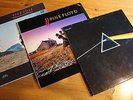
3 LP Leon Thomas Spirits Known Flying Dutchman
€
24
$
27


Favourite Auctions
To save auctions to your favourites, please login
If you don't have an account, please register
Description
Ein Wort zuvor: Gerne können Sie die LP's auch abholen. Sofern Sie aber den Versand bevorzugen, kommen zum Höchstgebot noch Euro 4 für den Versand per Hermes in einem stabilen Plattenpäckchen hinzu.
Bieten Sie bitte nicht, wenn Sie damit nicht einverstanden sind. Danke!
3 x LP's von Leon Thomas - alle auf Flying Dutchman
#1: Spirits Known And Unknown
Stereo FD-10115, im schweren Gatefold
Cover/Vinyl: vg+/ex
Leon Thomas' debut solo recording after his tenure with Pharoah Sanders is a fine one. Teaming with a cast of musicians that includes bassist Cecil McBee, flutist James Spaulding, Roy Haynes, Lonnie Liston Smith, Richard Davis, and Sanders (listed here as "Little Rock"), etc. Thomas' patented yodel is in fine shape here, displayed alongside his singular lyric style and scat singing trademark. The set begins with a shorter, more lyrical version of Thomas' signature tune "The Creator Has a Master Plan," with the lyric riding easy and smooth alongside the yodel, which bubbles up only in the refrains. It's a different story on his own "One," with Davis' piano leading the charge and Spaulding blowing through the center of the track, Thomas alternates scatting and his moaning, yodeling, howling, across the lyrics, through them under them and in spite of them. It's an intense ride and one that sets up the glorious "Echoes." This tune is Thomas at his most spiritual and uplifting, carrying the mysterious drift of his tune entwined with Spaulding's flute and a set of Pan pipes, fluttering in and out of the mix before his wail comes to the fore as a solo. The end of side one reaches into Thomas' past (he sang with everyone from Count Basie to Grant Green and Mary Lou Williams) for a highly original read of Horace Silver's classic "Song for My Father." Thomas imbues the tune with so much emotion, it's a wonder he can keep it under wraps. Side two is more free from in nature with "Damn Nam," a near rant, but one possessed with melodic vision and harmonic invention with this band. There's also the deeply moving "Malcolm's Gone," a co-write between Thomas and Sanders that features the latter's gorgeous blowing, hard and true in the middle of the mix, and a wildly spiritual Eastern vibe coming through in the improvisation. It's the longest track on the record, and one of the most criminally ignored in Thomas' long career. The album closes with Bell and Houston's "Let the Rain Fall on Me." It's a shimmering straight jazz number with a beautiful piano solo by Smith. It sends out a visionary album out on a sweet, soulful note. Ultimately, this is among Thomas' finest moments on vinyl, proving his versatility and accessibility to an audience who, for too long already, had associated him too closely with the avant-garde and free jazz.
#2: Blues And The Soulful Truth
Stereo FD 10155, schweres Gatefold
Cover/Vinyl: m-/m-
The late Leon Thomas was a vocalist who has proven to be influential among jazz and blues saxophonists, guitarists, and pianists, who've admitted their debt to his innovation. However, though there are many jazz and blues vocalists who have benefited from his style as well, he is seldom acknowledged for his highly original -- and idiosyncratic -- contribution to them. One can only speculate as to why, though Thomas' full-throated style which employed everything from yodels and Joe Turner-ish growls and shouts may have been too wide for anyone to grasp in its entirety without overtly sounding as if they were aping him. At the time of this reissue (2001), the only other Leon Thomas titles available under his own leadership were a European best-of collection and the inferior live album (badly edited), Sunrise on Gold Mountain. Blues and the Soulful Truth is among the artist's most enduring performances, either as a leader or sideman. There is his trademark, otherworldly modal improvisation on Gabor Szabo's exotica classic "Gypsy Queen," the deep, greasy gutbucket, funky blues of "Let's Go Down to Lucy" and "L-O-V-E," and the traditional tune "C.C. Rider" -- though Thomas' arrangement is anything but -- among a lengthy, eight-song set. Perhaps the most revealing examples of his singularity is his ability to interpret a song like John Lee Hooker's "Boom, Boom" as funky, jazzed-out, angular R&B -- enabled mightily by the saxophone stylings of Pee Wee Ellis and the criminally under-appreciated pianism of Neal Creque and the wild violin of John Blair -- after coming out of a pop-oriented soul tune such as "Love Each Other," written with a groove prevalent among commercial jazz and R&B recordings of the time, both sounding sincere, authentic, and completely full of the singer's presence. Indeed, on the aforementioned "Gypsy Queen" or his own "Shape Your Mind to Die," Thomas inhabits his material fully, as if nobody ever had ever sung or heard these songs and would ever sing them again. Also, the production innovation and percussive touches many of these tunes have yet to be repeated (Pharoah Sanders, Thomas' previous employer who introduced the singer to the world, adopted some of the artist's percussive techniques permanently), like the firecrackers raining against Airto Moreira's drums and Larry Coryell's ethereal guitar riffs, or the use of a "prepared" vibraphone and coat hangers in "China Doll," as they slip against the singer's wail and moan, and the elegant stick and brushwork of Bernard "Pretty" Purdie. In sum, Blues and the Soulful Truth (Which does echo Oliver Nelson's Blues and the Abstract Truth in vision as well as title), is a tour through the depth and dimension of Thomas' mind-blowing abilities as a singer in a wide range of African American musical traditions, proving at the time, and now again, that he was far more than a free jazz singer. Indeed, the artist not only was a stylist of originality, but a composer, arranger, ethnomusicologist, and a singer of startling beauty and power -- no matter the song. This album is a singular achievement, even among the fine recordings in Thomas' own catalogue, and should be considered first by those curious enough to look into his work -- you won't be disappointed no matter what you find, but this one will take you places you never anticipated going.
#3: Facets. The Legend Of Leon Thomas. An Anthology
Stereo FD 10164
Cover/Vinyl: m-/m-
Easy Walker is a fairly standard but highly enjoyable small-group soul-jazz session from Stanley Turrentine. Backed by a rhythm section of pianist McCoy Tyner, drummer Mickey Roker, and bassist Bob Cranshaw, Turrentine turns in a number of rich, round, and full-bodied leads which are perfectly complemented by Tyner's strutting, sympathetic piano. Largely divided between midtempo grooves and slow blues, with a couple of pop covers like "What the World Needs Now Is Love," thrown in, Easy Walker doesn't offer much challenging material, but it does let the musicians work a good groove, and occasionally showcase their improvisational skills, making it a good, relaxing soul-jazz session. The 1997 CD reissue features four bonus tracks which were recorded with drummer Billy Cobham and bassist Gene Taylor, along with Tyner; the highlight of these is a breezy version of Antonio Carlos Jobim's "Wave."
Biograhpy
Leon Thomas (who changed his name to Leone in 1974) made his mark in 1969, singing "The Creator Has a Master Plan" with Pharoah Sanders and showing that even avant-garde jazz can become popular under some circumstances. A fairly conventional singer, the most unusual aspect to Thomas was that he often broke out into yodelling in the middle of a vocal, a device since utilized occasionally by James Moody. Thomas, whose early associates included Grant Green, Jimmy Forrest, and Hank Crawford, studied music for two years at Tennessee State University. He moved to New York in 1958, toured with a show sponsored by the Apollo Theater, had two largely unrecorded stints with Count Basie (1961 and 1964-1965), and performed with such jazz artists as Mary Lou Williams, Randy Weston, Rahsaan Roland Kirk, and later on Oliver Nelson. After recording "The Creator Has a Master Plan" in 1969 (once under his own name, with the better-known version being on Sanders' Karma), Thomas seemed on the verge of stardom. However, his career faltered and he remained an underground figure. As a leader, Leon Thomas recorded for Flying Dutchman, Blues Time, Mega, the Italian Palcoscenico label (in 1979 with Freddie Hubbard's group); as the leader of a blues-oriented band for Portrait (1988); and for Mapleshade. He also appeared as a sideman in many situations, including on a Louis Armstrong 1970 record and with Carlos Santana (who he worked with in 1971). Thomas died of heart failure on May 8, 1999.
Non-EU bidders could pay with Paypal.
Deutschland und EU: Ueberweisung möglich.
Shipping fee:
EU = 6 EURO
World = 12 Euro
Viele weitere LP's, CD's, Bücher usw. in meinen anderen Auktionen! Jazz, Avantgarde, Garage, Freakbeat, Rock, Voodoo Rhythm, Fuzz, Yé Yé, Punk, Wergo, Elektra Nonesuch, Blue Note usw.
Schönen Dank für Ihr Interesse und viel Vergnügen beim Bieten!
Das hier ist ein Privatverkauf. Mit der Abgabe eines Gebotes erklären Sie sich ausdrücklich damit einverstanden, auf die ihnen gesetzlich zustehende Garantie/Gewährleistung bei Gebrauchtwaren zu verzichten. Keine Rücknahme des Artikels. Bieten Sie bitte nicht, wenn Sie mit dieser Regel nicht einverstanden sind.
price rating