6.5" 78 rpm THEARLE RAINBO RECORD CO PRIVATE DISC TRANSCRIPTION ARMED SERVICES
$
25


Favourite Auctions
To save auctions to your favourites, please login
If you don't have an account, please register
Description
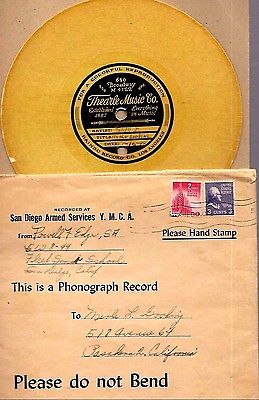
6.5" 78 rpm THEARLE RAINBO RECORD CO., LOS ANGELES, PRIVATE RECORDING DISC TRANSCRIPTION
MUSTARD GOLD RECORDING DISC COMES IN ORIGINAL SAN DIEGO ARMED SERVICES YMCA ENVELOPE WITH TWO VINTAGE STAMPS TOTALING 5 CENTS.
RECORDED: 1/16/1949, ONE SIDE SAYS "TO THE HOODING??? not sure of the word" HAS DATE AND "SIDE 1" FLIP SIDE SAYS "SIDE II".
LENGTH: UNKNOWN
THIS IS SOLD AS-IS, AS I DO NOT HAVE THE CORRECT EQUIPMENT TO PLAY THIS ODD PRIVATE RECORDING. THIS IS SOLD AS AN ODDITY FOR ITS FRAMING VALUE. IT MAY NOT PLAY WELL OR EVEN AT ALL. I HAVE NO IDEA WHAT THE SOURCE OF THE RECORDING IS, BUT IT WAS RECORDED AT THE SAN DIEGO ARMED SERVICES YMCA. IT WAS SENT FROM FLEET SONAR SCHOOL AND THE PERSONAL DETAILS ARE ON THE ENVELOPE. THE DISC ON SIDE 1 HAS A CHIP ON THE EDGE MAYBE GOING IN NO MORE THAN ONE OR TWO GROOVES. WHEN YOU ANGLE THE DISC IN THE LIGHT THE DISC HAS A SHELLACKED LOOK WITH LINES CRISSCROSSING THE NORMAL GROOVES. THE GROOVES LOOK LIKE THEY MIGHT PLAY, BUT THEY REQUIRE ANTIQUE OBSOLETE EQUIPMENT. IT IS MY UNDERSTANDING THESE SHOULD NOT BE PLAYED ON A STANDARD TURNTABLE, AS IT MAY DAMAGE IT. I AM CALLING THEM ACETATES OR TRANSCRIPTIONS, BUT I AM NOT SURE IF THAT IS THE CORRECT TERMINOLOGY FOR THESE ODD RECORDS.
SEE MORE ABOUT ACETATES BELOW
These discs are one of the most fragile formats and most at-risk of being lost due to deterioration, poor storage or mishandling. Transcription discs should be nearly, if not the top priority for preservation in many collections. If you have any of these discs in your archive or personal audio collection, you should be thinking about transfering them as they are highly unstable and fragile.
Electric transcription discs can also be referred to as
Transcription discs (for short)
ET discs (for short)
Lacquer discs
Instantaneous discs
Nitrocellulose discs
Cellulose nitrate discs
Acetate discs (a misnomer)
In general, we will refer to these discs as "transcription discs" or "lacquer discs" below. Anything which is particularly important will be highlighted in orange - you can read just the orange text to get a quick and basic understanding.
Transcription discs blanks were manufactured under some of the following brand names (not an exhaustive list):
audiodisc (Audio Devices)
Duodisc
Federal Perma-Disk or Perma Disk
Howard Recording Disc
Melodisc
National Hollywood Recording Disc
Philco
Presto
RCA De Luxe Recording Disc
Recordio
Recordisc
Silvertone
Soundcraft
Tempo-Tone
Tru-Test Recording
Victor Home Recording Record Blank
Voxite
Wilcox-Gay
ACETATES An acetate disc, also known as a test acetate, (a term from Jamaican reggae culture, now also applied to individually recorded discs of solid plastic), lacquer (a technically correct term preferred by engineers in the recording industry), transcription disc (a special recording intended for, or made from, a radio broadcast) or instantaneous disc (because it can be played immediately after recording without any further processing), is a type of gramophone record, a mechanical sound storage medium, widely used from the 1930s to the late 1950s for recording and broadcast purposes and still in limited use today. Unlike ordinary vinyl records, which are quickly formed from lumps of plastic by a mass-production molding process, a so called acetate disc is created by using a recording lathe to cut a sound-modulated groove into the surface of a special lacquer-coated blank disc, a real-time operation requiring expensive, delicate equipment and expert skill for good results. They are made for special purposes, almost never for sale to the general public. They can be played on any normal phonograph but will be degraded by wear much more quickly than vinyl. Some acetates are highly prized for their rarity, especially when they contain unpublished material. Acetates are typically produced by dubbing from a master tape recording. By electroplating the acetate master, stampers (special moulds) can be created, which in turn are used to press large quantities of regular vinyl records. Acetates are also used for testing the quality of the tape-to-disc transfer. Historically, they were also a favored medium for use in comparing different takes or mixes, and for getting preview copies of impending new releases into the hands of important disc jockeys.
price rating