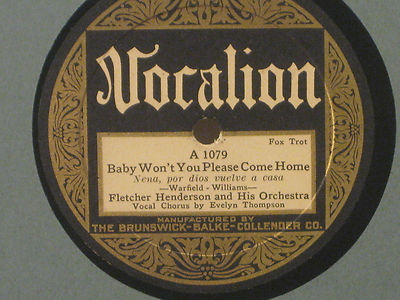
78 rpm race record 1920's Jazz Fletcher Henderson & His Orchestra Vocalian 1079
$
224


Favourite Auctions
To save auctions to your favourites, please login
If you don't have an account, please register
Description
Great 1920's Jazz record for the early Jazz Collector. Fletcher Henderson and His Orchestra on Vocalian #1079 - It is listed in the Race record Category - Some of These Days and Baby Won't You Please Come Home. Recorded in 1927 - a golden age of Jazz. The redhotjazz website had this to say about Fletcher Henderson -
" Fletcher Henderson led the most commercially successful of the African-American Jazz bands of the 1920s. The smooth sound of his orchestra gave birth to the Swing style of the next decade. Henderson was from a middle class family and held a degree in chemistry from Atlanta University. He moved to New York in 1920 intending to do post-graduate work there while working as a chemist, but he found that jobs were closed to him because of his race. He instead found work demonstrating sheet music for W.C. Handy's music publishing company. He left that company to become a manager at the Black Swan Recording Company, and organized a band to support Blues singer Ethel Waters. In 1922, Fletcher led a band at the Club Alabam, which later moved to the Roseland Ballroom (Broadway at 50th St.) where they stayed for the next ten years. Coleman Hawkins played saxophone in the band and is generally considered to be the first great saxophonist in Jazz. In 1924 he hired the up-and-coming trumpet player Louis Armstrong importing him from Chicago, where he had been playing with King Oliver's Creole Jazz Band. TheOrchestra continued to tour and record until 1939 when it disbanded, and he joinedBenny Goodman Orchestra as the pianist and arranger. This was the first time that a "White" band hired a "Black" musician to appear on stage with an orchestra.Goodman even used the same arrangements as the Fletcher Henderson Orchestrahad used. The band went on to become one of the most popular of the Swing bands. In 1943 Henderson left Goodman's band until 1947, when he rejoined Goodman them as an arranger. He toured as an accompanist for Ethel Waters in 1948 and 1949. In 1950 he suffered a stroke and was never able to play again. "
Condition - this breaks my heart a little bit - this record would be Excellent + or better if it weren't for one thing. It looks like someone played this record with the incorrect needle, but only on the outer margin. It looks like a big arc scratch just on the outer margin for about half the circumference of the record on both sides. On side A it barely got into the first groove, and on side B it stayed entirely in the margin. It might affect playability for the first second of Baby Won't You Please Come Home - It shouldn't affect playability at all on the other side. Other that that this record is immaculate - labels are pristine - very few rubs anywhere else on the record. Becuase of this I am still grading this record at VG+.
Condition grading rubric follows:
M :As new and unplayed (there are virtually no 78s that can categorically be claimed to be unplayed).
NM- : Nearly Mint, but has been played. No visible signs of wear or damage.
E+: Plays like new, with very, very few signs of handling, such as tiny scuffs from being slipped in and out of jackets.
E : Still very shiny, near new looking, with no visible signs of wear, but a few inaudible scuffs and scratches.
E- : Still shiny but without the luster of a new record, few light scratches.
VG+ : is an average condition 78 in which scuffs and general use has dulled the finish somewhat. Wear is moderate but playing is generally free from distortion. Surface noise not overly pronounced.
VG : Moderate, even wear throughout, but still very playable. Surface noise and scratches audible but not intrusive.
VG- : Quite playable still, but distortion and heavy greying in loud passages. Music remains loud in most passages. Surface noise and scratches well below music level.
price rating