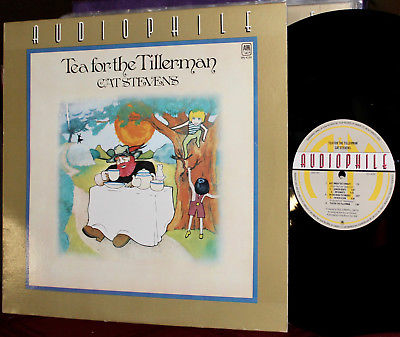
A&M AUDIOPHILE LP SPJ-4280: CAT STEVENS - Tea For The Tillerman - 1980 1/2-Speed
C$
60
$
43


C$ 60
Sold For
Feb 1, 2018
Sold Date
Oct 18, 2017
Start Date
C$ 100
Start price
1
Number Of Bids
Canada
Country Of Seller
eBay
Sold at
Favourite Auctions
To save auctions to your favourites, please login
If you don't have an account, please register
Description
****Welcome to our listing, thanks very much for looking!
****See our own website! We have lots of out of print LPs and CDs! You can find us on the world wide web at -
hearthedifference.net
****Shipping cost is only an estimate - it depends on the actual weight and size of the package as well as the service required. We do not profit from shipping costs, so if we overcharge, we will refund the difference back to you. It's always best to wait for our invoice before paying for your item.
****Please see our other listings for more great LPs and CDs - new items added daily!****To access our eBay store either click on the little red door at the top right section of any of our eBay listings or, click on -
http://stores.ebay.com/Hear-The-Difference
Background -
A&M Records was an American record label founded as an independent label by Herb Alpert and Jerry Moss in 1962. Due to the success of the discography A&M released, the label garnered interest and was eventually acquired by PolyGram in 1989 and began distributing releases from Polydor Ltd. from the UK. Throughout its operations, A&M housed well-known acts such as Procol Harum, Sting, Supertramp, Bryan Adams, Burt Bacharach, the Carpenters, Janet Jackson, Cat Stevens, Peter Frampton, Carole King, Styx, Joan Baez, The Police, Soundgarden and Sheryl Crow.PolyGram was acquired by Seagram and dissolved into Universal Music Group in 1998, and A&M's operations were ceased in January 1999 when it was merged with Geffen Records and Interscope Records to form the record company Interscope Geffen A&M Records. In 2007, Interscope Geffen A&M announced that A&M was revived as trademark and brand and was to be merged with Octone Records to form A&M Octone Records, which operated until 2013, when A&M Octone was folded into Interscope. Today, A&M's catalog releases are managed by Verve Records, Universal Music Enterprises and Interscope.
A&M Records was started in 1962 by partners Herb Alpert and Jerry Moss. Their first release (following two singles released under the label name Carnival Records) was "The Lonely Bull" by Herb Alpert & The Tijuana Brass, which sold around 700,000 copies. Sixteen of the first 25 albums were certified gold by the RIAA and helped A&M become a major label and ultimately the world's largest independent record company.
In Canada, A&M records started their own line of half speed mastered audiophile records, and had them pressed by JVC in Japan using their proprietary “Super Vinyl.” Many of these titles, by artists such as Supertramp, Styx, the Carpenters, and The Police, were widely available for sale in the United States. While these records looked a lot like those from Mobile Fidelity and used a similar half speed mastering process, the tapes used to make these audiophile records were at least one generation down in the duplication chain from those used to produce Mobile Fidelity records, resulting in a product with a quiet playing surface but sometimes spotty sound.
According to A&M; “The Audiophile process produces a superb master from which this record is manufactured on the purest possible anti-static vinyl. The cutting of the master from the original stereo tapes is performed at half the normal speed, the velocity of the cutting stylus being dramatically reduced results in a more faithful cutting of heavily modulated passages and the general extension of the frequency range. A&M Records’ Audiophile Series provides extremely high fidelity sound reproduction, remarkable clear and distinct, virtually free of surface and background noise."
Yusuf Islam (born Steven Demetre Georgiou, 21 July 1948), commonly known by his former stage name Cat Stevens, is a British singer-songwriter and multi-instrumentalist. His 1967 debut album reached the top 10 in the UK, and the album's title song "Matthew and Son" charted at number 2 on the UK Singles Chart. His albums Tea For The Tillerman (1970) and Teaser and the Firecat (1971) were both certified triple platinum in the US by the RIAA. His musical style consists of folk, pop, rock, and Islamic music.
His 1972 album Catch Bull at Four spent three weeks at number one on the Billboard 200, and 15 weeks at number one in the Australian ARIA Charts. He earned two ASCAP songwriting awards in 2005 and 2006 for "The First Cut Is The Deepest", and the song has been a hit for four different artists. His other hit songs include "Father and Son", "Wild World", "Peace Train", "Moonshadow", and "Morning Has Broken". In 2007 he received the British Academy's Ivor Novello Award for Outstanding Song Collection.
In December 1977, Stevens converted to Islam, and he adopted the name Yusuf Islam the following year. In 1979, he auctioned all his guitars for charity and left his music career to devote himself to educational and philanthropic causes in the Muslim community. He was embroiled in a long-running controversy regarding comments he made in 1989 about the death fatwa on author Salman Rushdie. He has received two honorary doctorates and awards for promoting peace from two organisations founded by Mikhail Gorbachev.
In 2006, he returned to pop music – releasing his first album of new pop songs in 28 years, titled An Other Cup. With that release and subsequent ones, he dropped the surname "Islam" from the album cover art – using the stage name Yusuf as a mononym. In 2009, he released the album Roadsinger, and in 2014, he released the album Tell 'Em I'm Gone, and began his first US tour since 1978. He was inducted into the Rock and Roll Hall of Fame in 2014. His second North American tour since his resurgence, featuring 12 shows in intimate venues, began on 12 September 2016."
Tea for the Tillerman is the fourth studio album by the singer-songwriter Cat Stevens. This album, Stevens' second during 1970, includes many of Stevens' best-known songs including "Where Do the Children Play?", "Hard Headed Woman", "Wild World", "Sad Lisa", "Into White", and "Father and Son". Four of the tracks ("Where Do the Children Play?", "On the Road to Find Out", "Tea for the Tillerman", and "Miles from Nowhere") were featured in the Hal Ashby and Colin Higgins's black comedy film Harold and Maude, in 1971. The track "But I Might Die Tonight" was featured in the film Deep End directed by Jerzy Skolimowski in 1970. Stevens, a former art student, created the artwork featured on the record's cover. "Tea for the Tillerman" was also used over the end credits for the BBC TV show Extras. "Miles From Nowhere" also appeared in the A-Team episode, "Alive at Five" while Templeton Peck is running away.
With "Wild World" as an advance single, this was the album that brought Stevens worldwide fame. The album itself charted into the top 10 in the United States, where he had previously had few listeners.
In a contemporary review for The Village Voice, music critic Robert Christgau gave the album a "B–" and found the music monotonous and lacking the "dry delicacy" Stevens exhibited on Mona Bone Jakon (1970). Rolling Stone magazine's Ben Gerson said that Stevens' songs effortlessly resonate beyond their artfully simple lyrics and hooks, despite his occasional overuse of dynamics "for dramatic effect."
In a retrospective five-star review, AllMusic's William Ruhlmann praised Stevens' themes of spirituality and transcendence, and felt that he had continued to show his ability as a pop melodicist: "As a result, Tea for the Tillerman became a big seller and, for the second time in four years, its creator became a pop star." On 18 November 2003, Rolling Stone included this album in its 500 Greatest Albums of All Time list at number 206. In 2006, the album was included in the book 1001 Albums You Must Hear Before You Die. In 2007, the album was included in the list of "The Definitive 200 Albums of All Time", released by The National Association of Recording Merchandisers and the Rock and Roll Hall of Fame.
Is it on the roads of Provence or the tube to Portobello Road that I visualize Cat? He is both the next in a long line of troubadours and very much the London neighborhood musician, encompassing at once the allure of the exotic and the ability to domesticate it. He wanders, but he returns home.
"Miles From Nowhere," "Wild World," "On the Road to Find Out," "Father and Son" are songs of leaving — travel through time and space. Every song is an excursion into Cat's personal world; together they constitute an album affirming the simple life and the individual's search for values. All of this is a far cry, although only a causal link away, from Cat Stevens, "pop star" (listen to the song of the same title on his lovely Mona Bone Jakon), subsequently a refugee from the glittering life, and later still, the TB ward.
Cat's melodies and lyrics are disarmingly, deceptively simple. He seems to fasten without effort onto tunes with a life of their own, tunes of small beginnings and wide resonances. He applies to them a furry voice with a kind of glottal buzz — perfect for the calypso "Longer Boats," while adding the right touch of seasoning to an ageless folk song like "Into White": "I built my house from barley rice/Green pepper walls, and water ice/tables of paper wood, windows of light/And everything emptying into White." It really must be heard.
There is an equally childlike and nursery-rhymish "On the Road to Find Out," which moves imperceptibly from fable to parable. Mixing theme and melody, I'd describe it as Dick Whittington meeting three blind mice, setting out to find London, and instead finding God. "Father and Son" is a dialogue between just that. Father, in a plea for the boy to stay, manages to reduce a complex thought to a trickle of words, "For you will still be here tomorrow but your dreams may not." To the boy, "From the moment I could talk I was ordered to listen." Cat skillfully betrays a vested interest in neither role.
Sometimes Cat places an over reliance on dynamics for dramatic effect; also, his keyboard and guitar playing seem a bit amateurish, although that in itself has a certain charm — he's just a folk singer, you know. If you've been listening to Donovan, Joni Mitchell, et al., though not necessarily these people, there's no reason you shouldn't be listening to Cat Stevens. - Ben Gerson, Rolling Stone
Mona Bone Jakon only began Cat Stevens' comeback. Seven months later, he returned with Tea for the Tillerman, an album in the same chamber-group style, employing the same musicians and producer, but with a far more confident tone. Mona Bone Jakon had been full of references to death, but Tea for the Tillerman was not about dying; it was about living in the modern world while rejecting it in favor of spiritual fulfillment. It began with a statement of purpose, "Where Do the Children Play?," in which Stevens questioned the value of technology and progress. "Wild World" found the singer being dumped by a girl, but making the novel suggestion that she should stay with him because she was incapable of handling things without him. "Sad Lisa" might have been about the same girl after she tried and failed to make her way; now, she seemed depressed to the point of psychosis. The rest of the album veered between two themes: the conflict between the young and the old, and religion as an answer to life's questions. Tea for the Tillerman was the story of a young man's search for spiritual meaning in a soulless class society he found abhorrent. He hadn't yet reached his destination, but he was confident he was going in the right direction, traveling at his own, unhurried pace. The album's rejection of contemporary life and its yearning for something more struck a chord with listeners in an era in which traditional verities had been shaken. It didn't hurt, of course, that Stevens had lost none of his ability to craft a catchy pop melody; the album may have been full of angst, but it wasn't hard to sing along to. As a result, Tea for the Tillerman became a big seller and, for the second time in four years, its creator became a pop star. - William Ruhlmann
Release date: 1980
-
A&M AUDIOPHILE Recordings LP Item - LIGHT GRAY / BEIGE record labels with primarily BLACK lettering.
-
Made in CANADA (possibly in JAPAN as many of the A&M Audiophile series were pressed in Japan, but appear to be made in Canada).
-
Pressing is in STEREO
-
Half-Speed Mastered Recordings (1/2 speed)
-
Record Catalog Number: SPJ-4280
-
This is a Half-Speed Mastered Limited Edition Audiophile.
Manufactured & distributed by A&M Records of Canada Ltd.
Originally released in 1970 on LP.
Out of print and extremely rare, this is a much sought after audiophile LP featuring the music of and performed by -
Cat Stevens
LP Title -
Tea For The Tillerman
Performing -A1. Where Do The Children Play? - 3:50
A2. Hard Headed Woman - 3:46
A3. Wild World - 3:18
A4. Sad Lisa - 3:40
A5. Miles From Nowhere - 3:32
B1. But I Might Die Tonight - 1:50
B2. Longer Boats - 3:10
B3. Into White - 3:24
B4. On The Road To Find Out - 5:07
B5. Father & Son - 3:37
B6. Tea For The Tillerman - 1:01
Performed by -
• Cat Stevens – classical guitar, acoustic guitar, keyboards, lead vocals
• Alun Davies – acoustic guitar, backing vocals
• Harvey Burns – drums, congas, tambourine
• John Ryan – double bass
• Del Newman – string arrangements
• Jack Rothstein – violin
CONDITION Details:
The LP jacket is in near mint minus condition! The jacket is tight and clean, with NO seam splits, with little to no shelf wear at the seams, spine and corners (see pics). The colors on the jacket are sharp. Considering the age of the LP, the jacket is in superb condition (see pictures with this listing as they are of the actual item).
The LP is in near mint minus condition! We found that the vinyl looked superb on this LP. There are no significant marks on the vinyl that we could see, even under strong, white light. The LP retains much of the original gloss and sheen. NO serious spindle marks either. Just beautifully made vinyl! That said, acquiring a vintage LP like this is for the performance and rarity of the LP, not necessarily for the sound quality.A Short Note About LP GRADING -
- Mint = Only used for sealed items.
- Near Mint = Virtually flawless in every way.
- Near Mint Minus = Item has some minor imperfections, some audible.
- Excellent = Item obviously played and enjoyed with some noise.
- Very Good Plus = Many more imperfections which are noticeable and obtrusive.
For best results, always thoroughly clean your LPs before playing them.
LPs can be audiophile quality pressings (any collector of fine MFSL, half speeds, direct to discs, Japanese/UK pressings etc., can attest to the difference a quality pressing can make to an audio system).
Don't let this rarity slip by!!!price rating




![The Man From U.N.C.L.E. (2015 Soundtrack) [2LP] LIMITED GREEN MARBLED 180 Gram](https://www.popsike.mobi/php/thumbnail.php?url=https://www.popsike.pics/pix/20151115/371486979468.jpg)
![The Man From U.N.C.L.E. (2015 Soundtrack) [2LP] LIMITED GREEN MARBLED 180 Gram](https://www.popsike.mobi/php/thumbnail.php?url=https://www.popsike.pics/pix/20151116/371487872245.jpg)