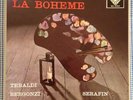
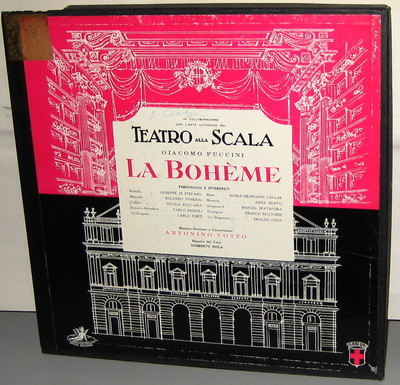
ANGEL 2-LPs 3560 B/L: Puccini - La Boheme - Callas, Di Stefano - OOP 1960s UK NM
$
125


$ 125
Sold For
Jan 8, 2013
Sold Date
Oct 10, 2012
Start Date
1
Number Of Bids
Canada
Country Of Seller
eBay
Sold at
Favourite Auctions
To save auctions to your favourites, please login
If you don't have an account, please register
Description
****Welcome to our eBay listing, thanks very much for looking!
****FREE SHIPPING to Canada and the USA - all other locations are subject to a reasonable shipping fee.
****Please check out our other eBay store listings and eBay auctions for more great LPs and CDs - new items added daily!
****To access our eBay store either click on the little red door at the top right section of any of our eBay listings or, click on -
http://stores.ebay.com/Hear-The-Difference
Background on this eBay item -
Giacomo Puccini (full name:Giacomo Antonio Domenico Michele Secondo Maria Puccini - born Lucca 22 December 1858 – died Brussels 29 November 1924) was an Italian composer whose operas are among the most frequently performed in the standard repertoire.Puccini was "the greatest composer of Italian opera after Verdi". Whilst his early work was rooted in traditional late-19th century romantic Italian opera, he successfully developed his work in the 'realistic' verismo style, of which he became one of the leading exponents.
Puccini was born in Lucca in Tuscany, into a family with five generations of musical history behind them, including the composer Domenico Puccini. His father Michele was a music teacher and an unsuccessful opera composer, who died when Giacomo was five years old. Giacomo began to study music at the age of 16 after completing his standard education.
In 1880, with the help of a relative and a grant, Puccini enrolled in the Milan Conservatory to study composition with Stefano Ronchetti-Monteviti, Amilcare Ponchielli, and Antonio Bazzini. In the same year, at the age of 21, he composed his Mass, which marks the culmination of his family's long association with church music in his native Lucca.
While studying at the Conservatory, Puccini obtained a libretto from Ferdinando Fontana and entered a competition for a one-act opera in 1882. Although it did not win, Le Villi was later staged in 1884 at the Teatro Dal Verme and it caught the attention of Giulio Ricordi, head of G. Ricordi & Co. music publishers, who commissioned a second opera, Edgar, in 1889. Edgar failed: it was a bad story and Fontana's libretto was poor. In fact Edgar nearly cost Puccini his career. Puccini had eloped with his former piano student, the married Elvira Gemignani, and Ricordi's associates were willing to turn a blind eye to his life style as long as he was successful. When Edgar failed, they suggested to Ricordi that he should drop Puccini, but Ricordi said that he would stay with him and made him an allowance from his own pocket until his next opera.
On commencing his next opera, Manon Lescaut, Puccini announced that he would write his own libretto so that "no fool of a librettist" could spoil it. Ricordi persuaded him to accept Ruggero Leoncavallo as his librettist, but Puccini soon asked Ricordi to remove him from the project. Four other librettists were then involved with the opera, as Puccini constantly changed his mind about the structure of the piece. It was almost by accident that the final two, Luigi Illica and Giuseppe Giacosa, came together to complete the opera. They remained with Puccini for his next three operas and probably his greatest successes: La bohème, Tosca and Madama Butterfly. Manon Lescaut was a great success and laid the foundations for Puccini's career and reputation.
La bohème is an opera in four acts, by Giacomo Puccini to an Italian libretto by Luigi Illica and Giuseppe Giacosa, based on Scènes de la vie de bohème by Henri Murger. The world premiere performance of La bohème was in Turin on 1 February 1896 at the Teatro Regio and conducted by the young Arturo Toscanini. Since then, La bohème has become part of the standard Italian opera repertory and is the one of the most frequently performed operas worldwide. In 1946, fifty years after the opera's premiere, Toscanini conducted a performance of it on radio with the NBC Symphony Orchestra. This performance was eventually released on records and on Compact Disc. It is the only recording of a Puccini opera by its original conductor.
According to its title page, the libretto of La bohème is based on Henri Murger's novel, Scènes de la vie de bohème, a collection of vignettes portraying young bohemians living in the Latin Quarter of Paris in the 1840s. Although usually called a novel, it has no unified plot. Like the 1849 play by Murger and Théodore Barrière, the opera's libretto focuses on the relationship between Rodolfo and Mimì, ending with her death. Also like the play, the libretto combines two characters from the novel, Mimì and Francine, into a single Mimì character.
Much of the libretto is original. The main plots of acts two and three are the librettists' invention, with only a few passing references to incidents and characters in Murger. Most of acts one and four follow the novel, piecing together episodes from various chapters. The final scenes in acts one and four —the scenes with Rodolfo and Mimì— resemble both the play and the novel. The story of their meeting closely follows chapter 18 of the novel, in which the two lovers living in the garret are not Rodolphe and Mimì at all, but rather Jacques and Francine. The story of Mimì's death in the opera draws from two different chapters in the novel, one relating Francine's death and the other relating Mimì's.
The published libretto includes a note from the librettists briefly discussing their adaptation. Without mentioning the play directly, they defend their conflation of Francine and Mimì into a single character: "Chi puo non confondere nel delicato profilo di una sola donna quelli di Mimì e di Francine?" ("Who cannot confuse in the delicate profile of one woman the personality both of Mimì and of Francine?") At the time, the novel was in the public domain, Murger having died without heirs, but rights to the play were still controlled by Barrière's heirs.
-
ANGEL records 2-LP BOXED set - RED record labels with SILVER lettering, sporting the famous Angel sitting on a record which takes up about half of the top section of each record label.
-
LPs were pressed in the UK (Great Britain / England)
-
Pressings are recorded in MONO
-
LPs were issued in the early 1960's we believe - there are no dates on the box, records or booklet indicated an actual date of manufacturing, but these are heavy, British made LPs.
-
This set comes complete with a superb multi page libretto / booklet
-
Record Catalog Number: 35360 B/L (35471, 35472)
Extremely rare, this is a near mint, UK-made, long out of print and highly desirable 2-LP BOXED set featuring the music of:
Giacomo Puccini
Music Contained in this Boxed Set / Title -
- La Boheme - Opera in 4 Acts
- Performed by -
- Maria Meneghini Callas, Mimi
- Giuseppe Di Stefano, Rodolfo
- Rolando Panerai, Marcello
- Anna Moffo, Musetta
- Nicola Zaccaria, Colline
- Manuel Spatafora, Schaunard
- Carlo Badioli, Benoit & Alcindoro
- Franco Ricciardi, Parpignol
- Orchestra and Chorus of La Scala, Milan
- Antonino Votto, conductor
- Norberto Mola, chorus master
CONDITION Details:
LP BOX:
-
The box containing the LPs is in very good condition.
-
The Box is solid and intact, with NO SPLITS! There is a bit of damage on the top seam of the front lid, near the spine (see picture). There is some minor shelf wear evident, primarily with respect to the seams and corners. Top lid is affixed to the bottom lid of the box.
-
A gorgeous and informative near mint multi-page libretto / booklet comes with this issue, making this set complete.
-
It has NO drill holes or saw marks of any kind on the jacket.
-
There is a name hand written on the front lid of the box as well as the remains of a sticker with a number written over it (see pictures for detail). Nothing has been written on the back or inside of the box.
-
The cover has clean and sharp colors - see pictures with this listing for more detail.
-
The LPs are in near MINT minus condition! - in great condition and obviously well taken care of!!
-
They retain much of the original gloss and sheen!
-
The records have no serious marks that we could see, even under strong white light. We play tested parts of the LPs and they sounded fine!
-
There are NO significant spindle marks on the record labels.
-
This is the near mint copy you have always wanted in your collection - any picky audiophile should be happy with this one! A better copy would be very difficult to locate!
-
This LP set may have a slight mark or two (spider marks) which are caused by sliding the LP in and out of the inner sleeve and are usually not audible on most audio systems (this is of course dependent on the sensitivity of your cartridge/arm combination - spider marks may sound on some systems, not on others - but this is a VERY CLEAN set) - as for any record, we recommend a proper LP cleaning before playing!
A Short Note About LP GRADING -
- Mint = Only used for sealed items.
- Near Mint = Virtually flawless in every way.
- Near Mint Minus = Item has some minor imperfections, some audible.
- Excellent = Item obviously played and enjoyed with some noise.
- Very Good Plus = Many more imperfections which are noticeable and obtrusive.