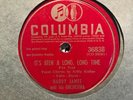
AVENGERS ENDGAME Harry James it's been a long long time 78 rpm original
$
53


Favourite Auctions
To save auctions to your favourites, please login
If you don't have an account, please register
Description
This copy grades V++ maybe even E-. VEry nice copy. I played it through with no skips or loud pops on my audiotechnica, but it does need cleaning. FREE SHIPPING
WIKIPEDIA:
The phonautograph, patented by Léon Scott in 1857, used a vibrating diaphragm and stylus to graphically record sound waves as tracings on sheets of paper, purely for visual analysis and without any intent of playing them back. In the 2000s, these tracings were first scanned by audio engineers and digitally converted into audible sound. Phonautograms of singing and speech made by Scott in 1860 were played back as sound for the first time in 2008. Along with a tuning fork tone and unintelligible snippets recorded as early as 1857, these are the earliest known recordings of sound.
In 1877, Thomas Edison invented the phonograph. Unlike the phonautograph, it could both record and reproduce sound. Despite the similarity of name, there is no documentary evidence that Edison's phonograph was based on Scott's phonautograph. Edison first tried recording sound on a wax-impregnated paper tape, with the idea of creating a "telephone repeater" analogous to the telegraph repeater he had been working on. Although the visible results made him confident that sound could be physically recorded and reproduced, his notes do not indicate that he actually reproduced sound before his first experiment in which he used tinfoil as a recording medium several months later. The tinfoil was wrapped around a grooved metal cylinder and a sound-vibrated stylus indented the tinfoil while the cylinder was rotated. The recording could be played back immediately. The Scientific American article that introduced the tinfoil phonograph to the public mentioned Marey, Rosapelly and Barlow as well as Scott as creators of devices for recording but, importantly, not reproducing sound.[13] Edison also invented variations of the phonograph that used tape and disc formats.[14][failed verification] Numerous applications for the phonograph were envisioned, but although it enjoyed a brief vogue as a startling novelty at public demonstrations, the tinfoil phonograph proved too crude to be put to any practical use. A decade later, Edison developed a greatly improved phonograph that used a hollow wax cylinder instead of a foil sheet. This proved to be both a better-sounding and far more useful and durable device. The wax phonograph cylinder created the recorded sound market at the end of the 1880s and dominated it through the early years of the 20th century.
Emile Berliner with disc record gramophoneLateral-cut disc records were developed in the United States by Emile Berliner (although Thomas Edison's original patent included flat disks), who named his system the "gramophone", distinguishing it from Edison's wax cylinder "phonograph" and American Graphophone's wax cylinder "graphophone". Berliner's earliest discs, first marketed in 1889, only in Europe, were 12.5 cm (approx 5 inches) in diameter, and were played with a small hand-propelled machine. Both the records and the machine were adequate only for use as a toy or curiosity, due to the limited sound quality. In the United States in 1894, under the Berliner Gramophone trademark, Berliner started marketing records of 7 inches diameter with somewhat more substantial entertainment value, along with somewhat more substantial gramophones to play them. Berliner's records had poor sound quality compared to wax cylinders, but his manufacturing associate Eldridge R. Johnson eventually improved it. Abandoning Berliner's "Gramophone" trademark for legal reasons, in 1901 Johnson's and Berliner's separate companies reorganized to form the Victor Talking Machine Company in Camden, New Jersey, whose products would come to dominate the market for many years.[15] Emile Berliner moved his company to Montreal in 1900. The factory, which became the Canadian branch of RCA Victor, still exists. There is a dedicated museum in Montreal for Berliner (Musée des ondes Emile Berliner).
In 1901, 10-inch disc records were introduced, followed in 1903 by 12-inch records. These could play for more than three and four minutes, respectively, whereas contemporary cylinders could only play for about two minutes. In an attempt to head off the disc advantage, Edison introduced the Amberol cylinder in 1909, with a maximum playing time of 4 1⁄2 minutes (at 160 rpm), which in turn were superseded by Blue Amberol Records, which had a playing surface made of celluloid, a plastic, which was far less fragile. Despite these improvements, during the 1910s discs decisively won this early format war, although Edison continued to produce new Blue Amberol cylinders for an ever-dwindling customer base until late in 1929. By 1919, the basic patents for the manufacture of lateral-cut disc records had expired, opening the field for countless companies to produce them. Analog disc records dominated the home entertainment market until they were outsold by digital compact discs in the 1980s, which were in turn supplanted by digital audio recordings distributed via online music stores and Internet file sharing.
78 rpm disc developments
Hungarian Pathé record, 90 to 100 rpmEarly speeds
Early disc recordings were produced in a variety of speeds ranging from 60 to 130 rpm, and a variety of sizes. As early as 1894, Emile Berliner's United States Gramophone Company was selling single-sided 7-inch discs with an advertised standard speed of "about 70 rpm".[16]
One standard audio recording handbook describes speed regulators, or governors, as being part of a wave of improvement introduced rapidly after 1897. A picture of a hand-cranked 1898 Berliner Gramophone shows a governor. It says that spring drives replaced hand drives. It notes that:
The speed regulator was furnished with an indicator that showed the speed when the machine was running so that the records, on reproduction, could be revolved at exactly the same speed...The literature does not disclose why 78 rpm was chosen for the phonograph industry, apparently this just happened to be the speed created by one of the early machines and, for no other reason continued to be used.[17]
A multinational product: an operatic duet sung by Enrico Caruso and Antonio Scotti, recorded in the US in 1906 by the Victor Talking Machine Company, manufactured c. 1908 in Hanover, Germany, for the Gramophone Company, Victor's affiliate in EnglandBy 1925, the speed of the record was becoming standardized at a nominal value of 78 rpm. However, the standard differed between places with alternating current electricity supply at 60 hertz (cycles per second, Hz) and those at 50 Hz. Where the mains supply was 60 Hz, the actual speed was 78.26 rpm: that of a 60 Hz stroboscope illuminating 92-bar calibration markings. Where it was 50 Hz, it was 77.92 rpm: that of a 50 Hz stroboscope illuminating 77-bar calibration markings.[18]
Acoustic recording
Early recordings were made entirely acoustically, the sound being collected by a horn and piped to a diaphragm, which vibrated the cutting stylus. Sensitivity and frequency range were poor, and frequency response was very irregular, giving acoustic recordings an instantly recognizable tonal quality. A singer almost had to put his or her face in the recording horn. A way of reducing resonance was to wrap the recording horn with tape.[19]
Lower-pitched orchestral instruments such as cellos and double basses were often doubled (or replaced) by louder instruments, such as tubas. Standard violins in orchestral ensembles were commonly replaced by Stroh violins, which became popular with recording studios.
Even drums, if planned and placed properly, could be effectively recorded and heard on even the earliest jazz and military band recordings. The loudest instruments such as the drums and trumpets were positioned the farthest away from the collecting horn. Lillian Hardin Armstrong, a member of King Oliver's Creole Jazz Band, which recorded at Gennett Records in 1923, remembered that at first Oliver and his young second trumpet, Louis Armstrong, stood next to each other and Oliver's horn could not be heard. "They put Louis about fifteen feet over in the corner, looking all sad."[20][21]
Electrical recording
An electronically recorded disc from Carl Lindström AG, Germany, c. 1930During the first half of the 1920s, engineers at Western Electric, as well as independent inventors such as Orlando Marsh, developed technology for capturing sound with a microphone, amplifying it with vacuum tubes, then using the amplified signal to drive an electromechanical recording head. Western Electric's innovations resulted in a broader and smoother frequency response, which produced a dramatically fuller, clearer and more natural-sounding recording. Soft or distant sounds that were previously impossible to record could now be captured. Volume was now limited only by the groove spacing on the record and the amplification of the playback device. Victor and Columbia licensed the new electrical system from Western Electric and began recording discs during the Spring of 1925. The first electrically recorded Red Seal record was Chopin's "Impromptus" and Schubert's "Litanei" performed by Alfred Cortot for Victor in Camden, New Jersey.[22]
A 1926 Wanamaker's ad in The New York Times offers records "by the latest Victor process of electrical recording".[23] It was recognized as a breakthrough; in 1930, a Times music critic stated:
... the time has come for serious musical criticism to take account of performances of great music reproduced by means of the records. To claim that the records have succeeded in exact and complete reproduction of all details of symphonic or operatic performances ... would be extravagant ... [but] the article of today is so far in advance of the old machines as hardly to admit classification under the same name. Electrical recording and reproduction have combined to retain vitality and color in recitals by proxy.[24]
Examples of Congolese 78 rpm records A 10-inch Decelith blank for making an individually cut one-off recording. A German product introduced in 1937, these flexible all-plastic discs were a European alternative to rigid-based lacquer (acetate) discs.Electrically amplified record players were initially expensive and slow to be adopted. In 1925, the Victor company introduced both the Orthophonic Victrola, an acoustical record player that was designed to play electrically recorded discs, and the electrically amplified Electrola. The acoustical Orthophonics were priced from US$95 to $300, depending on cabinetry. However the cheapest Electrola cost $650, in an era when the price of a new Ford Model T was less than $300 and clerical jobs paid around $20 a week.
The Orthophonic had an interior folded exponential horn, a sophisticated design informed by impedance-matching and transmission-line theory, and designed to provide a relatively flat frequency response. Its first public demonstration was front-page news in The New York Times, which reported:
The audience broke into applause ... John Philip Sousa [said]: '[Gentlemen], that is a band. This is the first time I have ever heard music with any soul to it produced by a mechanical talking machine' ... The new instrument is a feat of mathematics and physics. It is not the result of innumerable experiments, but was worked out on paper in advance of being built in the laboratory ... The new machine has a range of from 100 to 5,000 [cycles], or five and a half octaves ... The 'phonograph tone' is eliminated by the new recording and reproducing process.[25]
Gradually, electrical reproduction entered the home. The spring motor was replaced by an electric motor. The old sound box with its needle-linked diaphragm was replaced by an electromagnetic pickup that converted the needle vibrations into an electrical signal. The tone arm now served to conduct a pair of wires, not sound waves, into the cabinet. The exponential horn was replaced by an amplifier and a loudspeaker.
Sales of records declined precipitously during the Great Depression of the 1930s. RCA, which purchased the Victor Talking Machine Company in 1929, introduced an inexpensive turntable called the Duo Jr., which was designed to be connected to their radio sets. According to Edward Wallerstein (the general manager of RCA's Victor division), this device was "instrumental in revitalizing the industry".[26]
78 rpm materials
The earliest disc records (1889–1894) were made of variety of materials including hard rubber. Around 1895, a shellac-based material was introduced and became standard. Formulas for the mixture varied by manufacturer over time, but it was typically about one-third shellac and two-thirds mineral filler (finely pulverized slate or limestone), with cotton fibers to add tensile strength, carbon black for color (without which it tended to be an unattractive "dirty" gray or brown color), and a very small amount of a lubricant to facilitate release from the manufacturing press. Columbia Records used a laminated disc with a core of coarser material or fiber.
The production of shellac records continued throughout the 78 rpm era which lasted until the 1950s in industrialized nations, but well into the 1960s in others. Less abrasive formulations were developed during its waning years and very late examples in like-new condition can have noise levels as low as vinyl.[citation needed]
Flexible, "unbreakable" alternatives to shellac were introduced by several manufacturers during the 78 rpm era. Beginning in 1904, Nicole Records of the UK coated celluloid or a similar substance onto a cardboard core disc for a few years, but they were noisy. In the United States, Columbia Records introduced flexible, fiber-cored "Marconi Velvet Tone Record" pressings in 1907, but their longevity and relatively quiet surfaces depended on the use of special gold-plated Marconi Needles and the product was not successful. Thin, flexible plastic records such as the German Phonycord and the British Filmophone and Goodson records appeared around 1930 but not for long. The contemporary French Pathé Cellodiscs, made of a very thin black plastic resembling the vinyl "sound sheet" magazine inserts of the 1965–1985 era, were similarly short-lived. In the US, Hit of the Week records were introduced in early 1930. They were made of a patented translucent plastic called Durium coated on a heavy brown paper base. A new issue debuted weekly, sold at newsstands like a magazine. Although inexpensive and commercially successful at first, they fell victim to the Great Depression and US production ended in 1932. Durium records continued to be made in the UK and as late as 1950 in Italy, where the name "Durium" survived into the LP era as a brand of vinyl records. Despite these innovations, shellac continued to be used for the overwhelming majority of commercial 78 rpm records throughout the format's lifetime.
In 1931, RCA Victor introduced vinyl plastic-based Victrolac as a material for unusual-format and special-purpose records. One was a 16-inch, 33 1⁄3 rpm record used by the Vitaphone sound-on-disc movie system. In 1932, RCA began using Victrolac in a home recording system. By the end of the 1930s vinyl's light weight, strength, and low surface noise had made it the preferred material for prerecorded radio programming and other critical applications. For ordinary 78 rpm records, however, the much higher cost of the synthetic plastic, as well as its vulnerability to the heavy pickups and mass-produced steel needles used in home record players, made its general substitution for shellac impractical at that time.
During the Second World War, the United States Armed Forces produced thousands of 12-inch vinyl 78 rpm V-Discs for use by the troops overseas.[27] After the war, the use of vinyl became more practical as new record players with lightweight crystal pickups and precision-ground styli made of sapphire or an exotic osmium alloy proliferated. In late 1945, RCA Victor began offering "De Luxe" transparent red vinyl pressings of some Red Seal classical 78s, at a de luxe price. Later, Decca Records introduced vinyl Deccalite 78s, while other record companies used vinyl formulations trademarked as Metrolite, Merco Plastic, and Sav-o-flex, but these were mainly used to produce "unbreakable" children's records and special thin vinyl DJ pressings for shipment to radio stations.[28]
78 rpm disc sizes
In the 1890s, the diameter of the earliest (toy) discs was generally 12.5 cm (nominally 5 inches). By the mid-1890s, discs were usually 7 inches (nominally 17.5 cm) in diameter.
By 1910, the 10-inch (25 cm) record was by far the most popular standard, containing about three minutes of music or other entertainment on one side.
From 1903 onwards, 12-inch (30 cm) records were produced, mostly featuring classical music or operatic selections, with four to five minutes of music per side. Victor, Brunswick and Columbia also issued 12-inch popular medleys, usually spotlighting a Broadway show score.
An 8-inch (20 cm) disc with a 2-inch (50 mm)-diameter label became popular for about a decade[when?] in Britain, but those records cannot be played in full on most modern record players, because tonearms cannot track far enough toward the center of the record without modifying the equipment. In 1903, Victor offered a series of 14-inch (36 cm) "Deluxe Special" records, which played at 60 rpm and sold for two dollars. Fewer than fifty titles were issued, and the series was dropped in 1906, due to poor sales. Also in 1906, a short-lived British firm called Neophone marketed a series of single-sided 20-inch (50 cm) records, offering complete performances of some operatic overtures and shorter pieces. Pathé also issued 14-inch and 20-inch records around the same time.
78 rpm recording time
The playing time of a phonograph record depends on the available groove length divided by the turntable speed. Total groove length in turn depends on how closely the grooves are spaced, in addition to the record diameter. At the beginning of the 20th century, the early discs played for two minutes, the same as cylinder records.[29] The 12-inch disc, introduced by Victor in 1903, increased the playing time to three and a half minutes.[30] Because the standard 10-inch 78 rpm record could hold about three minutes of sound per side, most popular recordings were limited to that duration.[31] For example, when King Oliver's Creole Jazz Band, including Louis Armstrong on his first recordings, recorded 13 sides at Gennett Records in Richmond, Indiana, in 1923, one side was 2:09 and four sides were 2:52–2:59.[32]
In January 1938, Milt Gabler started recording for Commodore Records, and to allow for longer continuous performances, he recorded some 12-inch discs. Eddie Condon explained: "Gabler realized that a jam session needs room for development." The first two 12-inch recordings did not take advantage of their capability: "Carnegie Drag" was 3m 15s; "Carnegie Jump", 2m 41s. But at the second session, on April 30, the two 12-inch recordings were longer: "Embraceable You" was 4m 05s; "Serenade to a Shylock", 4m 32s.[33][34] Another way to overcome the time limitation was to issue a selection extending to both sides of a single record. Vaudeville stars Gallagher and Shean recorded "Mr. Gallagher and Mr. Shean", written by themselves or, allegedly, by Bryan Foy, as two sides of a 10-inch 78 in 1922 for Victor.[35] Longer musical pieces were released as a set of records. In 1903 HMV in England made the first complete recording of an opera, Verdi's Ernani, on 40 single-sided discs.[36] In 1940, Commodore released Eddie Condon and his Band's recording of "A Good Man Is Hard to Find" in four parts, issued on both sides of two 12-inch 78s. The limited duration of recordings persisted from their advent until the introduction of the LP record in 1948. In popular music, the time limit of 3 1⁄2 minutes on a 10-inch 78 rpm record meant that singers seldom recorded long pieces. One exception is Frank Sinatra's recording of Rodgers and Hammerstein's "Soliloquy", from Carousel, made on May 28, 1946. Because it ran 7m 57s, longer than both sides of a standard 78 rpm 10-inch record, it was released on Columbia's Masterwork label (the classical division) as two sides of a 12-inch record.[37] The same was true of John Raitt's performance of the song on the original cast album of Carousel, which had been issued on a 78-rpm album set by American Decca in 1945.
In the 78 era, classical-music and spoken-word items generally were released on the longer 12-inch 78s, about 4–5 minutes per side. For example, on June 10, 1924, four months after the February 12 premier of Rhapsody in Blue, George Gershwin recorded an abridged version of the seventeen-minute work with Paul Whiteman and His Orchestra. It was released on two sides of Victor 55225 and ran for 8m 59s.[38]
Record albums
78 rpm records were normally sold individually in brown paper or cardboard sleeves that were plain, or sometimes printed to show the producer or the retailer's name. Generally the sleeves had a circular cut-out exposing the record label to view. Records could be laid on a shelf horizontally or stood on an edge, but because of their fragility, breakage was common.
German record company Odeon pioneered the album in 1909 when it released the Nutcracker Suite by Tchaikovsky on 4 double-sided discs in a specially designed package.[36] However, the previous year Deutsche Grammophon had produced an album for its complete recording of the opera Carmen. The practice of issuing albums was not adopted by other record companies for many years. One exception, HMV, produced an album with a pictorial cover for its 1917 recording of The Mikado (Gilbert & Sullivan).
By about 1910,[note 1] bound collections of empty sleeves with a paperboard or leather cover, similar to a photograph album, were sold as record albums that customers could use to store their records (the term "record album" was printed on some covers). These albums came in both 10-inch and 12-inch sizes. The covers of these bound books were wider and taller than the records inside, allowing the record album to be placed on a shelf upright, like a book, suspending the fragile records above the shelf and protecting them.
In the 1930s, record companies began issuing collections of 78 rpm records by one performer or of one type of music in specially assembled albums, typically with artwork on the front cover and liner notes on the back or inside cover. Most albums included three or four records, with two sides each, making six or eight tunes per album. When the 12-inch vinyl LP era began in 1948, each disc could hold a similar number of tunes as a typical album of 78s, so they were still referred to as an "album", as they are today.
78 rpm releases in the microgroove era
For collectible or nostalgia purposes, or for the benefit of higher-quality audio playback provided by the 78 rpm speed with newer vinyl records and their lightweight stylus pickups, a small number of 78 rpm records have been released since the major labels ceased production. One attempt at this was in 1951, when inventor Ewing Dunbar Nunn founded the label Audiophile Records, which released a series of 78 rpm-mastered albums that were microgroove and pressed on vinyl (as opposed to traditional 78s, with their shellac composition and wider 3-mil sized grooves). This series came in heavy manilla envelopes and began with a jazz album AP-1 and was soon followed by other AP numbers up through about AP-19. Around 1953 the standard LP had proven itself to Nunn and he switched to 33 1⁄3 rpm and began using art slicks on a more standard cardboard sleeve. The Audiophile numbers can be found into the hundreds today but the most collectable ones are the early 78 rpm releases, especially the first, AP-1. The 78 rpm speed was mainly to take advantage of the wider audio frequency response that faster speeds like 78 rpm can provide for vinyl microgroove records, hence the label's name (obviously catering to the audiophiles of the 1950s "hi-fi" era, when stereo gear could provide a much wider range of audio than before). Also around 1953, Bell Records released a series of budget-priced plastic 7-inch 78 rpm pop music singles.[citation needed]
In 1968, Reprise planned to release a series of 78 rpm singles from their artists on their label at the time, called the Reprise Speed Series. Only one disc actually saw release, Randy Newman's "I Think It's Going to Rain Today", a track from his self-titled debut album (with "The Beehive State" on the flipside).[39] Reprise did not proceed further with the series due to a lack of sales for the single, and a lack of general interest in the concept.[40]
In 1978, guitarist and vocalist Leon Redbone released a promotional 78 rpm record featuring two songs ("Alabama Jubilee" and "Please Don't Talk About Me When I'm Gone") from his Champagne Charlie album.[41]
In 1980, Stiff Records in the United Kingdom issued a 78 by Joe "King" Carrasco containing the songs "Buena" (Spanish for "goo
Maximilian Pilzer (February 26, 1890 – May 30, 1958) was a conductor and violinist.[1][2] He was concertmaster of the New York Philharmonic orchestra from 1915-17.[3]
Paul Samuel 'Pops' Whiteman[1] (March 28, 1890 – December 29, 1967)[2] was an American bandleader, composer, orchestral director, and violist.[3]
As the leader of one of the most popular dance bands in the United States during the 1920s and early 1930s, Whiteman produced recordings that were immensely successful, and press notices often referred to him as the "King of Jazz". His most popular recordings include "Whispering", "Valencia", "Three O'Clock in the Morning", "In a Little Spanish Town", and "Parade of the Wooden Soldiers". Whiteman led a usually large ensemble and explored many styles of music, such as blending symphonic music and jazz, as in his debut of Rhapsody in Blue by George Gershwin.[4]
Whiteman recorded many jazz and pop standards during his career, including "Wang Wang Blues", "Mississippi Mud", "Rhapsody in Blue", "Wonderful One", "Hot Lips (He's Got Hot Lips When He Plays Jazz)", "Mississippi Suite", "Grand Canyon Suite", and "Trav'lin' Light". He co-wrote the 1925 jazz classic "Flamin' Mamie". His popularity faded in the swing music era of the mid-1930s, and by the 1940s he was semi-retired from music. He experienced a revival and had a comeback in the 1950s with his own network television series, Paul Whiteman's Goodyear Revue, which ran for three seasons on ABC. He also hosted the 1954 ABC talent contest show On the Boardwalk with Paul Whiteman.
Whiteman's place in the history of early jazz is somewhat controversial. Detractors suggest that his ornately orchestrated music was jazz in name only, lacking the genre's improvisational and emotional depth, and co-opted the innovations of black musicians. Defenders note that Whiteman's fondness for jazz was genuine. He worked with black musicians as much as was feasible during an era of racial segregation. His bands included many of the era's most esteemed white musicians, and his groups handled jazz admirably as part of a larger repertoire.[5]
Critic Scott Yanow declares that Whiteman's orchestra "did play very good jazz...His superior dance band used some of the most technically skilled musicians of the era in a versatile show that included everything from pop tunes and waltzes to semi-classical works and jazz. [...] Many of his recordings (particularly those with Beiderbecke) have been reissued numerous times and are more rewarding than his detractors would lead one to believe."[6]
In his autobiography, Duke Ellington declared, "Paul Whiteman was known as the King of Jazz, and no one as yet has come near carrying that title with more certainty and dignity."[7]
Gluck was born as Reba Feinsohn to a Jewish family in Iași, Romania, the daughter of Zara and Leon Feinsohn.[2] Gluck moved to the United States at a young age. Although her initial success came at the Metropolitan Opera in New York City, Gluck later concertized widely in America and became an early recording artist. Although various sources claim that her recording of "Carry Me Back to Old Virginny" for the Victor Talking Machine Co. was the first celebrity recording by a classical musician to sell one million copies, Victor ledgers do not support the claim—nor did Gluck ever make such a claim herself. It was awarded a gold disc, only the seventh to be granted at that time.[3] Gluck was a founder of the American Woman's Association.
Her daughter Marcia Davenport was the child of her first marriage (to Bernard Glick, an insurance man).[2] Gluck later married violinist Efrem Zimbalist and had two children, Efrem Zimbalist, Jr. (1918–2014)[4] and Maria. Gluck evidently adopted her professional surname as a variation of her first husband's surname ("Glick").
Gluck retired to New Hartford, Connecticut, to raise her family in 1925. Although by background an assimilated and nonpracticing Jew who continued to consider herself ethnically Jewish, she found herself attracted, along with her husband Efrem, to Anglican Christianity, and they regularly attended the Episcopal Church in New Hartford. Efrem Jr. and Maria were both christened there, and the couple placed Efrem in an Episcopal boarding school in New Hampshire. Efrem Jr. later became active in evangelical circles and was one of the founders of Trinity Broadcasting Network.[5][6][7][8] Gluck recorded several Christian hymns in duet with Louise Homer, among them "Rock of Ages",[9] "Whispering Hope",[10] "One Sweetly Solemn Thought",[11] and "Jesus, Lover of My Soul".[12]
After a long illness, she was taken to the Rockefeller Institute Hospital in Manhattan, New York City, but died from liver failure several days later, at 9:30 am on October 27, 1938, at the age of 54.[1]
- 1 Plot
- 2 Cast
- 3 Production
- 4 Music
- 5 Marketing
- 6 Release
- 6.1 Theatrical
- 6.2 Home media
- 7 Reception
- 7.1 Box office
- 7.2 Critical response
- 7.3 Accolades
- 8 Future
- 9 Notes
- 10 References
- 11 External links
- Robert Downey Jr. as Tony Stark / Iron Man:[5][6]
According to directors Joe and Anthony Russo, Downey was the only actor to receive the entire screenplay for the film.[7] Screenwriters Christopher Markus and Stephen McFeely knew that Stark's death was inevitable both as a "[move] to selflessness" and as an end to the "chapter" Stark started. They felt that his death was earned after granting him "the perfect retirement life," adding, "That's the life he's been striving for [...] They got married, they had a kid, it was great. It's a good death. It doesn't feel like a tragedy. It feels like a heroic, finished life."[8] Joe Russo explained that Stark "always knew he was going to die because he could never reconcile that notion in himself of not protecting the universe," and added that Stark was the most defiant among the Avengers since "Stark is the most formidable of all of them [...] because of his heart."[9] The Russos sought Downey's approval for Stark's arc, which they had developed since Captain America: Civil War (2016).[10] - Chris Evans as Steve Rogers / Captain America:[6]
Markus described Rogers as someone who is "moving toward some sort of enlightened self-interest". McFeely knew Rogers "was going to get his dance" he promised Peggy Carter in Captain America: The First Avenger (2011), with McFeely said that Rogers "postponed a life" to "fulfill his duty", and McFeely "didn't think we were ever going to kill him", which is "not the [Rogers story] arc". Instead, Rogers's arc was to "finally get to put [his] shield down".[8] Patrick Gorman provided on-set reference for an elderly Steve Rogers.[11] - Mark Ruffalo as Bruce Banner / Hulk:[12]
In this film, Banner has managed to balance his two sides with gamma experimentation, enabling him to combine his intelligence with the Hulk's strength and physical stature,[13] based on the "Professor Hulk" comic book identity.[14] Compared to other heroes, who were demotivated by their loss against Thanos, Banner is the only character to remain hopeful, with Anthony Russo explaining, "Banner is the sole character who is actually forging into a bright new future, trying to build something totally new and find something completely new [...] Banner is the one who is most heroic in a sense that he maintains his will to keep trying."[15] This concludes a character arc that was established in Thor: Ragnarok (2017) and continued in Avengers: Infinity War.[16] - Chris Hemsworth as Thor:[17]
Thor now wields a mystical axe known as Stormbreaker, after the destruction of his hammer, Mjolnir, in Thor: Ragnarok.[18] In the film, Thor has become an overweight, drunken ruler of Asgard's refugees in Tønsberg, Norway. Referencing this drastic character change, Hemsworth said, "I just had an opinion. I wanted to do something different this time. Each film I've wanted to, in particular, the last couple, and they were on board," and added, "We shot for many hours and days and discussed how far could we push (Thor) and what we could do different."[19] Anthony Russo added, "Even though there's a lot of fun to be had in the movie with his physical condition, it's not a gag. It's a manifestation of where he is on a character level, and we think it's one of the most relatable aspects of him. I mean, it's a very common sort of response to depression and pain."[20] Thor's story was his favorite arc, saying: "Part of Chris' magic as a comedic actor is his dedication to the depth of the character on a very earnest level [...] It's so devious and subversive when comedy is coming from a place of complete commitment and emotional complexity."[21] Hemsworth underwent around three hours of hair and makeup for the transformation, which also required him to wear a large silicone prosthetic suit; he called himself "Lebowski Thor" on set. Initially, Thor was supposed to revert to his "old chiseled self" in the middle of Endgame, but Hemsworth successfully argued in favor of retaining Thor's new physique.[22] - Scarlett Johansson as Natasha Romanoff / Black Widow:[23][6]
At the beginning of the film, Romanoff continues to command several teams from around the galaxy in the Avengers headquarters, which Joe Russo explained stemmed from her inability to move on from their failure to stop Thanos, saying, "she's doing everything she can to try and hold the community together [...] She's the watcher on the wall still." On the decision for Romanoff to sacrifice herself for Barton to acquire the Soul Stone to bring back everyone, Joe Russo stated that it was part of a larger theme exploring the desire to sacrifice, compared to the desire to protect in Infinity War; he says, "When she gets to that [Soul Stone] scene, I think she understands that the only way to bring the community back is for her to sacrifice herself."[24] McFeely stated, "Her journey, in our minds, had come to an end if she could get the Avengers back. She comes from such an abusive, terrible, mind-control background, so when she gets to Vormir and she has a chance to get the family back, that's a thing she would trade for."[8] To prepare for the film, Johansson underwent a high-intensity workout regimen, which included plyometrics, Olympic weightlifting, and gymnastics, as well as a time-restricted eating diet, all under the supervision of her longtime trainer, Eric Johnson, with whom she had worked since Iron Man 2 (2010), the film which introduced her character.[25] - Jeremy Renner as Clint Barton / Hawkeye:[26]
McFeely described Barton's dark turn as "a good example of people who had much stronger stories after the Snap." The film's cold open, which features the disintegration of Barton's family, was initially supposed to be in Infinity War following Thanos's snap; however, it was moved to Endgame instead, with Markus explaining that it was "going to blunt the brutality of what [Thanos] did."[8] Joe Russo felt it was "a very tragic scene to open the movie with. It's one of the few scenes in the movie that actually makes me tear up when I watch it, because I think about my own family [...] And then you think about what would happen to you, as a father. You'd become very self-destructive."[15] - Don Cheadle as James "Rhodey" Rhodes / War Machine:[27]
Cheadle described Rhodes's newfound belonging as an Avenger as "not so much straddling one foot in the military. He's much more on the side of The Avengers than he was prior." This is reflected on Rhodes's more instinctive and realist worldview in the midst of encountering the fantastic, with Cheadle explaining, "He's definitely got some 'what-the-eff-is-happening' [attitude,] more than maybe the rest of them do, given his background. But it's a trial by fire, and he's quickly adapted to what [the threat] is, rather than what he wishes it were."[28] - Paul Rudd as Scott Lang / Ant-Man:[6]
Lang is portrayed by twins Bazlo and Loen LeClair as a baby, by Jackson A. Dunn at age 12, and by Lee Moore at age 93.[29] This was Moore's final film before his death in August 2018.[30] Markus explained that adding Lang helped with implementing time travel into the film, saying, "we had access to him in the second movie, and the fact that he was bringing a whole subset of technology that did have something to do with a different concept of time was like a birthday present."[31] - Brie Larson as Carol Danvers / Captain Marvel:[32][33]
Markus stated that Danvers's powers are on a scale that has not previously existed in the MCU and likened her personality to Rogers's, "which is sort of a person who's right and knows they're right and doesn't really want to hear it when you tell them they're wrong".[34] Danvers has little screen time in the film, which McFeely reasoned as "not the story we're trying to tell—it's the original Avengers dealing with loss and coming to a conclusion, and she's the new, fresh blood."[8] Larson filmed her scenes for Endgame before beginning work on her solo film Captain Marvel (2019), which was released first. Captain Marvel directors Anna Boden and Ryan Fleck were present for the filming of her scenes in Endgame and gave Danvers's characterization in the film their blessing.[35] - Karen Gillan as Nebula:[36]
After being previously featured as an antagonist or an anti-hero in previous MCU films, Nebula undergoes a redemption arc in the film where she makes amends for her past actions, including an encounter with a past version of herself, with Gillan adding that she is "staring her former self in the face and it's really clear how far she's come from that angry, bitter and twisted person. She's starting to connect with other people and find some level of forgiveness." Gillan guessed that Nebula would play a prominent role in the film when she realized that Infinity War and Endgame would be adapted from The Infinity Gauntlet, which she had previously read when she was initially cast as Nebula in Guardians of the Galaxy (2014). Gillan shared several scenes with Downey in the film's opening, and the two improvised most of their scenes together.[37] - Danai Gurira as Okoye[38]
- Benedict Wong as Wong[39]
- Jon Favreau as Happy Hogan[40]
- Bradley Cooper as Rocket:[41]
Sean Gunn was again the stand-in for Rocket during filming, with his acting and expressions serving as motion reference for the character.[42] Rocket's appearance in the film continues a story arc that was established by Guardians of the Galaxy writer-director and Endgame executive producer James Gunn in the first two Guardians of the Galaxy films, was continued in Infinity War and Endgame, and will conclude in Guardians of the Galaxy Vol. 3 (2023).[43] - Gwyneth Paltrow as Pepper Potts:[40] Potts wears a weaponized powered exosuit of armor made for her by Stark, based on the Rescue armor.[44][45] Paltrow said this would be her final major appearance in the MCU.[46]
- Josh Brolin as Thanos:[47][48]
Avengers: Endgame is a 2019 American superhero film based on the Marvel Comics superhero team the Avengers. Produced by Marvel Studios and distributed by Walt Disney Studios Motion Pictures, it is the direct sequel to Avengers: Infinity War (2018) and the 22nd film in the Marvel Cinematic Universe (MCU). Directed by Anthony and Joe Russo and written by Christopher Markus and Stephen McFeely, the film features an ensemble cast including Robert Downey Jr., Chris Evans, Mark Ruffalo, Chris Hemsworth, Scarlett Johansson, Jeremy Renner, Don Cheadle, Paul Rudd, Brie Larson, Karen Gillan, Danai Gurira, Benedict Wong, Jon Favreau, Bradley Cooper, Gwyneth Paltrow, and Josh Brolin. In the film, the surviving members of the Avengers and their allies attempt to reverse the destruction caused by Thanos in Infinity War.
The film was announced in October 2014 as Avengers: Infinity War – Part 2, but Marvel later removed this title. The Russo brothers joined as directors in April 2015, with Markus and McFeely signing on to write the script a month later. The film serves as a conclusion to the story of the MCU up to that point, ending the story arcs for several main characters. The plot revisits several moments from earlier films, bringing back actors, settings and subplots from throughout the franchise. Filming began in August 2017 at Pinewood Atlanta Studios in Fayette County, Georgia, shooting back-to-back with Infinity War, and ended in January 2018. Additional filming took place in the Metro and Downtown Atlanta areas, New York state, Scotland, and England. The official title was revealed in December 2018. With an estimated budget of $356–400 million, the film is one of the most expensive films ever made.
Avengers: Endgame premiered in Los Angeles on April 22, 2019, and was released in the United States on April 26, as part of Phase Three of the MCU. The film received praise for its direction, acting, musical score, action sequences, visual effects, and emotional weight, with critics lauding its culmination of the 22-film story. The film grossed $2.798 billion worldwide, surpassing Infinity War's entire theatrical run in just eleven days and breaking numerous box office records, including becoming the highest-grossing film of all time, which it held from July 2019 until March 2021. The film received numerous awards and nominations, including a nomination for Best Visual Effects at the 92nd Academy Awards, three nominations at the 25th Critics' Choice Awards (winning two), and a nomination for Special Visual Effects at the 73rd British Academy Film Awards.
Contents
Plot
In 2018, twenty-three days after Thanos killed half of all life in the universe,[N 1] Carol Danvers rescues Tony Stark and Nebula from deep space and they reunite with the remaining Avengers—Bruce Banner, Steve Rogers, Thor, Natasha Romanoff, and James Rhodes—and Rocket on Earth. Locating Thanos on an uninhabited planet, they plan to use the Infinity Stones to reverse his actions, but discover Thanos has already destroyed them to prevent further use. Enraged, Thor decapitates Thanos.
Five years later, in 2023, Scott Lang escapes from the Quantum Realm.[N 2] Reaching the Avengers Compound, he explains that he experienced only five hours while trapped. Theorizing the Quantum Realm allows time travel, they ask Stark to help them retrieve the Stones from the past to reverse the actions of Thanos in the present. Stark, Rocket, and Banner, who has since merged his intelligence with the Hulk's strength, build a time machine. Banner notes that altering the past does not affect their present; any changes create alternate realities. Visiting the Asgardian refugees' settlement New Asgard, in Norway, Banner and Rocket recruit an overweight and despondent Thor. In Tokyo, Romanoff recruits Clint Barton, who has become a vigilante after the death of his family.
Banner, Lang, Rogers, and Stark travel to New York City during Loki's attack in 2012.[N 3] At the Sanctum Sanctorum, Banner convinces the Ancient One to give him the Time Stone after promising to return the various Stones to their proper points in time. At Stark Tower, Rogers retrieves the Mind Stone from Hydra sleeper agents, but Stark and Lang's attempt to steal the Space Stone fails, allowing 2012-Loki to escape with it. Rogers and Stark travel to Camp Lehigh in 1970, where Stark obtains an earlier version of the Space Stone and encounters his father, Howard. Rogers steals Pym Particles from Hank Pym to return to the present and spies his lost love, Peggy Carter.
Meanwhile, Rocket and Thor travel to Asgard in 2013;[N 4] Rocket extracts the Reality Stone from Jane Foster, while Thor gets encouragement from his mother, Frigga, and retrieves his old hammer, Mjolnir. Barton, Romanoff, Nebula, and Rhodes travel to 2014; Nebula and Rhodes go to Morag and steal the Power Stone before Peter Quill can,[N 5] while Barton and Romanoff travel to Vormir. The Soul Stone's keeper, Red Skull, reveals it can only be acquired by sacrificing a loved one. Romanoff sacrifices herself, allowing Barton to get the Stone. Rhodes and Nebula attempt to return to their own time, but Nebula is incapacitated when her cybernetic implants link with her past self, allowing 2014-Thanos to learn of his future self's success and the Avengers' attempt to undo it. 2014-Thanos sends 2014-Nebula forward in time to prepare for his arrival.
Reuniting in the present, the Avengers place the Stones into a gauntlet that Stark, Banner, and Rocket had built. Banner, having the most resistance to their radiation, wields the gauntlet and reverses Thanos's disintegrations. Meanwhile, 2014-Nebula, impersonating her future self, uses the time machine to transport 2014-Thanos and his warship to the present, which he then uses to destroy the Avengers Compound. Present-day Nebula convinces 2014-Gamora to betray Thanos, but is unable to convince 2014-Nebula and kills her. Thanos overpowers Stark, Thor, and a Mjolnir-wielding Rogers and summons his army to retrieve the Stones, intent on using them to destroy the universe and create a new one. A restored Stephen Strange arrives with other sorcerers, the restored Avengers and Guardians of the Galaxy, the Ravagers, and the armies of Wakanda and Asgard to fight Thanos's army. Danvers also arrives and destroys Thanos's warship, but Thanos overpowers her and seizes the gauntlet. Stark obtains the Stones and uses them to disintegrate Thanos and his army, but the strain of using them kills him.
Following Stark's funeral, Thor appoints Valkyrie as the new ruler of New Asgard and joins the Guardians. Rogers returns the Stones and Mjolnir to their proper timelines and remains in the past to live with Carter. In the present, an elderly Rogers passes his shield to Sam Wilson.
Cast
price rating