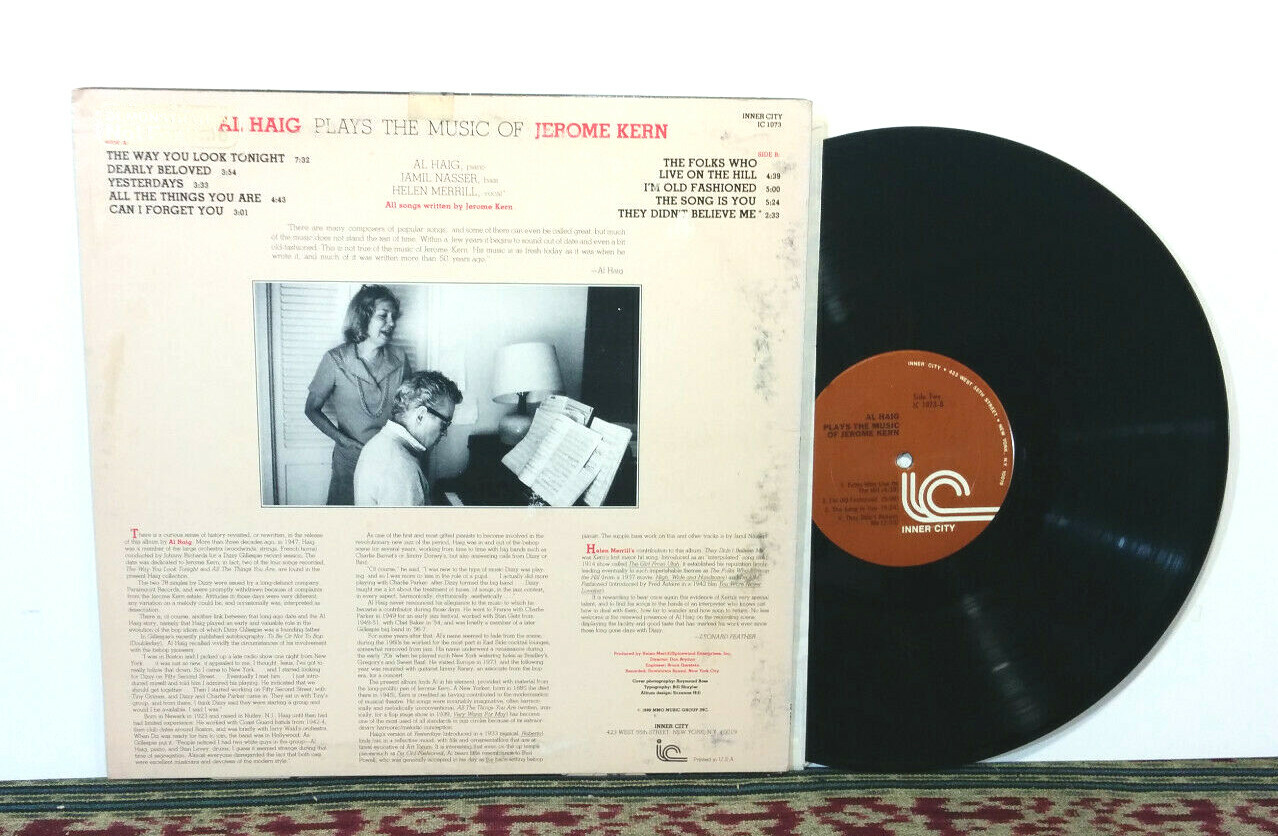
Al Haig Plays The Music Of Jerome Kern, LP 1980 JAZZ - NM Vinyl - PROMO
$
23




Favourite Auctions
To save auctions to your favourites, please login
If you don't have an account, please register
Description
(Visually Graded) Vinyl looks Near Mint and sleeve looks VG+. See pics and info for details.
Al Haig Plays The Music Of Jerome Kern
Label:
Inner City Records – IC 1073
Format:
Vinyl, LP, Album, Reissue, 12", 33 RPM, Promo
Country:
US
Released:
1980
Genre:
Jazz
Style:
Post Bop, Vocal
Tracklist
A1 The Way You Look Tonight 7:32
A2 Dearly Beloved 3:54
A3 Yesterdays 3:33
A4 All The Things You Are 4:43
A5 Can I Forget You 3:01
B1 The Folks Who Live On The Hill 4:39
B2 I'm Old Fashioned 5:00
B3 The Song Is You 5:24
B4 They Didn't Believe Me 2:33
Credits
Artwork [Typography] – Bill Shuyler
Bass – Jamil Nasser
Cover – Raymond Ross
Design [Album Design] – Suzanne Hill
Directed By – Don Brydon
Engineer – Bruce Gerstein
Liner Notes – Leonard Feather
Piano, Liner Notes – Al Haig
Producer – Helen Merrill
Written-By – Jerome Kern
Notes
Recorded at Downtown Sound, New York City.
Originally released on Trio Records in 1978.
(C)1980 MMO Music Group Inc.
(P)Trio Records
- Al Haig
Real Name:
Allan Warren Haig
Profile:
American jazz pianist and one of the pioneers of bebop.
Born : July 19, 1922 in Newark, New Jersey.
Died : November 16, 1982 in New York City, New York. (Heart attack)
Al started playing with Dizzy Gillespie and Charlie Parker in 1945, and performed and recorded under Gillespie from 1945 to 1946, as a member of Eddie Davis And His Beboppers in 1946 (also featuring Fats Navarro), and Eddie Davis And His Quintet in 1947, under Parker from 1948 to 1950, and under Stan Getz from 1949 to 1951.
The Gillespie quintet, which included Haig, recorded four 78 r.p.m. sides for Guild Records in May 1945 which are regarded as the first recordings to demonstrate all elements of the mature bebop style. He was part of the celebrated nonet on the first session of Miles Davis' Birth of the Cool. Although Haig became known for his distinctive and pioneering bebop style, he in fact spent much of his career playing in non-jazz contexts. His work was the subject of a revival in the 1970s.
In 1969 Haig was acquitted of a murder charge. He had been accused of strangling his third wife, Bonnie, at their home in Clifton, New Jersey on 9 October 1968. He had said in evidence that his wife had been drunk, and had died in a fall down a flight of stairs. Grange Rutan, Haig's second wife, challenged Haig's account in her 2007 book, Death of a Bebop Wife. Rutan's book is partly autobiographical, partly based on interviews with friends and family members.
She describes Bonnie's story in detail, describing an underside to Haig that included a history of serial domestic abuse. Rutan notes that several family members sounded alarm bells regarding Haig's violent personality that went unheeded. Importantly, she quotes bassist Harold Gaylor, who was talking with Haig before a performance at the Edison Hotel lounge in the early seventies, when Haig admitted to him he had caused Bonnie's death.
In 1974 Haig was invited to tour Europe by Tony Williams, owner of Spotlite Records in the UK. At the end of a very successful tour he recorded the 'Invitation' album for Spotlite, with Gilbert Rovère, on bass and Kenny Clarke on drums. This kick-started his re-emergence and over the next eight years he built a strong following in Europe and toured several times, recording in the UK and France, and appearing elsewhere. He recorded for several Japanese labels. -wikipedia
- We really want you to be happy with your purchase. If the vinyl does not live up to our grading upon receipt, please email us through EBAY before leaving a Feedback or Rating so that we may correct it for you. We have a 30 day return policy.
price rating



![Yuck [Digipak] by Yuck.](https://www.popsike.mobi/php/thumbnail.php?url=https://www.popsike.pics/pix/20160805/191938752023.jpg)

