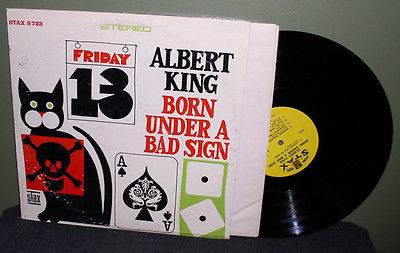
Albert King "Born Under A Bad Sign" LP VG+ Orig S 723
$
100


Favourite Auctions
To save auctions to your favourites, please login
If you don't have an account, please register
Description
Albert King "Born Under A Bad Sign" LP Stax Records S 723 (US)
Vinyl is VG+, Jacket is VG
Original Press
Out of Print!!
Track Listing:
A1Born Under A Bad Sign 2:45 A2
Crosscut Saw 2:31 A3
Kansas City 2:29 A4
Oh, Pretty Woman 2:45 A5
Down Don't Bother Me 2:13 A6
The Hunter 2:43 B1
I Almost Lost My Mind 3:25 B2
Personal Manager 4:28 B3
Laundromat Blues 3:19 B4
As The Years Go By 3:43 B5
The Very Thought Of You 3:45
Albert King (April 25, 1923 – December 21, 1992) was an American blues guitarist and singer, and a major influence in the world of blues guitar playing. King was posthumously inducted into the Rock and Roll Hall of Fame in May 2013.
History
The town was originally named "Indian Bayou" in 1882 because the site along the river bank was formerly inhabited by a Choctaw Indian village. Between 1882 and 1886, the town's name was changed from "Indian Bayou" to "Eureka," then to "Belengate," and finally "Indianola," which was allegedly in honor of an Indian princess named "Ola." The town population developed at this site due to the location of a lumber mill on the river.
In 1891, Minnie Cox was appointed postmaster of Indianola, becoming the first black female postmaster in the United States. Her rank was raised from fourth class to third class in 1900, and she was appointed to a full four-year term. Cox's position was one of the most respected and lucrative public posts in Indianola, as it served approximately 3,000 patrons and paid $1,100 annually—a large sum at that time. White resentment to Cox's prestigious position began to grow, and in 1902 some white residents in Indianola drew up a petition requesting Cox’s resignation. James K. Vardaman, editor of the The Greenwood Commonwealth and a white supremacist, began delivering speeches reproaching the people of Indianola for “tolerating a negro [sic] wench as a postmaster.” Racial tensions grew, and threats of physical harm led Cox to submit her resignation to take effect January 1, 1903. The incident attracted national attention, and President Roosevelt refused to accept her resignation, feeling Cox had been wronged, and the authority of the federal government was being compromised. "Roosevelt stood resolute. Unless Cox's detractors could prove a reason for her dismissal other than the color of her skin, she would remain the Indianola postmistress". Roosevelt closed Indianola’s post office on January 2, 1903, and rerouted mail to Greenville; Cox continued to receive her salary. That same month, the United States Senate debated the Indianola postal event for four hours, and Cox left Indianola for her own safety and did not return. In February 1904, the post office was reopened, but demoted in rank from third class to fourth class.
In the early and mid-twentieth century a number of Blues musicians originated in the area, including B.B. King, who worked in the local cotton industry in Indianola in the 1940s before pursuing a professional musical career.
In July 1954, two months after the Supreme Court of the United States announced its unanimous decision in Brown v. Board of Education, ruling that school segregation was unconstitutional, the local plantation manager Robert B. Patterson met with a group of like-minded individuals in a private home in Indianola to form the White Citizens' Council. Its goal was to resist any implementation of racial integration in Mississippi.
The Indianola Historic District was added to the National Register of Historic Places in 2009.
Geography
Indianola is located at 33°26?53?N 90°38?51?W (33.447999, -90.647414) at the junction of U.S. Routes 82 and 49W.
According to the United States Census Bureau, the city has a total area of 8.7 square miles (23 km2), of which 8.6 square miles (22 km2) is land and 0.1 square miles (0.26 km2) (1.03%) is water, including Indian Bayou, which runs the length of the city and beyond.
Indianola is 30 miles (48 km) from Greenwood.
The topography of Indianola is flat, with the only significant elevation changes along waterways such as Indian Bayou and one Indian mound located on Main Street east of U.S. 49.[citation needed]
Demographics
As of the census[8] of 2000, there were 12,066 people, 3,899 households, and 2,982 families residing in the city. The population density was 1,400.3 people per square mile (540.5/km²). There were 4,118 housing units at an average density of 477.9 per square mile (184.5/km²). The racial makeup of the city was 25.73% White, 73.38% African American, 0.01% Native American, 0.46% Asian American, 0.16% from other races, and 0.27% from two or more races. Hispanic or Latino of any race were 0.71% of the population.
There were 3,899 households out of which 39.8% had children under the age of 18 living with them, 40.8% were married couples living together, 31.1% had a female householder with no husband present, and 23.5% were non-families. 20.8% of all households were made up of individuals and 9.7% had someone living alone who was 65 years of age or older. The average household size was 3.05 and the average family size was 3.5. In the city the population was spread out with 32.9% under the age of 18, 11.5% from 18 to 24, 26.5% from 25 to 44, 18.4% from 45 to 64, and 10.6% who were 65 years of age or older. The median age was 30 years. For every 100 females there were 83.0 males. For every 100 females age 18 and over, there were 75.3 males.
The median income for a household in the city was $26,308, and the median income for a family was $31,186. Males had a median income of $27,310 versus $17,622 for females. The per capita income for the city was $12,082. About 22.5% of families and 27.4% of the population were below the poverty line, including 35.8% of those under age 18 and 21.5% of those age 65 or over.
Economy
Because Indianola is located at the intersection of U.S. Route 49W and U.S. Route 82, as of 2004 it is one of the last economically viable small towns in the Mississippi Delta. In the 1980s and 1990s the city government convinced a major retailer to build a distribution center near the intersection of the two highways. This development infused cash into the local economy and allowed semiskilled jobs to be established.
In August 2011, Delta Pride, a catfish processing company, closed its plant in Indianola.
Culture
Club Ebony in IndianolaJ. Todd Moye, author of Let the People Decide: Black Freedom and White Resistance Movements in Sunflower County, Mississippi, 1945–1986, said that "Life in Indianola still moves at a pace established by its distinguishing characteristic, the picturesque and languid Indian Bayou that winds through downtown."
The blues
It is the birthplace of the blues musician Albert King. The blues harp player, Little Arthur Duncan, was born in Indianola in 1934. Henry Sloan lived in Indianola, and Charley Patton died near the city.
B.B. King grew up in Indianola as a child. He comes to the blues festival named for him every year. King referenced the city with the title of his 1970 album Indianola Mississippi Seeds. The B.B. King Museum and Delta Interpretive Center, a $14 million facility dedicated to King and the blues, opened in September 2008. Many street names are named after King and his music, including B.B. King Road, Lucille St. (named after his guitar), and Delta Blues St.
All records are shipped in professional 7” & 12” box mailers. All CDs are shipped in padded bubble mailers. Buy multiple items and save on shipping. Thanks for Visiting!!
price rating
![The Beatles - She Loves You 45 rpm Picture Sleeve Swan S-4152 [Sleeve Only]](https://www.popsike.mobi/php/thumbnail.php?url=https://www.popsike.pics/pix/20221215/155311691163.jpg)