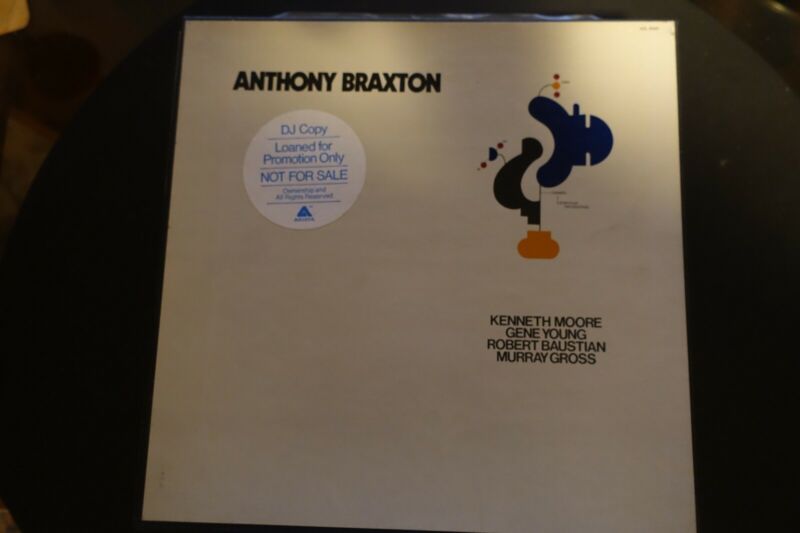
Anthony Braxton – For Four Orchestras Arista – A3L 8900 3LP Set
$
33


Favourite Auctions
To save auctions to your favourites, please login
If you don't have an account, please register
Description
Anthony Braxton – For Four Orchestras
Label:
Arista – A3L 8900
Format:
3 × Vinyl, LP, Album, Stereo, Quadraphonic
Box Set
Country:
US
Released:
1978
Genre:
Jazz
Style:
Free Jazz, Free Improvisation
Tracklist
A For Four Orchestras - Composition
B For Four Orchestras - Composition
C For Four Orchestras - Composition
D For Four Orchestras - Composition
E For Four Orchestras - Composition
F For Four Orchestras - Composition
Companies etc
Phonographic Copyright (p) – Arista
Copyright (c) – Arista
Credits
Bass – Arthur Kell, Daniel Savage (2), David Seckinger, Jeffrey Hill (2), Jeffrey Soule, Leon Dorsey, Mark Shapire, Matthew McCauley (2), Michael Talbert (2), Mikkel Jordahl, Robert Adair, Suzanne Tarshis
Bass Clarinet – Carol Robinson, Cynthia Douglass, David Ballon, Mark Gallagher (3)
Bassoon – Allen Smith, Ann Kosanovic, Deanna Kory, Mark Gross
Cello – Aaron Henderson, Carol Elliott (2), Carole Stipleman, Daniel Kazez, Dawn Wilder, Elizabeth Knowles, Elizabeth Warren (2), Kathy Kelly (3), Mattew Wexler, Michele McTeague, Sarah Binford, Steven Drake (2), Steven Harrison (2), Steven Wise, Suzanne Wijsman, Tom Rosenberg
Clarinet [Eb] – Bela Schwartz, David Bell (2), David Hostetler (2), James Colbert (2), John Guest (2), Marta Schworm, Marty Rossip, Michael Zakim
Composed By – Anthony Braxton
Conductor – Gene Young (2), Kenneth Moore, Murray Gross, Robert Baustian
Design, Art Direction – Howard Fritzson
Flute [Alto] – Adam Kuenzel, Carol Goodwillow, Joel Karr, Wendy Tarnoff
Harp – Cynthia Mowery, Nancy Lendrim, Naomi Markus, Susan Kelly (2)
Oboe – Bernard Gabis, Cameron McClusky, Carolyn Hove, Claudia Patton, Giselle Lautenbach, James Hois, Michael Harrison (8), Pamela Hill (2)
Percussion – Andre Whatley, Andrew Collier, Charles Wood (3), David Wiles, Derek Davidson, Galen Work, Gregg Linde, John Gardner (9), John Kennedy (7), Philip Seeman, Stephen Pascher, Victor Thomas (4)
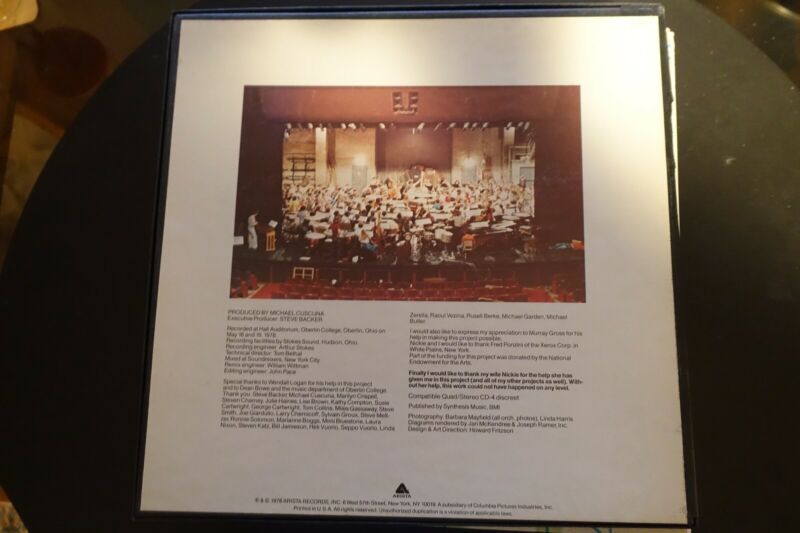
Photography By – Linda Harris
Photography By [Orchestra Photos] – Barbara Mayfield
Piccolo Flute – Betsy Adler, Celeste Johnson (2), Leonard Garrison, Virginia Elliott
Trombone – Ann Mondragon, Bradley Cornell, Brian Campbell (6), David Fogg, David Stocklosa, Eileen Jones, Erik Johnson (2), Kadie Nichols, Mark Adams (10), Mark Kaiser, Richard Ruotolo, Robert Asmussen
Trumpet – Alan Campbell (2), Chris Kerrebrock, Dave Rinaldi, David Driesen, James Kirchenbauer, John Bourque, Thomas Gotwals, William Camp
Tuba – Barry Jenson, Brian Bailey (3), John Lomonaco (2), Steven Box
Viola – Alex GuroffIgor Polisitsky, Amy Leventha, Beth Thorne, David Rogers (5), Dee Ortel, Helen McDermott, James Thomas (9), Jeffery Durachta, Kathleen Elliott, Nanci Severence, Naomi Barlow, Norin Saxe, Rachel Yurman, Sarah Bloom, Theodore Chemey
Violin [First] – Audrey Hale, Barry Sargent, David Wilson (4), Diane Cooper, Edward Shlasko, Francine Swartzentruber, Judith Bixler, Karin von Gierke, Lilyn Graves, Lorraine Adel, Mary Bolling, Monique Reid (3), Pamela Stuckey, Peter Jaffe, Robert Scarrow, Shelley Fowle, Stanislav Branovicki, Steven Schuch, Susan Demetris, Zabeth Oechlin
Violin [Second] – Alison Feuerwerker, Amorie Robinson, Andra Marx, Elizabeth Welch (2), Ellen Ziontz, Jane Moon, Jennifer Doctor, Jennifer Steiner, Johnathan Dunn, Julie Badger, Kathy Blackwell, Lauri Gutman, Lori Fay, Lynda Mapes, Marcus Woo, Margaret Morgan (2), Marriane Smith, Sally Becker, Shannon Simonson, Susan Brenneis
Notes
Four 39-piece orchestras from the Oberlin College Conservatory of Music.
(dedicated to the historian-writer-educator Eileen Southern)
114:30
Recorded at Hall Auditorium, Oberlin College, Oberlin, Ohio, May 18 & 19, 1978
from Braxton's notes in the booklet: "Composition is the first completed work in a series of ten compositions that will involve the use of multiple-orchestralism and the dynamics of spacial activity. This work is scored for 160 musicians and has been designed to utilize both individual and collective sound-direction (in live performance). Each orchestra is positioned near the corners of the performing space, and the audience is seated in both the center and sides of the space (around and in between each orchestra). The resulting activity has been constructed to fully utilize every area of the room--which is to say, each section of the performing space will give the listener a very different aspect of the music. The science related to how this multiple use of space is utilized, will also open another chapter in multi-orchestra activity, and hopefully this work will be viewed as a positive contribution to transitional multi-orchestralism--as we move to the next cycle.The nature of how extends the dynamic possibilities of multi-orchestra activity has to do with its use of spaciality--involving both the nature of how information is transferred from orchestra to orchestra (where the listener of this record can hear the actual movement of activity change speakers) with the addition of 'trajectoral-activity' (where, in a live performance, the listener can experience the route of a given transfer). More so, this composition has also been constructed to include the actual change of performance direction as well. In other words 'information' in would also involve how the rotation of a given ensemble (as that ensemble is playing) changes the actual direction of the group making the music. This has been accomplished by having all of the performers (with the exception of the percussionist and the harpist) in rotating chairs--where even the direction of the music is calculated. Thus, the nature of spaciality in this composition would encompass an additional dynamic inclusion, for the spacial implications of environment would thus take on added dimensions. Because, in fact, to experience the realness of this composition is to experience a living and breathing universe. ***The actual composing of took place in July of 1977, lasting until the middle of May, 1978 (with sequence corrections up until August). The piece is scored for 160 musicians and each orchestra is made up with the same individual components. The make-up of each orchestra is as follows: two flues (one doubling on piccolo), oboe, English horn, two clarinets (one doubling on soprano clarinet), bass clarinet, bassoon, two trumpets, two trombones, bass trombone, tuba, harp, five first violins, five second violins, five violas, four cellos, three basses, and three percussion. The original floor plan of the composition was not able to be used for this recording as the space requirement it necessitated exceeded what was possible for us, so an alternate seating arrangement was utilized. The actual recording of took place in May, '78, on the campus of Oberlin College and involved four intensive sessions in two days. For this reason, the composition was recorded in sequence-patches, rather than in sectional areas. The total material would also exceed two hours and a half and as such, I have taken out about thirty minutes of the music in order to preserve the sound quality of this record. There have also been other adjustments as well, for the problem of time and economics in a project like this has to be taken into account--but what is documented here is an excellent version of the 'essence' of the piece. The placement of activity in this project has been designed to totally utilize the spacial dynamics of the quadraphonic technology--each orchestra will be heard coming from a separate speaker, and the mixture of events in a given section should give the sense of sound movement through space--and this will also be apparent (though to a somewhat lesser extent) to stereo record players as well."
Cover is in excellent condition
Album is in excellent conditionVinyl grading is visual only and conforms to no standard grading conventions other than personal observation. Most of the records I am listing have either never been played or played no more than a few times.
They have been unplayed and stored on shelves for the last 25 years.
US Purchases of LPs and CDs that sell for under $15 can ship via Media Mail. Any other items that sell for under $15 can ship via 1st Class Mail.
All US sales over $20 will ship via Priority Mail
Any item that sells for under $20 can be shipped Internationally via USPS International 1st Class Mail.
Any Item above $20 will ship internationally via Priority Mail International.
To ship via 1st Class Mail International you must have at least 25 positive feedback. NO EXCEPTIONS
Shipping and Handling costs do not include any duty taxes required by your country.
All import duty taxes - VAT etc. are the responsibility of the buyer
Returns are not accepted
Any questions email me before bidding
859 (GS 7.0.21 (859))
price rating