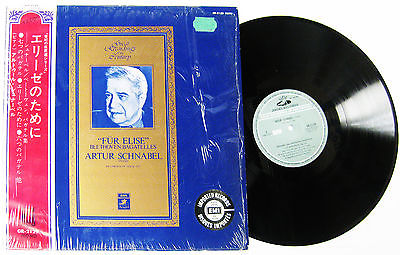
Artur Schnabel "Fur Elise" Beethoven Bagatelles Angel EMI Japan NEAR MINT DISC
$
29


Favourite Auctions
To save auctions to your favourites, please login
If you don't have an account, please register
Description
Artur Schnabel
Beeathoven Bagatelles
Angel EMI GR-2129 LP (Japan)
Deceptively deep. A bagatelle means a trifle. In music, it describes a short, lightweight piece. Beethoven wrote his first two opus numbers of bagatelles mostly as standalones. The last five bagatelles of op. 119 were written for a piano pedagogy project under another's editorship and then published with some other fugitive pieces. You might have thought such things beneath Beethoven. Indeed, the publisher Peters wrote to the composer to tell him just that about several items of op. 119. Indeed, he thought that no one would believe Beethoven had written them. However, this reflects a high-minded attitude toward art that few artists can afford. Charles Ives, after all, had made beaucoup bucks as the senior partner in the largest insurance firm in America. He could afford to publish himself (and did). Most professional composers are happy to pick up the occasional car commercial. Beethoven couldn't really ignore the large amateur market.
That said, light or not, the bagatelles are still Beethoven and at least worth a listen. Obviously, the length of a piece does not guarantee quality. I'd rather listen to a Bartók piano piece for children than to a Liszt oratorio, but catering to my prejudices, I probably compare po'-boys to pralines.
The Bagatelles, op. 33, most closely fit the definition of the genre, but even here Beethoven pitches quite a few curves. In the very first, he throws in an irregular minor episode that works against the largely duple phrasing. In the second, the main theme begins somewhere in the measure, off the beat, while the episodes proceed evenly. In the third, we're treated to a sudden change of key in the second subphrase, from F to G and then back to F just as abruptly.
Op. 119 does show a split between the first six numbers and the last five, despite, again, Beethoven's indulgence of caprice. In the first, he begins in the middle of things with music more suited to an "answering" phrase than an initial statement. The contrast foretells the lyricism of Brahms, and the piece ends up in the air, on what at first sounds like a dominant and then miraculously "melts" into another key, all on a sustained chord. The second number has an odd asymmetrical shape. What sounds like a contrast is actually the end. We don't get to hear the opening material again, and the proportions between the two sections are odd, the longer part by far the first. The last five numbers reflect more of late Beethoven -- his revived interest in counterpoint and new piano textures. Their scope -- that is, the musical vision and heft -- belies their length. You seem to have taken a substantial journey, similar to what you might get in a sonata movement, in a very short space of time. The weirdest number is the shortest, number 10, madly syncopated. I think of someone tumbling down a hill.
Beethoven described his Bagatelles, op. 126, to the publisher Schott as "likely the best I have written." They fully justify his opinion of them. Some trifles by lesser lights need an interpreter to add something for them to "come off." These need an interpreter penetrating enough to reveal the secrets they keep. Beethoven probably offered the score to Schott because the Peters comment on parts of op. 119 wounded him. This last set represents fully the late-Beethoven world. Unlike the others, he probably meant them to be played in order as a whole, for he wrote in the manuscript "Cycle of Miniatures." Furthermore, beginning with the second bagatelle, the key centers descend by a third, from one to the next: g, E-flat, b, G, E-flat. Hence, you see planning and forethought put into transitions. One hears echoes of the late sonatas, particularly the "Hammerklavier," as well as Beethoven's fascination with extreme register highs and lows, "casual" counterpoint," and flirting daringly with musical breakdown or stasis, which we find both in the finale to the Ninth and in the Missa Solemnis. You can find all these things in the fifth and sixth bagatelles. The end to the sixth (and to the set) calls to mind the presto at the end of the Ninth.
In my earlier days, I searched for easy things to play in a vain attempt to ramp up my piano technique to dismal. I've actually played some of the bagatelles, after a fashion. So I am absolutely overawed by Schnabel's readings. He has the gift of "naturalness" -- hardly ever natural in a musician -- the ability to appear simultaneously straightforward and incredibly wise. Op. 33/3 is beautifully delicate and capricious. Op. 119/4 has a very simple surface, yet Schnabel teases out its heart. The final number of op. 126 alternates between the beautifully lyric and the zany. Above all, he communicates Beethoven's urge toward exploration even of small spaces. William Blake once urged us to "see a world in a grain of sand." Here, Beethoven does as well.
Again, I praise Pristine's transfers. There's a bit of crackle here and there, but you'd have to be a stinging grampus to complain. What gets me is how well they capture the quality of both the piano sound and the subtle color shifts in Schnabel's playing.
Definitely a disc to savor.
Vinyl is NEAR MINT in a paper inner sleeve in a picture sleeve in EXCELLENT condition (shrinkwrap partially intact) w OBI
Note About Shipping To The U.S.
We are located in Canada, but have registered ourselves on eBay.com instead of eBay.ca because it gives us significantly better global exposure. The problem with this is that eBay wants us to charge shipping appropriate to US, where media mail and other options make for fairly reasonable delivery costs. We tried it for a while but ended up losing money on shipping or having to cancel the orders because we couldn't afford to ship for those rates. To manage this we have set the US shipping to run a calculator based on an American location (we chose Plattsburgh as fairly close) and charging according to UPS pricing. This avoids the cancellation issue, but appears to the buyer to be a prohibitive shipping cost and misrepresents the shipping as being only expedited. If you give us your postal code we will see if we can offer a more reasonable option, but generally we can get a single LP by air to most places in the continental US for $11, a few bucks less for ground.
Thanks for shopping Sir Helmitt,
Jeff Green, e-sales
price rating


![Beyond Magnetic [EP] by Metallica (Vinyl, Warner Bros.) Brand New Sealed RSD](https://www.popsike.mobi/php/thumbnail.php?url=https://www.popsike.pics/pix/20220806/155107117021.jpg)








![Saiva - Markerna Bortom [New Vinyl LP]](https://www.popsike.mobi/php/thumbnail.php?url=https://www.popsike.pics/pix/20171016/132365947421.jpg)
![Peru Negro - Peru Negro [New Vinyl LP]](https://www.popsike.mobi/php/thumbnail.php?url=https://www.popsike.pics/pix/20190619/362682106814.jpg)
![Citizen - As You Please [New Vinyl LP] Colored Vinyl, Digital Download](https://www.popsike.mobi/php/thumbnail.php?url=https://www.popsike.pics/pix/20190812/143354008642.jpg)


