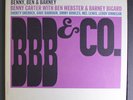
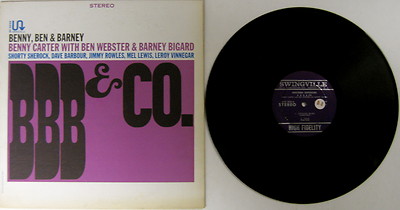
BBB & Co. Benny, Ben, & Barney Swingville LP 1962 Original SV 2032
$
82


Favourite Auctions
To save auctions to your favourites, please login
If you don't have an account, please register
Description
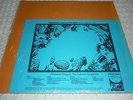
Album Cover Very Good To Excellent Record Excellent++++ Has Rolodex sticker side one label B-8 see Pictures Patina fabulous on this Disc.
Bennett Lester Carter (August 8, 1907 – July 12, 2003) was an American jazz alto saxophonist, clarinetist, trumpeter, composer, arranger, and bandleader. He was a major figure in jazz from the 1930s to the 1990s, and was recognized as such by other jazz musicians who called him King. In 1958, he performed with Billie Holiday at the legendary Monterey Jazz Festival.
The National Endowment for the Arts honored Benny Carter with its highest honor in jazz, the NEA Jazz Masters Award for 1986.[1] He was awarded the Grammy Lifetime Achievement Award in 1987, winner of the Grammy Award in 1994 for his solo "Prelude to a Kiss", and also the same year, received a star on the Hollywood Walk of Fame.[2] In 2000 awarded the National Endowment for the Arts, National Medal of Arts, presented by President Bill Clinton
Benjamin Francis Webster (March 27, 1909 – September 20, 1973), a.k.a. "The Brute" or "Frog," was an influential American jazz tenor saxophonist. Webster, born in Kansas City, Missouri, was considered one of the three most important "swing tenors" along with Coleman Hawkins and Lester Young. Known affectionately as "The Brute",[1] he had a tough, raspy, and brutal tone on stomps (with his own distinctive growls), yet on ballads he played with warmth and sentiment. Stylistically he was indebted to alto star Johnny Hodges, who, he said, taught him to play his instrument.
Albany Leon Bigard[1] (March 3, 1906 – June 27, 1980), aka Barney Bigard, was an American jazz clarinetist and tenor saxophonist, though primarily known for the clarinet.
Bigard was born in New Orleans and studied music and clarinet with Lorenzo Tio. He moved to Chicago in the early 1920s, where he worked with Joe "King" Oliver and others. During this period, much of his recording with Oliver and others, including clarinetist Johnny Dodds, was on tenor saxophone, an instrument he played often with great lyricism, as on Oliver's hit recording of "Someday Sweetheart".
In 1927 he joined Duke Ellington's band in New York, where he stayed until 1942. With Ellington, he was the featured clarinet soloist, while also doing some section work on tenor.
After leaving Ellington's Orchestra, he moved to Los Angeles, California and did sound track work, including an onscreen featured role with an allstar band led by Louis Armstrong in the 1946 film New Orleans.
He began working with trombonist Kid Ory's band during the late 1940s, and later worked with Louis Armstrong's touring band, the All Stars, and others. He died in Culver City, California.
Bigard wrote an autobiography entitled With Louis and The Duke, and he is credited as composer or co-composer on several numbers, notably the Ellington standard "Mood Indigo".
price rating
![Gloria Trevi - Tu Angel De La Guarda [Vinyl] [LP] NEW Sealed Reissue FAST USA SH](https://www.popsike.mobi/php/thumbnail.php?url=https://www.popsike.pics/pix/20231117/225876131398.jpg)