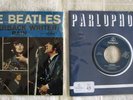
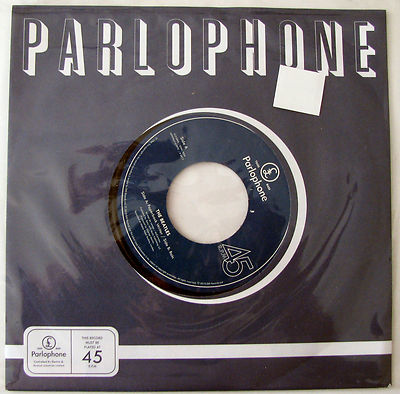
BEATLES "RAIN & PAPERBACK WRITER" -- NEW/SEALED/UNPLAYED - RECORD STORE DAY 2010
$
27


Favourite Auctions
To save auctions to your favourites, please login
If you don't have an account, please register
Description
PAYMENT DUE WITHIN
5 DAYS
of
AUCTION CLOSE
ALL RECORDS SHIPPED PROFESSIONALLY
with
TRACKING
in
VINYL PROTECTIVE SLEEVES
SPECIAL, THICK, CARDBOARD MAILERS
and
PROTECTED by a CARDBOARD PAD
on
EACH SIDE of the RECORD
_______
THE BEATLES
"RAIN & PAPERBACK WRITER"
NEW/SEALED/UNPLAYED
From the RECORD STORE DAY 2010 promotion
ORIGINAL OWNER
-- never opened or played --
(I bought 2)
_________________________
Paperback Writer
"Paperback Writer"
Single by The Beatles B-side "Rain" Released 30 May 1966 (US)
10 June 1966 (UK) Format 7" Recorded 13 April 1966
EMI Studios, London Genre Hard rock,[1] power pop[2] Length 2:18 (stereo version)
2:26 (mono single version) Label Parlophone R5452 (UK)
Capitol 5651 (US) Writer(s) Lennon–McCartney Producer George Martin Certification Gold (RIAA)[3]
"Paperback Writer" is a 1966 song recorded and released by The Beatles. Written by Paul McCartney[4] and credited to Lennon–McCartney, the song was released as the A-side of their eleventh single. The single went to the number one spot in the United States, United Kingdom, Ireland, West Germany, Australia, New Zealand and Norway. On the US Billboard Hot 100, the song was at number one for two non-consecutive weeks, being interrupted by Frank Sinatra's "Strangers in the Night".
"Paperback Writer" was the last new song by the Beatles to be featured on their final tour in 1966, and was the group's only U.S. number one released that year.
Recording
The track was recorded between 13 April and 14 April 1966.
"Paperback Writer" is marked by the boosted bass guitar sound throughout, partly in response to John Lennon demanding to know why the bass on a certain Wilson Pickett record far exceeded the bass on any Beatles records.[5] This changed with the "Paperback Writer" single.
"'Paperback Writer' was the first time the bass sound had been heard in all its excitement," said Beatles' engineer Geoff Emerick in Mark Lewisohn's book The Complete Beatles Recording Sessions. "To get the loud bass sound, Paul played a different bass, a Rickenbacker. Then we boosted it further by using a loudspeaker as a microphone. We positioned it directly in front of the bass speaker and the moving diaphragm of the second speaker made the electric current."[5]
The background vocal harmonies at the beginning of the third chorus are provided by Lennon and George Harrison who sing the title of the French nursery rhyme "Frère Jacques" in several slow incantations. These harmonies occur at a little over one minute into the track.[6]
Emerick stated that the "Paperback Writer" / "Rain" single was cut louder than any other Beatles record up to that time, due to a new piece of equipment used in the mastering process, referred to as "Automatic Transient Overload Control", which was devised by the EMI maintenance department.[7]
Song lyrics
According to disc jockey Jimmy Savile, McCartney wrote the song in response to a request from an aunt who asked if he could "write a single that wasn't about love."[8][9] Savile said, "With that thought obviously still in his mind, he walked around the room and noticed that Ringo was reading a book. He took one look and announced that he would write a song about a book."[8] In a 2007 interview, McCartney recalled that he wrote the song after reading in the Daily Mail about an aspiring author, possibly Martin Amis.[10] The Daily Mail was Lennon's regular newspaper and copies were in Lennon's Weybridge home when Lennon and McCartney were writing songs.[8]
The song's lyrics are in the form of a letter from an aspiring author addressed to a publisher. The author badly needs a job and has written a paperback version of a book by a "man named Lear." This is a reference to the Victorian painter Edward Lear, who wrote nonsense poems and songs of which Lennon was very fond (though Lear never wrote novels).
Aside from deviating from the subject of love, McCartney had it in mind to write a song with a melody backed by a single, static chord. "John and I would like to do songs with just one note like 'Long Tall Sally.' We got near it in 'The Word.'"[11] McCartney claimed to have barely failed to achieve this goal with "Paperback Writer," as the verse remains on G until the end, at which point it pauses on C. The backing vocals during this section are from the French children's song "Frère Jacques".[12]
Promotion
In Britain, the single was promoted with a photograph depicting the Beatles with raw meat and decapitated baby dolls tossed about (the same photograph was later used as an album cover in the US and became infamous as the Butcher cover).[13]
For the American release of the single, the cover depicted the Beatles playing live, but with Lennon and Harrison's images reflected so that it appears that they are playing left-handed. (See the image at the top of the page).
The promotional film for the song, one of the first of its type, shot amongst ornate garden statuary, was directed by Michael Lindsay-Hogg, who went on to direct the Beatles' final film, the documentary Let It Be.[14]
Personnel
There is some dispute over who played what on "Paperback Writer". In the November 2005 issue of Guitar Player magazine, Paul McCartney claims to have played the song's famous opening riff on his Epiphone Casino guitar,[15] and photos from the song's session seem to verify this claim. McCartney is also widely credited for the song's iconic bass line, but photos from the session show George Harrison playing a Burns Nu-Sonic bass, not an electric guitar. Whether or not Harrison recorded a bass line for "Paperback Writer" that was later removed and retracked by McCartney remains unclear.
- Paul McCartney – vocal, bass
- John Lennon – backing vocal, rhythm guitar
- George Harrison – backing vocal, lead guitar
- Ringo Starr – drums, tambourine
Rain
"Rain" Single by The Beatles A-side "Paperback Writer" Released 30 May 1966 (US)
10 June 1966 (UK) Format 7" Recorded 14 April 1966
EMI Studios, London Genre Psychedelic rock Length 2:59 Label Parlophone Writer(s) Lennon–McCartney Producer George Martin
"Rain" is a song by the English rock band The Beatles, credited to Lennon–McCartney and first released in June 1966 as the B-side of the "Paperback Writer" single. Both songs were recorded during the sessions for the album Revolver though neither appears on that album.
Written by John Lennon, "Rain" has been called The Beatles' finest B-side, noted for its slowed-down rhythm track and backwards vocals, both of which were a hint of things to come on Revolver, released two months later.[1][2][3]
Three promotional films were made for the song "Rain".[4] These videos, along with other Beatles videos at the time, sparked George Harrison to say during the Beatles Anthology, "So I suppose, in a way, we invented MTV."[5]
Music and lyrics
The inspiration for "Rain" is agreed on by Neil Aspinall, The Beatles' roadie, and John Lennon. They both described the band's arrival in Melbourne, Australia, marked by rain and poor weather.[6] Lennon said, "I've never seen rain as hard as that, except in Tahiti", and later explained that "Rain" was "about people moaning about the weather all the time".[7]
While technologically elaborate, "Rain" has a simple musical structure. Set in the key of G major (the final mix pitches it about a quarter of a semitone below this, while the backing track was taped in G sharp), it begins with what Alan W. Pollack calls, "a ra-ta-tat half-measure's fanfare of solo snare drums", followed by a guitar intro of the first chord. The verses are nine measures long, and the song is in 4/4 time. Each verse is based on the G, C, and D chords (I, IV, and V). The refrain contains only I and IV chords, and is twelve measures long (the repetition of a six-measure pattern). The first two measures are the G chord. The third and fourth measures are the C chord. The third measure has the C chord in the so-called 6/4 (second) inversion. The fifth and sixth measures return to the G chord. Pollack says the refrain seems slower than the verse, though it is at the same tempo, an illusion achieved by "the change of beat for the first four measures from its erstwhile bounce to something more plodding and regular". After four verses and two refrains, a short solo for guitar and drums is played, with complete silence for one beat. What is heard next is what Pollack calls "historically significant" reverse lyrics.[8] The Beatles pioneered the fade-out fade-in coda that was later used on "Strawberry Fields Forever" and Led Zeppelin's "Thank You".[9]
Recording
Recording began on 14 April 1966, in the same session as "Paperback Writer", and concluded on 16 April, with a series of overdubs before mixing on the same day.[2][10] At that time, The Beatles were enthused about experimenting in the studio to achieve new sounds and effects.[11] These experiments were showcased in their influential seventh album, Revolver. Geoff Emerick, who was the engineer for both sessions, described one technique he used to alter the sonic texture of the track by recording the backing track "faster than normal." When played back, slightly slower than the usual speed, "the music had a radically different tonal quality.[12] The opposite technique was used to alter the tone of Lennon's lead vocal: it was recorded with the tape machine slowed down, making Lennon's voice sound higher when played back.[13]
The last verse of "Rain" includes backwards vocals, one of the first uses of this technique on a record.[7][14] The backwards vocals are Lennon singing the lyrics of the song: "When the sun shines," "Rain," and "If the rain comes, they run and hide their heads."[15] Both Lennon and producer George Martin have claimed credit for the idea; Lennon said:
“ After we'd done the session on that particular song—it ended at about four or five in the morning—I went home with a tape to see what else you could do with it. And I was sort of very tired, you know, not knowing what I was doing, and I just happened to put it on my own tape recorder and it came out backwards. And I liked it better. So that's how it happened.[16][17] ”Emerick confirms Lennon's creative accident, but Martin remembers it differently:
“ I was always playing around with tapes and I thought it might be fun to do something extra with John's voice. So I lifted a bit of his main vocal off the four-track, put it on another spool, turned it around and then slid it back and forth until it fitted. John was out at the time but when he came back he was amazed.[2][12] ”Regardless of who is credited for the technique, "from that point on," Emerick wrote, "almost every overdub we did on Revolver had to be tried backwards as well as forwards." [18]
The "Paperback Writer"/"Rain" single was the first release to use a new device invented by the maintenance department at Abbey Road called "ATOC" for "Automatic Transient Overload Control". The new device allowed the record to be cut at a louder volume, louder than any other single up to that time.[12] On the final mix of the single, Lennon played a 1965 Gretsch Nashville, Paul McCartney a 1964 Rickenbacker 4001S bass, Harrison a 1964 Gibson SG, and Ringo Starr used Ludwig drums.[3][10] Both McCartney and Starr have been praised for their performances on their instruments in this song.
Personnel
- John Lennon – lead vocal, rhythm guitar - Gretsch Nashville, backing vocals
- Paul McCartney – backing vocal, bass - Rickenbacker 4001
- George Harrison – backing vocal, lead guitar - Gibson SG
- Ringo Starr – drums, tambourine
PAYMENT DUE WITHIN
5 DAYS
of
AUCTION CLOSE
GOLDMINE'S RECORD GRADING SYSTEM
How to Grade: Look at everything about a record -- Its playing surface, its label, its edges -- under a strong light. Then, based on your overall impression, give it a grade based on the following criteria:
Mint (M): Absolutely perfect in every way -- certainly never played, possibly even still sealed (More on still sealed under "Other considerations"). Should be used sparingly as a grade, if at all.
Near Mint (NM or M-): A nearly perfect record. Many dealers won't give a grade higher than this, implying (perhaps correctly) that no record is ever truly perfect.
The record should show no obvious signs of wear. A 45 RPM or EP sleeve should have no more than the most minor defects, such as almost invisible ring wear or other signs of slight handling.
An LP jacket should have no creases, folds, seam splits or any other noticeable similar defect. No cut-out holes, either. And of course, the same should be true of any other inserts, such as posters, lyric sleeves and the like.
Basically, an LP in Near Mint condition looks as if you just got it home from a new record store and removed the shrink wrap.
Very Good Plus (VG+): A Very Good Plus record will show some signs that it was played and otherwise handled by a previous owner who took good care of it.
Record surfaces may show some slight signs of wear and may have slight scuffs or very light scratches that don't affect one's listening experience. Slight warps that do not affect the sound are OK.
The label may have some ring wear or discoloration, but it should be barely noticeable. The center hole will not have been misshapen by repeated play.
Picture sleeves and LP inner sleeves will have some slight ring wear, lightly turned-up corners, or a slight seam split. An LP jacket may have slight signs of wear also and may be marred by a cut-out hole, indentation or corner indicating it was taken out of print and sold at a discount.
In general, if not for a couple minor things wrong with it, this would be Near Mint. All but the most mint-crazy collectors will find a Very Good Plus record highly acceptable.
A synonym used by some collectors and dealers for "Very Good Plus" is "Excellent."
Very Good (VG): Many of the defects found in a VG+ record will be more pronounced in a VG disc. Surface noise will be evident upon playing, especially in soft passages and during a song's intro and fade, but will not overpower the music otherwise. Groove wear will start to be noticeable, as will light scratches (deep enough to feel with a fingernail) that will affect the sound.
Labels may be marred by writing, or have tape or stickers (or their residue) attached. The same will be true of picture sleeves or LP covers. However, it will not have all these problems at the same time, only two or three of them.
Good (G), Good Plus (G+): Good does not mean Bad! A record in Good or Good Plus condition can be put onto a turntable and will play through without skipping. But it will have significant surface noise and scratches and visible groove wear (on a styrene record, the groove will be starting to turn white).
A jacket or sleeve will have seam splits, especially at the bottom or on the spine. Tape, writing, ring wear or other defects will start to overwhelm the object.
If it's a common item, you'll probably find another copy in better shape eventually. Pass it up. but if it's something you have been seeking for years, and the price is right, get it... but keep looking to upgrade.
Poor (P), Fair (F): The record is cracked, badly warped, and won't play through without skipping or repeating. The picture sleeve is water damaged, split on all three seams and heavily marred by wear and writing. The LP jacket barely keeps the LP inside it. Inner sleeves are fully seam split, crinkled, and written upon.
Except for impossibly rare records otherwise unattainable, records in this condition should be bought or sold for no more than a few cents each.
Other grading considerations. Most dealers give a separate grade to the record and its sleeve or cover. In an ad, a record's grade is listed first, followed by that of the sleeve or jacket.
With Still Sealed (SS) records, it's safe to assume that they are in Very Good Plus to Near Mint
condition (unless there is notable damage). There are many original factory sealed records still out there (warehouses full)--just be carefull: it's easy to re-seal one. Let the buyer beware!
Abbreviations
brass plug: small brass plug in cover to indicate cut-outcc: cut corner, slice of cover is missing to indicate cut-out
coh: cut-out-hole, small hole in cover
dnap: does not affect play
in shrink: in original shrinkwrap (but not sealed)
in loose bag: in original loose bag (predates shrinkwrap)
noc: name on cover (nobc: name on back cover, nofc: name on front cover)
nol: name on label
re: reissue, not the first pressing
rw: ringwear (wear on cover resembling the shape of the record)
sm: sawmark, small cut in cover to indicate cut-out
soc: sticker on cover (sobc: sticker on back cover, sofc: sticker on front cover)
sol: sticker on label
ss: seam split
toc: tape on cover (tobc: tape on back cover, tofc: tape on front cover)
tol: tape on label
woc: writing on cover (wobc: writing on back cover, wofc: writing on front cover)
wol: writing on label
price rating