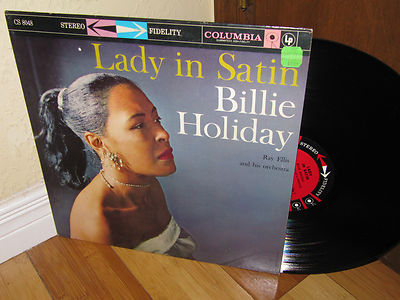
BILLIE HOLIDAY - Lady in Satin 1958 Stereo Columbia "6 eye" gorgeous VG++ lp
$
53


Favourite Auctions
To save auctions to your favourites, please login
If you don't have an account, please register
Description
"Lady in Satin"
Columbia CS 8048
Stereo
Released 1958
Made in the U.S.A.
has original inner sleeve
Record Condition: VG++ very clean,has a few superficial surface marks,plays well,slight edge wobble that does not affect play or sound
Labels: Red, white and black "6 eye" logo
The first popular jazz singer to move audiences with the intense, personal feeling of classic blues, changed the art of American pop vocals forever. More than a half-century after her death, it's difficult to believe that prior to her emergence, jazz and pop singers were tied to the Tin Pan Alley tradition and rarely personalized their songs; only blues singers like and actually gave the impression they had lived through what they were singing. 's highly stylized reading of this blues tradition revolutionized traditional pop, ripping the decades-long tradition of song plugging in two by refusing to compromise her artistry for either the song or the band. She made clear her debts to and (in her autobiography she admitted, "I always wanted 's big sound and ' feeling"), but in truth her style was virtually her own, quite a shock in an age of interchangeable crooners and band singers.
With her spirit shining through on every recording, 's technical expertise also excelled in comparison to the great majority of her contemporaries. Often bored by the tired old Tin Pan Alley songs she was forced to record early in her career, fooled around with the beat and the melody, phrasing behind the beat and often rejuvenating the standard melody with harmonies borrowed from her favorite horn players, and . (She often said she tried to sing like a horn.) Her notorious private life -- a series of abusive relationships, substance addictions, and periods of depression -- undoubtedly assisted her legendary status, but 's best performances ("Lover Man," "Don't Explain," "Strange Fruit," her own composition "God Bless the Child") remain among the most sensitive and accomplished vocal performances ever recorded. More than technical ability, more than purity of voice, what made one of the best vocalists of the century -- easily the equal of or -- was her relentlessly individualist temperament, a quality that colored every one of her endlessly nuanced performances.
's chaotic life reportedly began in Baltimore on April 7, 1915 (a few reports say 1912) when she was born . Her father, , was a teenaged jazz guitarist and banjo player later to play in . He never married her mother, Sadie Fagan, and left while his daughter was still a baby. (She would later run into him in New York, and though she contracted many guitarists for her sessions before his death in 1937, she always avoided using him.) 's mother was also a young teenager at the time, and whether because of inexperience or neglect, often left her daughter with uncaring relatives. was sentenced to Catholic reform school at the age of ten, reportedly after she admitted being raped. Though sentenced to stay until she became an adult, a family friend helped get her released after just two years. With her mother, she moved in 1927, first to New Jersey and soon after to Brooklyn.
In New York, helped her mother with domestic work, but soon began moonlighting as a prostitute for the additional income. According to the weighty legend (which gained additional credence after her notoriously apocryphal autobiography Lady Sings the Blues), her big singing break came in 1933 when a laughable dancing audition at a speakeasy prompted her accompanist to ask her if she could sing. In fact, was most likely singing at clubs all over New York City as early as 1930-31. Whatever the true story, she first gained some publicity in early 1933, when record producer -- only three years older than herself, and just at the beginning of a legendary career -- wrote her up in a column for Melody Maker and brought to one of her performances. After recording a demo at Columbia Studios, joined a small group led by to make her commercial debut on November 27, 1933 with "Your Mother's Son-In-Law."
Though she didn't return to the studio for over a year, spent 1934 moving up the rungs of the competitive New York bar scene. By early 1935, she made her debut at the Apollo Theater and appeared in a one-reeler film with . During the last half of 1935, finally entered the studio again and recorded a total of four sessions. With a pick-up band supervised by pianist , she recorded a series of obscure, forgettable songs straight from the gutters of Tin Pan Alley -- in other words, the only songs available to an obscure black band during the mid-'30s. (During the swing era, music publishers kept the best songs strictly in the hands of society orchestras and popular white singers.) Despite the poor song quality, and various groups (including trumpeter , alto , and tenors and ) energized flat songs like "What a Little Moonlight Can Do," "Twenty-Four Hours a Day" and "If You Were Mine" (to say nothing of "Eeny Meeny Miney Mo" and "Yankee Doodle Never Went to Town"). The great combo playing and 's increasingly assured vocals made them quite popular on Columbia, Brunswick and Vocalion.
During 1936, toured with groups led by and , then returned to New York for several more sessions. In late January 1937, she recorded several numbers with a small group culled from one of 's new discoveries, . Tenor , who'd briefly known several years earlier, and trumpeter were to become especially attached to . The three did much of their best recorded work together during the late '30s, and herself bestowed the nickname on , while he dubbed her for her elegance. By the spring of 1937, she began touring with as the female complement to his male singer, . The association lasted less than a year, however. Though officially she was fired from the band for being temperamental and unreliable, shadowy influences higher up in the publishing world reportedly commanded the action after she refused to begin singing '20s female blues standards.
At least temporarily, the move actually benefited -- less than a month after leaving , she was hired by 's popular band. She began singing with the group in 1938, one of the first instances of a black female appearing with a white group. Despite the continuing support of the entire band, however, show promoters and radio sponsors soon began objecting to -- based on her unorthodox singing style almost as much as her race. After a series of escalating indignities, quit the band in disgust. Yet again, her judgment proved valuable; the added freedom allowed her to take a gig at a hip new club named Café Society, the first popular nightspot with an inter-racial audience. There, learned the song that would catapult her career to a new level: "Strange Fruit."
The standard, written by Café Society regular and forever tied to , is an anguished reprisal of the intense racism still persistent in the South. Though initially expressed doubts about adding such a bald, uncompromising song to her repertoire, she pulled it off thanks largely to her powers of nuance and subtlety. "Strange Fruit" soon became the highlight of her performances. Though refused to record it (not for its politics but for its overly pungent imagery), he allowed a bit of leverage to record for Commodore, the label owned by jazz record-store owner . Once released, "Strange Fruit" was banned by many radio outlets, though the growing jukebox industry (and the inclusion of the excellent "Fine and Mellow" on the flip) made it a rather large, though controversial, hit. She continued recording for Columbia labels until 1942, and hit big again with her most famous composition, 1941's "God Bless the Child." , who also worked A&R for Decca, signed her to the label in 1944 to record "Lover Man," a song written especially for her and her third big hit. Neatly side-stepping the musician's union ban that afflicted her former label, soon became a priority at Decca, earning the right to top-quality material and lavish string sections for her sessions. She continued recording scattered sessions for Decca during the rest of the '40s, and recorded several of her best-loved songs including 's "'Tain't Nobody's Business If I Do," "Them There Eyes," and "Crazy He Calls Me."
Though her artistry was at its peak, 's emotional life began a turbulent period during the mid-'40s. Already heavily into alcohol and marijuana, she began smoking opium early in the decade with her first husband, Johnnie Monroe. The marriage didn't last, but hot on its heels came a second marriage to trumpeter and a move to heroin. Despite her triumphant concert at New York's Town Hall and a small film role -- as a maid (!) -- with in 1947's New Orleans, she lost a good deal of money running her own orchestra with . Her mother's death soon after affected her deeply, and in 1947 she was arrested for possession of heroin and sentenced to eight months in prison.
Unfortunately, 's troubles only continued after her release. The drug charge made it impossible for her to get a cabaret card, so nightclub performances were out of the question. Plagued by various celebrity hawks from all portions of the underworld (jazz, drugs, song publishing, etc.), she soldiered on for Decca until 1950. Two years later, she began recording for jazz entrepreneur , owner of the excellent labels Clef, Norgran, and by 1956, Verve. The recordings returned her to the small-group intimacy of her Columbia work, and reunited her with as well as other top-flight musicians such as , , and . Though the ravages of a hard life were beginning to take their toll on her voice, many of 's mid-'50s recordings are just as intense and beautiful as her classic work.
During 1954, toured Europe to great acclaim, and her 1956 autobiography brought her even more fame (or notoriety). She made her last great appearance in 1957, on the CBS television special The Sound of Jazz with , , and providing a close backing. One year later, the LP clothed her naked, increasingly hoarse voice with the overwrought strings of . During her final year, she made two more appearances in Europe before collapsing in May 1959 of heart and liver disease. Still procuring heroin while on her death bed, was arrested for possession in her private room and died on July 17, her system completely unable to fight both withdrawal and heart disease at the same time. Her cult of influence spread quickly after her death and gave her more fame than she'd enjoyed in life. The 1972 biopic Lady Sings the Blues featured struggling to overcome the conflicting myths of 's life, but the film also illuminated her tragic life and introduced many future fans. By the digital age, virtually all of 's recorded material had been reissued: by Columbia (nine volumes of ), Decca (), and Verve ().
SHIPPING
PAY FULL PRICE FOR SHIPPING FIRST ITEM,EVERY RECORD
AFTER THAT IS $1 in the US only.
PLEASE EMAIL ME WITH QUESTIONS,CHEERS!
YOUR RECORD WILL BE PACKED WITH CARE IN A RECORD MAILER. I WILL SHIP OVERSEAS. IF OVER $100 DOLLARS THIS WILL NEED TO BE REGISTERED FOR $12 DOLLARS PLUS SHIPPING PRICE.
Mint (M) Perfect Condition, which basically means that it is as good as new, literally. The vinyl has to look new and sound as though it was never played, and the cover has to look untouched. Some argue that the only mint records are brand new unopened ones still in their original packing.
Near Mint (NM) Vinyl is near perfect. At most, a light scuff appears on the record, but it should play without any noise or skips. The record sleeve should also be near perfect with only minor signs of wear. There should be no" outline sleeve.)
Very Good+
(VG+) This is the grading category where the quality of the sound is affected -- there will be some surface noise -- and the vinyl will show wear, including surface scuffs and some light scratches. However, the record is still very listenable as there are no deep scratches that cause skips. On the cover, the corners may be slightly bent, but not broken. There may be wear to the seams but not tears or holes.
Very Good
(VG) Vinyl doesn't necessarily look good, but still plays well enough. Surface noise will probably be present, including pops and clicks. At higher volume levels, the music should overpower any pops and clicks present. There may be seam splitting, but not complete separation of the sleeve panels from each other. There will be noticeable ring wear on the cover, but the cover should for the most part still be in good condition.
Good (VG-) Vinyl is well played and looks it. However, the record should still play without skipping. It will have substantial surface noise, pops and clicks. Loss of various parts of the dynamic range will occur due to worn grooves. This grade depends a lot on the owner and the type of records he or she collects. A rock record may still sound ok at a high volume, but quieter styles of music will be practically unlistenable. The record cover may have many problems including seam splits, tears, and writing on it.
Fair/Poor (F/P)
Using the word fair for this quality of record is, in the opinion of JRS, too generous and not recommended since it may be misleading. Records described as fair (F) or Poor (P) in the Goldmine grading system are ones that are basically unlistenable. Surface noise, skips and pops make hearing what's on the record nearly impossible, if not completely impossible. The cover is falling apart, torn, and has writing all over it. The only reason to keep it would be if the record is extremely rare or you want to eventually melt the vinyl and shape it into an ashtray.
price rating


![BEATLES please please me JAPAN ONLY CVR '66 orig LP RED VINYL rare [FREE P+P]](https://www.popsike.mobi/php/thumbnail.php?url=https://www.popsike.pics/pix/20140927/371151766630.jpg)