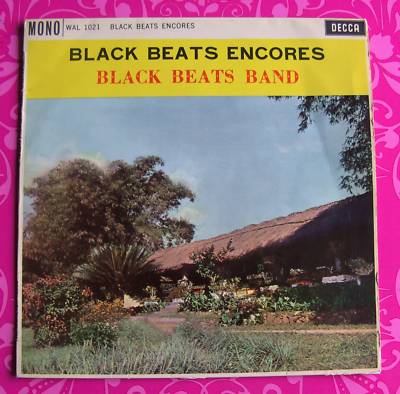
BLACK BEATS BAND BlackBeats Encores 10"LP DECCA 50s VG+
£
34
$
45


Favourite Auctions
To save auctions to your favourites, please login
If you don't have an account, please register
Description
10” DISC
ARTIST: BLACK BEATS BAND
TITLE: BLACK BEATS ENCORES
LABEL + YEAR: Decca WAL 1021, yellow with silver lettering label, Decca unboxed logo; 1950s recording, UK Press Mono
CONDITION VINYL: VG+, play grade VG+/Ex
CONDITION SLEEVE: VG+, the front is very nice & all is clean, this has a 1 ½” split on bottom opening edge which has been repaired
DESCRIPTION:
Side One:
AMMA MERE WU – HIGH LIFE
TELEPHONE LOBI – HIGH LIFE
SORE BE TIE’M – HIGH LIFE
NKOME NKOMO – HIGH LIFE
OWO KO NI FE – HIGH LIFE
Side Two:
SROTOI YE MLI – HIGH LIFE
KASA BERE’W – HIGH LIFE
BU DURU MANA – HIGH LIFE
GYE KO DIDI – HIGH LIFE
WONMA MENKA – HIGH LIFE
'King Bruce formed the Black Beats in 1952, fronting a guitar/bass/drums combo with a luxurious spread of horns that now have all the acoustic properties of a Thirties 78, a vintage crispness that's no bad thing when you're whirling around to such quaint confections today' Q Magazine
King Bruce: Highlife Master June 3, 1922 - Sept 12, 1997
The Ghanaian musician King Bruce who died in Accra on September 12, 1997, aged 75, was one of the generation which established highlife music as the voice of Africa during the pre- and post-independence eras. He was a musician, composer, accountant, civil servant and entrepreneur who 'ran' more than eight different dance bands. King Bruce was born on June 3, 1922, to a Ga family in Jamestown, the colonial, old town area of Accra, which he never left during his eventful career. His mother sang with a traditional women's group and several brothers were keen musicians. At Achimota College, Accra, music was part of the curriculum and during the war years Bruce also enjoyed American big band music.
In 1947 Bruce came to London to study accountancy but, along with many Africans, found himself excluded from the social scene. As he told the BBC, 'We had difficulties getting white girls to dance with us. So I decided to switch my interests from ballroom dancing to [playing] ballroom music.' He took up trumpet initially but was later to alternate with saxophone.
Bruce returned to Ghana in 1951 to continue his career in the Post Office Savings Bank at a time when British record companies were discovering the potential of a new market. Deliberately mixing work and pleasure, he briefly joined the seminal Accra Orchestra and stood in with leaders of the burgeoning highlife scene, E.T. Mensah and Guy Warren, before setting up his first Black Beats band in 1952 with tenor sax player Saka Acquaye. 'We were interested in playing good dance band music, but keen on giving everything a recognisable African beat,' he said. Although semi-professional, Bruce maintained a line-up of 20-odd musicians including future bandleaders such as Jerry Hansen. Main attractions were the star vocalists Lewis Wadawa and Frank Barnes.
Bruce composed in the Ga language and English but he was open to other contributors. 'In the old days people like Bob Cole and Oscomore Ofiori approached successful band leaders offering songs to record. Oscomore used to bring Twi and Fanti songs and I provided the Ga songs. That way we covered the whole country. I used to get the composers to come and sing themselves and then pay them as a guest artist or as a regular member of the band - as then, none of us was entiltled to royalties.'
price rating