BLACK RANDY METROSQUAD IDI AMIN DANGERHOUSE IDI-722 7"
£
24
$
31


Favourite Auctions
To save auctions to your favourites, please login
If you don't have an account, please register
Description
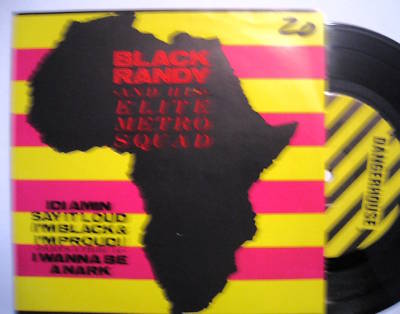
YOU ARE BIDDING ON A RARE 7"
BLACK RANDY AND HIS METROSQUAD
IDI AMIN
I'M BLACK & PROUD PART 3
I'M BLACK & PROUD PART 14
I WANNA BE A NARK
RELEASED ON DANGERHOUSE RECORDS IDI-722
THIS RECORD COMES IN A FOLD AROUND SLEEVE
THE RECORD IS IN EXCELLENT CONDITION, THE SLEEVE IS IN EXCELLENT CONDITION OTHER THAN A NUMBER 20 BEING WRITTEN ON THE FRONT
WE DO COMBINE POSTAGE FOR ITEMS PURCHASED MEANING THAT WE DO PROVIDE POSTAGE DISCOUNTS ON MULTIPLE PURCHASES WHERE POSSIBLE, AS A RULE THE FIRST LP IS CHARGED AT STANDARD POSTAL RATE AND EACH ITEM THERE AFTER AT AROUND A 50% DISCOUNT, AND THE SAME GOES FOR 7" RECORDS, THERE MAY BE A FEW EXCEPTIONS TO THIS, SUCH AS BEING UNABLE TO COMBINE POSTAGE FOR A POSTER AND A RECORD, PLEASE FEEL FREE TO CONTACT US IF YOU ARE STILL UNSURE
ITEMS ARE PACKAGED IN STIFF CARD MAILERS WITH STIFFENERS, AND ARE REMOVED FROM SLEEVES PRIOR TO PACKING-UNLESS THE ITEM IS SOLD AS 'SEALED'
Black Randy & the Metrosquad was founded in 1977 in Los Angeles. Their frontman, John "Jackie" Morris a.k.a. Black Randy, was basically the focal point of the group, which had keyboardist/guitarist David Brown as its musical director. Black Randy's shtick was that he portrayed himself as black, but was obviously white; James Brown's "I'm Black and I'm Proud" was one of the cover songs that Black Randy & the Metrosquad played as a matter of routine. But Black Randy was much more than that; he was a talented lyricist whose work brims with irony and thumbs its nose at everything, even the L.A. proto-punk culture that spawned it. Black Randy & the Metrosquad were perhaps the wittiest band on the L.A. punk scene in the late '70s.
David Brown and his partner Pat Garrett formed Dangerhouse Records in 1977, today viewed as one of the premier D.I.Y. labels on the American punk scene in the late '70s. Black Randy & the Metrosquad were its most frequently represented artist: three singles; a spot on the Yes L.A. compilation; and Dangerhouse's only full-length LP, Pass the Dust, I Think I'm Bowie. This wasn't due so much to in-house nepotism as it was that many of the other L.A. punk bands represented on Dangerhouse had major-label aspirations which they didn't want to endanger by virtue of appearing on the smaller label. Black Randy & the Metrosquad had no such ambition, and one wonders what the general public would've thought of songs such as "Sperm Bank Baby" and "I Slept in an Arcade" ("I saw Jesus and I saw God/I saw Candy Samples and big Johnny Wadd") had they ever encountered them. Or "Idi Amin," a song of praise to the ruthless African dictator ("Idi you're bad/I'm your fan"). The title song on Black Randy & the Metrosquad's first single, "Trouble at the Cup," advocates that L.A. punks should form roving bands to do battle with Los Angeles police, material hardly ready for prime time then and even less so in the 21st century. All of this was done tongue-in-cheek, and the musical compliment devised by Brown and the ever-rotating musicians behind Black Randy (at one point including the entire L.A. band the Eyes) was sophisticated and even somewhat innovative, embracing funk, pop, and avant-garde elements. Among the vocalists who passed through Black Randy's ever-changing regimen of backup singers, the Blackettes, were Exene Cervenka, Alice Bag, Jane Wiedlen ,and Belinda Carlisle.
The Dangerhouse recordings and the album Pass the Dust, I Think I'm Bowie were, and are, the best way to experience Black Randy. This author caught a live set by Black Randy & the Metrosquad at the Temple Beautiful in San Francisco in February, 1980 (along with the second-ever appearance of fledgling group Wall of Voodoo, whose drummer, Joe Nanini, also played with Black Randy). This was a chaotic, indecipherable mess, with the frontman completely out of control, rolling around the stage, barely singing the songs, and Brown rushing around from here to there, trying the salvage what he could of the show. Indeed, by this time the group's days were already numbered, as Jackie "Black Randy" Morris was quickly becoming mired in a swirl of drug abuse and alcohol-related problems. Black Randy & the Metrosquad were long broken up by the time Morris died in 1983 or 1984, from complications related to HIV. Black Randy's work is only infrequently available, and a Sympathy for the Record Industry reissue of Pass the Dust made available in the early '90s has already been dropped from their catalogue without fanfare. But the band's work is well worth seeking out, as its sardonic humor and musicality still holds up well decades later, and is light years away from the regimented sameness of approach that afflicted L.A.-based punk bands in the wake of Black Flag.
price rating