BOB DYLAN- GREAT WHITE WONDER RARE 1969 VINTAGE TMOQ 2LP FOLK PSYCH CLASSIC ROC
$
30


Favourite Auctions
To save auctions to your favourites, please login
If you don't have an account, please register
Description
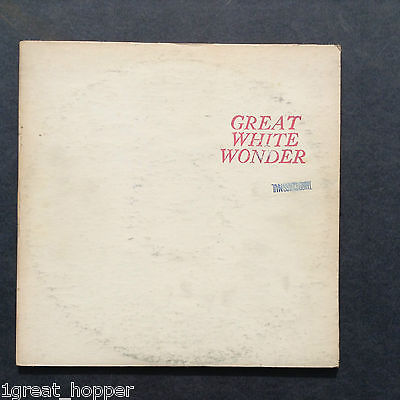
BOB DYLAN- GREAT WHITE WONDER RARE 1969 VINTAGE TMOQ 2LP FOLK PSYCH CLASSIC ROCK
1969 plain label - NO MATRIX INFORMATION
The condition of the gatefold cover is about EXCELLENT with an additional rubber stamp indicating "Third Class Mail". The condition of both discs are NEAR MINT and play well.
This LP has been in cool dry storage for years, and display a great glossy mirror finish.
This is the first underground rock release, a legendary double album originally pressed in a run of 1,000-2,000 copies by two anonymous L.A. insiders known as Dub and Ken. It began appearing in stores in June 1969, and got its nickname from the plain white jacket. This is the second version, still from 1969, but decorated with the titular stamp. This was the first time these previously unheard 23 tracks had been available anywhere, though the sequencing logic is hard to pin down. Ten cuts were drawn from the "Minnesota Tapes", a collection of American standards recorded in May and December 1961. "Only a Hobo" and "Bob Dylan's New Orleans Rag" came from 1963 Columbia demos, and "Sitting on a Barbed Wire Fence" and "If You Gotta Go, Go Now" were great-sounding studio outtakes from the Highway 61 sessions. A version of "The Death of Emmitt Till" was pulled from a session with the magazine Broadside, and "Living the Blues" was recorded off of the television, from the May 1969 appearance on "The Johnny Cash Show". There are also seven Basement Tape demos from just before Dylan left to make John Wesley Harding in Nashville. Along with "This Wheel's On Fire", "The Mighty Quinn", "Nothing Was Delivered", "Too Much Of Nothing" and "Open The Door, Homer", there was also "Tears of Rage" and "I Shall Be Released", which had respectively opened and closed Music From Big Pink. Great White Wonder was a grab-bag retrospective of Dylan's career to that point, serving as something of a corrective to his absence and a harbinger of a career that wouldn't continue along the path it had taken for the first half of the decade. There is a near endless variety of editions of this LP. The same companies have packaged the same album many ways, and some of them have been altered by the distributors, retailers, and end line consumer. Along with the minor intentional alterations (such as changes in insert or stamp color and label design) there are inadvertent minor changes such as differing hues of the same color cardboard jacket stock, or raw vinyl used to press the LP (which is relatively nice in this case). It would be a herculean task to try to document every minor unintentional variant, but this version is identifiable by its lack of matrix information and front cover rubber stamp, which is the same one TMQ would later use for their "official" issue (the first press was also technically TMQ, but there was no rubber stamp, insert or label design yet).
In terms of recording quality, these songs sounded absolutely horrible. They were only intended as demos, and odds are the versions that were circulating had been dubbed numerous times, resulting in a significant loss of fidelity. But the low grade of the recordings-- particularly in comparison to the other, better-recorded songs on Wonder-- only added to their aura, and to the sense that fans were listening in on a secret meeting between collaborators. "We went in with a sense of humor… It was all a goof," the Band's Robbie Robertson later told Greil Marcus. "We were playing with absolute freedom; we weren't doing anything we thought anybody else would ever hear, as long as we lived. But what started in that basement, what came out of it… came out of this little conspiracy, of us amusing ourselves." This was the nature of a leak in 1969-- a rare glimpse into the backstage life of a superstar. A conspiracy built from a conspiracy.
In 1969, Bob Dylan was one of three artists famous enough to create the kind of demand required to trigger a leak of unreleased studio recordings (the Beatles and the Rolling Stoneswould soon both fall prey to now-legendary leaks). While history records Wonder as rock's first widely circulated bootleg, underground releases of Wonder's ilk are like the cool uncle of the digital leak. By definition, they're indistinguishable: recordings (live or studio-made) which are not released on the artist's label but instead sold or traded in ancillary or underground markets (Dub and Ken had a "label" they called TMQ, or "Trademark of Quality"). Fans had been trading magnetic tapes of already-released albums for years by this point, but Wonder was different: It was the first time that unheard recordings of a superstar's new compositions had leaked to the public, and were being sold. It's easy to take such a thing for granted today, when leaks circulate freely online, but Wonder represented the earliest moment when advancing technologies combined with popular demand and illicit entrepreneurship to create cracks in the record industry's otherwise firm facade.
Despite the fact that many copies of Wonder were pressed at professional operations, the quality was extremely poor: Oftentimes, the top layer of vinyl would literally scrape off after about 20 plays.
In 2012, a simple Google search can turn up Wonder in full via BitTorrent, with few worries about private investigators tracking your movements. In 1969, however, the stakes were significantly higher, and much more money was being put into Wonder's production-- and exchanged for access to it. Southern California record stores saw it flying off the shelves-- or, more accurately, out from under the counter. Dub and Ken were wholesaling the album just like any other, reported Jerry Hopkins for Rolling Stone in September 1969, charging $4.50 each and lowering the price to $4.25 after the first 50. A typical markup was $2, though some stores were charging much more. "Those shops carrying the LP seem happy," Hopkins noted, "with many reporting the album's arrival has had the same effect on business as a new Beatles or Stones LP might have." By October, Wonder had spread to New York, and the Timesreported that "at a small record stop near Columbia University, the proprietor just winked when asked where he had gotten the albums."
Dubs of dubs of dubs of Wonder, some with different track orders and most with different cover art, were proliferating through the underground. This is how Norton Beckman and Ben Goldman, two record store owners from the Fairfax district of Los Angeles, acquired their copies. They took an early version of the tape to an audio engineer in downtown L.A., who made acetates from it, which were then used to make "stampers"-- the master versions that were pressed to be sold. These were processed in the off hours of a record processing company-- "one of the many in the city who ask no questions," Rolling Stone noted, then pressed and inserted into plain white sleeves at S&R Record Manufacturers in Gardena. Despite the fact that many copies of Wonder were pressed at professional operations, the quality was extremely poor: Oftentimes, the top layer of vinyl would literally scrape off after about 20 plays.
Beckman and Goldman became the target of Columbia's investigation into Wonderbootlegging. They were given up to Columbia's A&R department by "an anonymous phone call from a woman who said she knew who the bootleggers were," Rolling Stone claimed. The woman was an acquaintance of the bootleggers, and was reporting them because the two "had been bad-mouthing some friends of hers." Columbia was quick to make a public show of finding and stopping the Wonder bootlegs, though they had already proliferated far out of their legal control. "We consider the release of this record an abuse of the integrity of a great artist," Columbia said in a 1969 press release. "They are at one time defaming the artist and defrauding his admirers." But to many fans, Wonder was the opposite of fraud; particularly with countercultural vibes in the air, Columbia was the bad guy.
Though they had to make a public stance against bootlegging, Dylan's label was fully aware that their legal options were significantly limited. Columbia sent private detectives to uncover record stores selling Wonder and filed cease and desist orders against transgressors, but that was about the limit of their capabilities. They had no idea who Dub and Ken were, let alonewhere they were, so they couldn't serve the two pirates with a legal order. As Clinton Heylin observed in his great 1995 book Bootleg: The Secret History of the Other Recording Industry,Wonder's tracklisting might have seemed random, but Dub and Ken weren't dumb-- they made sure to craft it to fit in a liminal legal zone. Columbia couldn't verify if the "Minnesota Tape" songs were recorded after Dylan signed with them (and he was a minor when he signed his contract with the label, to boot). The traditional songs were mostly in the public domain. Furthermore, the Basement Tape material wasn't recorded in a Columbia studio, the Band weren't under contract, and Dylan was himself between contracts with the label. (For some inexplicable reason, Columbia failed to do anything about the Highway 61 sessions included on the album.) And Dub and Ken were savvy enough not to include Dylan's name or likeness anywhere on the packaging, so as to avoid a lawsuit over those aspects of his identity.
In the wake of Wonder, bootlegging flourished, though quality was never guaranteed. Devoted rock fans near in-the-know stores could rely on buying unauthorized recordings cobbled together from leaked studio tapes, audience recordings of live performances, and televised appearances from Dylan, the Rolling Stones, and the Beatles. "In Minnesota, Come Back is being sold illegally," reported Rolling Stone in 1970. "This is a poor quality copy of the Beatles' Let It Be album, due to be released God only knows when… Quality is… poor, as if the tape was recorded by a mike off a speaker, instead of directly dubbed."
Other bootlegs were of a much higher quality, and the practice was turning into a bonafide industry. Greil Marcus reviewed three bootlegs in a 1970 issue of the magazine: the Wonderfollowup Stealin', the Plastic Ono Band's Live Peace in Toronto, and the tremendous live Stones LP Live'r Than You'll Ever Be (recorded and released by Dub himself). Marcus took into account the vagaries of quality as well as the content. "Consider them new records by the Beatles, the Stones, and Dylan," Marcus wrote. "They aren't going to be around for very long, and simply on the basis of their musical quality, they should be bought right now. None of these albums is a mere 'collectors item,' like the Great White Wonder stuff-- all of them are listenable and exciting on their own terms."
In early 1970, the idea of flooding the market with consistent streams of new material from huge artists wasn't part of record labels' plans, though perhaps it should have been. B-side collections and live albums were expensive to produce and publicize, and their market was still very limited, at least in the labels' imaginations. It must have been thrilling to hear what Marcus claimed was "the ultimate Rolling Stones album," a high quality version of a show at the Oakland Coliseum in 1969 (which Marcus suspected was done from the stage by a sound technician, but which Dub confessed was accomplished merely by "the Sennheiser shotgun pointed at the PA system"). "Whatever we take out of their pockets, we're doing as much for them in terms of publicity and interest in their music," one bootlegger told Rolling Stone, in language that echoes down to 21st century downloading defenses. He continued, asserting that the rules of market competition still apply in the underground. "The word 'moral' doesn't apply. It's a matter of get what you can, and when someone else pops up copying our stuff, we do what we can to get more product at less cost. Maybe that's what the big record companies should do-- compete with us. They weren't going to release this material anyway, were they?"
What happens with mp3 leaks illuminates a very basic economic fact: Official markets will always lead to unsanctioned ones that feed off of the legit products-- and often operate much more efficiently.
While labels tried everything they could (at least publicly) to stamp out bootlegging, the artists themselves were much more amenable to their existence. The Live'r boot was so good, in fact, that after the Stones' road manager heard a copy at KSAN in San Fransisco, he bought a copy for himself and five more-- one for each band member. When the entirety of the Basement Tapes was finally released in 1975, Dylan himself was publicly surprised at the reception and strong commercial showing: "I thought everybody already had them." It makes sense that artists then and now would be more tolerant of leaks than their labels. While they need only concern themselves with making music to be discovered and heard by as many people as they wish, the labels have to foot the bill for production, distribution, and promotion.
On one basic level, what happened in 1969 with Wonder-- and what happens every day with mp3 leaks-- illuminates a very basic economic fact: Official markets will always lead to unsanctioned ones that feed off of the legit products-- and often operate much more efficiently. Consumer desire has never automatically limited itself to strictly legal operations, particularly when fans can convince themselves (often rightly) that they're doing no harm to the artists. In his recent book Pop Song Piracy, Barry Kernfeld pointed out that for as long as companies have been selling musical objects-- from sheet music to albums, cassettes, compact discs, and mp3s-- they have been faced with threats to their monopoly over distribution due to unauthorized duplication and circulation. Playing devil's advocate, since consumers are always encouraged to get the most product for the least amount of money and time, why should music fans make moral distinctions that capitalism itself doesn't?
Thanks to the unpredictable interplay of record labels, artists, laws, technologies, and music journalism, bootlegging and leaks can upend the the power structure when it comes to rolling out new releases-- but only the scope, not the idea, has changed in the last 40-plus years. In the late 60s, FM was still the Wild West compared to today's radio landscape, and rock journalism was in its infancy. Music copyright laws were full of loopholes, and duplication technologies were developing at an unprecedented pace. It was a moment when renowned critics would review hot new bootlegs, and Rolling Stone's publisher could openly lobby Columbia to release a particular Bob Dylan album. When record store owners could feel relatively safe moving illicitly pressed LPs from behind the counter, and radio jocks would play unofficial tracks in regular rotation. Labels filed lawsuits against bootleggers in vain, resenting a significant loss of control over their own operations, but often reaped their promotional benefits nonetheless.
And now: Bloggers and status updaters rewrote the guidebook for music journalism and promotion, leaving them in an unsettled state akin to the late 60s and early 70s (though now with much more gratis labor). Leaks are mass duplicated on the same machines that also serve as jukeboxes and publishing outlets, driving money not to labels or record stores or shady pressing plants but international file-locker sites like Mediafire, corporately owned ISPs, and proprietors of cloud servers. Fans take to Twitter and message boards begging for a leak of whatever new album has just been announced. And when these records are inevitably set free, they're often cloaked in the modern equivalent of plain white wrappers with a generic stamp-- .zip or .rar files renamed to travel online, unnoticed by label employees and Google-scouring security firms. Great White Wonder may be a modern impossibility in its original incarnation, but 40 years later, in a vastly de-industrialized music climate, its ongoing legacy suggests less a digital revolution than the mundane fact that, in the face of innovation, some old habits die hard.
Shipping and handling is a flat rate of $4 anywhere in the U.S.A. via media mail. NO international shipping.
price rating