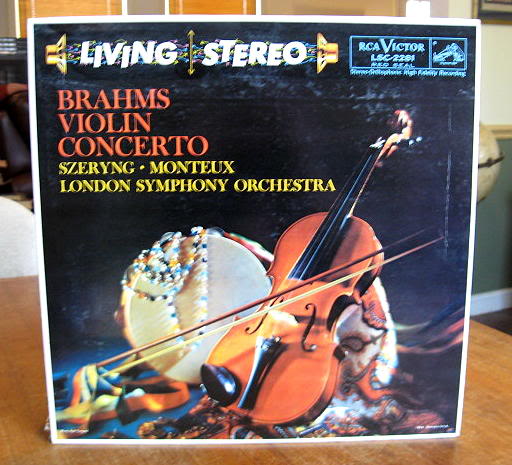
BRAHMS violin concerto SZERYNG/LSO LSC-2281 1S/1S SD
$
67


Favourite Auctions
To save auctions to your favourites, please login
If you don't have an account, please register
Description
.
Note to bibliographers and eBay sellers and any and all sellers:
feel free to copy the text of this item description.
.....................................................................................................................................
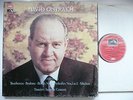
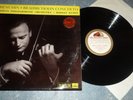
You are bidding on a LP record:JOHANNES BRAHMS
CONCERTO IN D, Op. 77
HENRYK SZERYNG, violinist
LONDON SYMPHONY ORCHESTRA
PIERRE MONTEUX, conductor
recorded in England
RCA VICTOR LIVING STEREO
RCA LSC-2281
shaded dog on labels
Inspection rubberstamp on rear cover
1959
.
satnrose
·
Matrix numbers end with "1/S" on both sides
.
.
The cover is slightly worn
The record itself appears to be in fine condition
We have not tested its quality by playing it.
If you are dissatisfied with it, we will refund your money.
In other words, you have nothing to lose by bidding!
.
.
Message from a satisfied customer:"I am not sure where you got this LP but if you come across any others in this kind of shape I will gladly pay you twice as much for them. This LP is in perfect shape! Thanks again."
Our response:
"Although we don't test records by playing them, I am very careful about buying only those records that appear to be in superb condition. That means I buy about one record for every 100 that I look at. We don't sell a lot of records, but our record buyers have been happy with their purchases 99%+ of the time. ..."
.
.
·
Another Q & A:
Q: Concerning the condition of this record - I am un-familiar with the term near fine!! In the record collector field the terms that are used for all except 78s are g Good Vg Very Good VG+ slight wear and signs of use M- Mint Midus - Played but looks almost like new M Mint Unused New Pristine no marks or signs of wear. Using the above kindly descibe the condition. thanks M___A: M___: Since I didn't play the record to judge its quality, then any statement I might make of condition is just a guess. So, I deliberately refuse to use Goldmine terminology, because I don't want to mislead people. It is my hope that, when seeing my descriptions, they will realize that my description is just a guess based on visual appearance. Besides, since I offer an unconditional guarantee, that should pose no problem. ... - Good luck! - Joel of satnrose ...
.
.
.
The following information was taken from the Wikipedia:
Violin Concerto in D major, Op. 77 is a violin concerto in three movements composed by Johannes Brahms in 1878 for and dedicated to his friend, violinist Joseph Joachim. It was Brahms' only violin concerto, and, according to Joachim, one of the four great German violin concerti.
It is scored for solo violin and an orchestra consisting of flutes, oboes, clarinets, bassoons; 4 horns, 2 trumpets, timpani, strings.
It follows the standard concerto form, with three movements in the pattern quick-slow-quick:
Allegro non troppo (D major)
Adagio (F major)
Allegro giocoso, ma non troppo vivace - Poco più presto (D major)
Originally, the work was planned in four movements like the second piano concerto. The middle movements, one of which was intended to be a scherzo — a mark that Brahms intended a symphonic concerto rather than a virtuoso showpiece — were discarded and replaced with what Brahms called a "feeble Adagio." Some of the discarded material was reworked for the second piano concerto.
Brahms, who was impatient with the minutiae of slurs marking the bowing, rather than phrasing, as his usual practice was, asked Joachim's advice on the writing of the solo violin part. Joachim, who had first been alerted when Brahms informed him in August that "a few violin passages" would be coming in the mail, was eager that the concerto should be playable and idiomatic, and collaborated willingly, not that all his advice appeared in the final score. The most familiar cadenza, which appears in the first movement, is by Joachim, though a number of people have provided alternatives, including Leopold Auer, Max Reger, Fritz Kreisler, Jascha Heifetz, George Enescu, Nigel Kennedy and Rachel Barton Pine. A recording of the concerto released by Ruggiero Ricci has been coupled with Ricci's recordings of sixteen different cadenzas.
The work was premiered in Leipzig on January 1, 1879 by Joachim, who insisted on opening the concert with the Beethoven Violin Concerto, written in the same key, and closing with the Brahms. Joachim's decision could be understandable, though Brahms complained that "it was a lot of D major—and not much else on the program." Joachim was not presenting two established works, but one established one and a new, difficult one by a composer who had a reputation for being difficult. The two works also share some striking similarities. For instance, Brahms has the violin enter with the timpani after the orchestral introduction: this is a clear homage to Beethoven, whose Violin concerto and "Piano Concerto No. 6" (a transcription of that same concerto) also make unusual use of the timpani.
Brahms conducted the premiere. Various modifications were made between then and the work's publication by Fritz Simrock later in the year.
Critical reaction to the work was mixed: the canard that the work was not so much for violin as "against the violin" is attributed equally to conductor Hans von Bülow and to Joseph Hellmesberger, to whom Brahms entrusted the Vienna premiere, which was however rapturously received by the public. Henryk Wieniawski called the work "unplayable", and the violin virtuoso Pablo de Sarasate refused to play it because he didn't want to "stand on the rostrum, violin in hand and listen to the oboe playing the only tune in the adagio."
Against these critics, modern listeners often feel that Brahms was not really trying to produce a conventional vehicle for virtuoso display, as his peers perhaps had not expected him to; Brahms had higher musical aims. Similar criticisms have been voiced over the string concerti of other great composers, such as Ludwig van Beethoven's violin concerto[citation needed] or Hector Berlioz's Harold in Italy for having the soloist be "almost part of the orchestra."
The cadenza in the finale is notable for being accompanied by the orchestra.
The Violin Concerto is considered one of the most important works in the violin repertoire. The technical demands on the soloist are formidable, with generous use of multiple stopping, broken chords, rapid scale passages, and rhythmic variation. The difficulty might be attributed to Brahms being chiefly a pianist (this may also explain the technical demands Tchaikovsky made in his violin concerto).
Brahms chose the violin-friendly key of D major for his concerto. Since the violin is tuned G'D'A'E, the open strings, resonating sympathetically, add brilliance to the sound. For this reason, composers of all eras (e.g. Bach, Mozart, Beethoven, Schumann, Tchaikovsky, Sibelius, Prokofiev, Korngold and Khachaturian) have written violin concertos in either D major or D minor.
.
.
.
.
The following information was taken from the Wikipedia:
Henryk Szeryng (22 September 1918 – 8 March 1988) was a violin virtuoso of Polish and Jewish heritage.... For the rest of the article, click here: wikipedia.
.
To see our other auctions: click here *
.
Shipping and Handling in the USA is $4.00
Foreign bidders must pay more for postage
We always ship records in a box,
not an envelope.
.
We accept payment by PAYPAL
.
International Buyers – Please Note:Import duties, taxes and charges are not included in the item price or shipping charges. These charges are the buyer's responsibility.
Please check with your country's customs office to determine what these additional costs will be prior to bidding/buying.
These charges are normally collected by the delivering freight (shipping) company or when you pick the item up – do not confuse them for additional shipping charges.
We do not mark merchandise values below value or mark items as "gifts" - US and International government regulations prohibit such behavior.
.
One more thing, and please note:
we never never never use "Second Chance Offers" ,
so, if you get a message
offering you a second chance to buy this item after the auction closes -
IT IS SPAM ! Do not reply!
.
.
Click here for a guide toA Book That Looks Like Nothing
Also:
Satnrose's Bookselling Hints
and
Tip of the Day
and, just for fun:
Deposit Haiku Here
¼ ½ ¾ ·
·
---
price rating