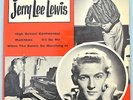
BUDDY HOLLY. " RAVE ON / TAKE YOUR TIME" CORAL UK 1958 ORIG TRI.EX.
£
15
$
20


Favourite Auctions
To save auctions to your favourites, please login
If you don't have an account, please register
Description
Buddy Holly ?– Rave On / Take Your Time
Label: Coral ?– 45-Q 72325 Format: Vinyl, 7", Single, 45 RPMCountry: UK Released: 1958 Genre: Rock Style: Rock & Roll, Rockabilly
TracklistHide Credits
A Rave On Written-By – Bill Tilghman, Norman Petty, Sonny West B Take Your Time Written-By – Buddy Holly, Norman PettyArtist Biography by Bruce Eder
The "Crickets" started out as pure fiction -- the name a ruse used by Buddy Holly, Jerry Allison, andJoe B. Mauldin to avoid the provisions of a 1956 contract that Holly had signed with Decca Records, that would have prevented the release of their then-new recording of "That'll Be the Day" on the Brunswick label. The name stuck, and for the next 15 months, there were records by the Crickets and records by Buddy Holly -- which were virtually interchangeable -- and they were billed as Buddy Holly & The Crickets. By the end of 1958, however, the references to "Buddy Holly and the Crickets" were becoming valid in the worst possible way -- Holly's shifting and expanding musical interests, coupled with his move to New York and marriage to Maria Elena Santiago, and the differing relationships that the three had with their manager, Norman Petty, led to a split between Holly and his bandmates in the months immediately prior to Holly's death in a plane crash on February 3, 1959.
The result of their split was a separate existence for the Crickets. Jerry Allison became de facto leader of the group, and they were soon a quartet again, with Sonny Curtis on guitar and Earl Sinks as lead singer. In 1959, still managed and produced by Norman Petty, they recorded "Love's Made a Fool of You" backed with "Someone, Someone," which failed to chart. Their next serious assault on the charts -- a version of Curtis' "I Fought the Law" cut for Coral Records -- vanished without a trace in 1959, and their rendition of "More Than I Can Say" also failed to find an audience for them, though it did wonders for Bobby Vee and, by extension, for Curtis as its composer. They recorded a handful of singles for Coral Records, and later signed to Liberty Records with Jerry Naylor in the lead singer spot (sometimes switching off with Sonny Curtis), in addition to recording with Buddy Holly soundalikeBobby Vee.
The group recorded for Liberty for four years, from 1961 through 1965, even doing their versions of several Beatles songs, but apart from a pair of minor hits, "My Little Girl" and "Please Don't Ever Change," were unable to generate any enthusiasm. One of Naylor's successors, David Box, died in a plane crash in 1964. They did find some lingering success in England, and the group even managed to appear in two jukebox movies on either side of the Atlantic, Just for Fun (1963) in England (doing "My Little Girl" and "Teardrops Feel Like Rain") and The Girls on the Beach (1965) in America (doing "La Bamba"), but by the end of the '60s, Mauldin had left music while Allison was singing lead; he andCurtis were also working as session musicians, and Curtis scored a huge success at the dawn of the '70s as the composer of the theme song for The Mary Tyler Moore Show.
Allison and Curtis were the core of the group in the early 1970's, mostly working as a touring act rather than a recording outfit, though new records did appear on various labels, including Mercury and MCA. In the wake of the revival of interest in Holly's music at the end of the '70s, the Crickets re-formed on a steady basis, with Joe B. Mauldin returning to the lineup after more than a decade out of music. In 1986, Curtis left the fold to re-establish himself as a solo performer, and was replaced by Gordon Payne on vocals. In 1988, they recorded the single "T-Shirt," produced by longtime fan Paul McCartney, which became a minor hit and led to the release of an LP of the same name from Epic Records -- their presence in record stores, however, is usually restricted to the Buddy Holly period and their early-'60s history.
Strictly Graded - RECORD COLLECTOR Grading System.
Grading System: In order to assist everyone who buys and sells rare discs, Record Collector magazine has originated a set of standards for the condition of second-hand records, I have added a (+) or (-) to my gradings where applicable.
MINT: The record itself is in brand new condition with no surface marks or deterioration in sound quality. The cover and any extra items such as the lyric sheet, booklet or poster are in perfect condition. Records advertised as Sealed or Unplayed should be Mint.
EXCELLENT: The record shows some signs of having been played, but there is very little lessening in sound quality. The cover and packaging might have slight wear and/or creasing.
VERY GOOD: The record has obviously been played many times, but displays no major deterioration in sound quality, despite noticeable surface marks and the occasional light scratch. Normal wear and tear on the cover or extra items, without any major defects, is acceptable.
GOOD: The record has been played so much that the sound quality has noticeably deteriorated, perhaps with some distortion and mild scratches. The cover and contents suffer from folding, scuffing of edges, spine splits, discoloration, etc.
FAIR: The record is still just playable but has not been cared for properly and displays considerable surface noise; it may even jump.
The cover and contents will be torn, stained and/or defaced.
POOR: The record will not play properly due to scratches, bad surface noise, etc. The cover and contents will be badly damaged or partly missing.
BAD: The record is unplayable or might even be broken, and is only of use as a collection-filler.
POSTAGE DISCOUNTS FOR MULTIPLE PURCHASES.REQUEST INVOICE PRIOR TO PAYMENT SO YOU BENEFIT.
price rating



![[NEW] Velvet Goldmine Soundtrack LP 2019 Blue Orange VINYL ROXY MUSIC BRIAN ENO](https://www.popsike.mobi/php/thumbnail.php?url=https://www.popsike.pics/pix/20240418/296374097096.jpg)