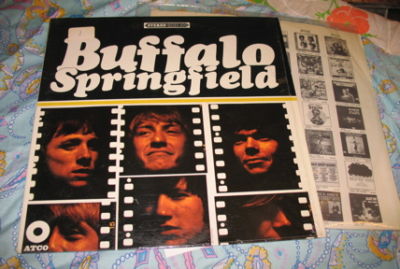
BUFFALO SPRINGFIELD s/t LP 1st press w/o FWIT NM/VG+
$
248


Favourite Auctions
To save auctions to your favourites, please login
If you don't have an account, please register
Description
BUFFALO SPRINGFIELD s/t LP
1966 Atco (SD 33-200) stereo press still in original shrinkwrap. This is the original press without “For What It’s Worth” and includes “Baby Don’t Scold Me”, which was omitted from subsequent pressings to fit the hit. The Vinyl is very clean/NM Sleeve/VG+…Buffalo Springfield was a folk rock group that served as a springboard for the careers of Neil Young, Stephen Stills, Richie Furay and Jim Messina, two of whom played in rock group Crosby, Stills, Nash and Young later in their career. Buffalo Springfield is best known for the song "For What It's Worth". After the band's formation in April 1966, a series of disruptions, including infighting and the pressure of working in the music industry, resulted in constant changes in the group's lineup and ultimately culminated in the group's disbanding after roughly 25 months. Buffalo Springfield released a total of three albums but left many demo recordings, studio outtakes and live recordings, as well as a reputation for excellent musicianship and high band dysfunction.[1] Despite the band's short tenure and relatively limited output it was one of the most influential bands of the 1960s, with virtually all members going on to successful careers and with two (Stills and Young) reaching the very top levels of rock stardom.
Neil Young and Stephen Stills first crossed paths in 1965 at the Fourth Dimension in Thunder Bay, Ontario.[2] Young was there with The Squires, a Winnipeg group he had been leading since February 1963, and Stills was on tour with The Company, a spin off from the Au Go Go Singers. Although the two would not see each other again for almost a year, the encounter left both with a strong desire to work together.
When The Company broke up at the end of that tour, Stills moved to the West Coast, where he worked as a studio musician and auditioned unsuccessfully for, among other things, The Monkees.[3] (He was rejected on the grounds that "your hair and teeth aren't photogenic." Asked whether he knew anyone who looked like him, he suggested that Peter Tork audition; Tork was hired.) Told by record producer Barry Friedman that there would be work available if he could assemble a band, Stills invited fellow Au Go Go Singers alumnus Richie Furay and former Squires bass player Ken Koblun to come join him in California. Both agreed, although Koblun chose to leave before very long and rejoined the group 3's a Crowd.
In early 1966 in Toronto, Young met Bruce Palmer, a Canadian who was playing bass for a group called the Mynah Birds. In need of a lead guitarist, Palmer invited Young to join the group, and Young accepted. The Mynah Birds were set to record an album for Motown Records when their singer Ricky James Matthews (later known as Rick James) was arrested for draft evasion. With their record deal canceled, Young and Palmer decided to head for Los Angeles where they hoped to hook up with Stills.
Roughly a week later, discouraged at having been unable to locate Stills and ready to depart for San Francisco, they were stuck in traffic on Sunset Boulevard in Los Angeles when Stills, Furay and Friedman, sitting in their white van, recognized Young’s black 1953 Pontiac hearse, which happened to be passing by in the opposite direction. After an illegal u-turn by Furay, some shouting, hand-waving, and much excitement, the four musicians realized that they were united in their determination to put together a band. Drummer Dewey Martin, who had played with country artists such as Patsy Cline and The Dillards, was added to the roster less than a week later after contacting the group at the suggestion of the Byrds' manager, Jim Dickson.
Taking their name from the side of a steamroller—made by the Buffalo-Springfield Roller Company—that had been parked on the street outside Friedman’s house (where Stills and Furay were staying), the new group debuted on April 11, 1966 at The Troubadour in Hollywood. A few days later, they began a short tour of California as the opening act on a bill featuring the Dillards and the Byrds.
[edit] Management and first recordings
No sooner had the Byrds' tour ended than Chris Hillman persuaded the owners of the Whisky a Go Go to give the band an audition. Buffalo Springfield essentially became the house band at the Whisky for seven weeks, from May 2 to June 18, 1966. This series of concerts solidified the band’s reputation for exhilarating live performances and attracted interest from a number of record labels. It also brought an invitation from Friedman to Dickie Davis, who had been lighting manager for the Byrds, to become involved in the group’s management. In turn, Davis sought advice from Sonny & Cher’s management team, Charlie Green and Brian Stone. They eventually struck a deal with Ahmet Ertegün of Atlantic Records and arranged for the band to start recording at Gold Star Studios in Hollywood.
Young, Stills and Furay would all record demos for the album, but Greene and Stone, who had installed themselves as the album's producers, deemed Young's voice "too weird" and assigned lead vocals on the majority of Young's songs to Furay.
The first Buffalo Springfield single, “Nowadays Clancy Can’t Even Sing”, was released in August but made little impact outside of Los Angeles, where it reached the Top 25. The group was dissatisfied with and reworked some of their early recording efforts for the rest of the album. In fact, Young and Stills have long maintained that their own mono mix was superior to the stereo mix engineered by Greene and Stone. The album—eponymously titled Buffalo Springfield—was originally released by Atlantic’s subsidiary Atco in mono and in stereo in December 1966. A revamped version (see below) issued both in mono and stereo with a different track order, came in March 1967.
In November 1966 Stills composed his landmark song, "For What It's Worth", after witnessing police actions against the crowds of young people who had gathered on the Sunset Strip to protest the closing of a nightclub called Pandora's Box. The song was performed on Halloween night at the Whisky a Go Go, recorded within the next few days, and on the air in Los Angeles on radio station KHJ soon after. By March 1967 it was a Top Ten hit. Atco took advantage of this momentum by replacing the song "Baby Don't Scold Me" with "For What It's Worth" and re-releasing the album…. Payment:
Due within 10 days of auction end unless other arrangements have been made prior to bidding.
Shipping & packaging:
I package your records with the highest level of professionalism, using the best packing materials available. All shipping rates, including combined shipping is listed below. I will ship via priority or registered mail on request.
United States:
7" records and CD’s: $3.50 - .50 each additional.
10” records, LPs, 2xLPs, 3xLPs: $4.00 (media mail) - $1.00 each additional
Priority mail is $8.00-$1.00 each additional
Canada:
7" records/CD’s: $5.00 - $1 each additional.
LPs & 10": $9.00 - $2 each additional.
Double LPs, 180 & 220 gram records: $10 - $2.00 each additional.
Triple LPs, 2x 180 & 2x 220 gram records: $11.00 - $2.50 each additional.
International:
7" records/CD’s: $7.00- $1.50 each additional.
LPs & 10": $14 - $2.50 each additional
Double LPs, 180 & 220 gram records: $17.50 - $3.00 each additional
Triple LPs, 2x 180 & 2x 220 gram records: $18.50 - $3.50 each additional.
PACKAGING: I pack and mail items with care, I ship all LP’s in a new rigid custom LP mailer and filler pads with the disc, in the inner sleeve, placed behind cover to prevent seam splitting. I DO NOT use flimsy "freebie" post office priority mailers!
GRADING
(M) Mint : Absolutely perfect in every way - certainly never played, possibly even still sealed. (More on still sealed below). Should be used sparingly as a grade, if at all.
(NM or M-) Near Mint : A nearly perfect record. Many dealers won't give a grade higher than this implying (perhaps correctly) that no record is ever truly perfect. The record shows no obvious sign of wear. A 45-rpm sleeve has no more than the most minor defects, such as almost invisible ring wear or other signs of slight handling. An LP jacket has no creases, folds, seam splits or any other noticeable similar defect. No cutout holes, either. And of course, the same is true of any other inserts, such as posters, lyric sleeves, and the like. Basically, Near Mint looks as if you just got it home from a new record store and removed the shrink-wrap.
(VG+) Very Good Plus: Shows some signs that it was played and otherwise handled by a previous owner who took good care of it. Record surfaces may show some slight signs of wear and may have slight scuffs or very light scratches that don't affect one's listening experience. Slight warps that do not affect the sound are OK. The label may have some ring wear or discoloration, but is should be barely noticeable. The center hole is not misshapen by repeated play. Picture sleeves and LP inner sleeves will have some slight wear, lightly turn-up corners, or a slight seam-split. An LP jacket my have slight signs of wear also and may be marred by a cut-out hole, indentation or corner indicating it was taken out of print and sold at a discount. In general, if not for a couple of minor things wrong with it, this would be Near Mint. All but the most mint-crazy collectors will find a Very Good Plus record highly acceptable.
(VG) Very Good : Many of the defects found in a VG+ record are more pronounced in a VG disc. Surface noise is evident upon playing, especially in soft passages and during the song's intro and fade, but will not overpower the music otherwise. Groove wear will start to be noticeable, as will light scratches (deep enough to feel with a fingernail) that will affect the sound. Writing may mar labels, or have tape or stickers (or their residue) attached. The same will be true of picture sleeves or LP covers. However, it will not have all of these problems at the same time, only two or three of them.
(G) Good, (G+) Good Plus: Good does not mean bad! A record in Good or Good Plus condition can be put onto a turntable and will play through without skipping. But it will have significant surface noise and scratches and visible groove wear. A jacket or sleeve has seem splits, especially at the bottom or on the spine. Tape, writing, ring wear or other defects will start to overwhelm the object. If it's a common item, you'll probably find another copy in better shape eventually. Pass it up. But if it's something you have been seeking for years, and the price is right, get it.
(P) Poor , (F) Fair: The record is cracked, badly warped, and won't play through without skipping or repeating. The picture sleeve is water damaged, split on all three seams and heavily marred by wear and/or writing. The LP jacket barely keeps the LP inside it. Inner sleeves are fully seam split, and written upon. Except for impossibly rare records otherwise unattainable, records in this condition should be bought or sold for no more than a few cents each.
ABBREVIATIONS: WOC- writing on cover, WOL-writing on label, DH-drillhole/punchhole, PRST-promo stamp or sticker, RSST-radio station stamp, TSM-taped seam, SPSM-split seam, TOC-tear on cover, SMW-seamwear/scuffed seams (not split), STKRES-sticker residue/glue, RW-ringwear, CC-cut corner
price rating




![DOCTOR BIRD/MOVE UP - AL & THE VIBRATORS/THE FUGITIVES [R/STEADY] 7](https://www.popsike.mobi/php/thumbnail.php?url=https://www.popsike.pics/pix/20150805/301705081781.jpg)