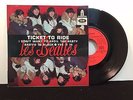
BeaTles TICKET TO RIDE & YES IT IS - 45rpm pic slv VG++
$
35


Favourite Auctions
To save auctions to your favourites, please login
If you don't have an account, please register
Description
IF YOU ARE NOT PLEASED WITH ANY of my SHIPPING RATES or INSTRUCTIONS
PLEASE DO NOT BID !!
PLEASE READ COMPLETE ITEM DESCRIPTION BEFORE BIDDING
_______________________________________
ALL VINYL IS RATED VISUALLY
UNDER DIRECT SUNLIGHT & BRIGHT INCANDESCENT LIGHT
________________________
SORRY - NO RETURNS
Review the photos carefully, use them to determine if the item meets your standards. Ratings vary greatly from person to person so PLEASE BE SURE you want this item
--- BEFORE BIDDING ---
all sales final --- All Sales Final --- ALL SALES FINAL
__________
PAYMENT MUST BE RECEIVED WITHIN:
3 DAYS
AFTER AUCTION CLOSE!!
OR
SELLER RESERVES THE RIGHT TO CANCEL SALE AND RELIST THE ITEM
_________________
I TRY to ship within 48hrs. of payment!!!
_________________________
SEE GOLDMINE RECORD GRADING INFORMATION at VERY BOTTOM
NOW THAT the SMALL PRINT is OUT of the WAY
UP FOR AUCTION IS:
ORIGINAL 1965 CAPITOL RECORDS
PRESSING
OF
The BeaTles
"TICKET TO RIDE"
B/W
"YES IT IS"
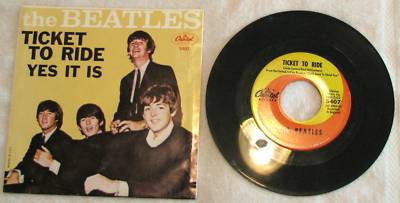
45 RPM w/picture sleeve
CAPITOL #5407
Vinyl: VG+
LABELS READ: "FROM THE UNITED ARTISTS RELEASE "EIGHT ARMS TO HOLD YOU"
TICKET TO RIDE
WAS THE FIRST RELEASE SONG FROM
A FILM PROJECT WHICH EVENTUALLY BECAME
HELP!
____
Sleeve: NEAR MINT MINUS
EXAMINE THE PHOTOS OF THIS SLEEVE VERY VERY CLOSELYTHE BACKGROUND IS NOT AS GREENISH AS FIRST PRESSINGS
AND I SUSPECT ONE of TWO POSSIBILITIES:
1) IT IS A RE-ISSUE
I HAVE NEVER HEARD OF THIS RECORD BEING REISSUED
OR, THE MORE LIKELY PROBABILITY
2) IT IS A REPRODUCTION
PLEASE TAKE THIS INTO CONSIDERATION BEFORE YOU BID
and
__________________________
SOME HISTORY ABOUT THIS RECORD
Ticket to Ride
Single by The Beatles from the album Help! B-side "Yes It Is" Released 9 April 1965 Format 7" Recorded 15 February 1965
Abbey Road Studios Genre Rock Length 3:10 Label Parlophone Writer(s) Lennon/McCartney Producer George Martin The Beatles singles chronology "I Feel Fine"
(UK-1964)
—
"Eight Days a Week"
(US-1965) "Ticket to Ride"
(1965) "Help!"
(1965)
[show]14 tracks Side one
- "Help!"
- "The Night Before"
- "You've Got to Hide Your Love Away"
- "I Need You"
- "Another Girl"
- "You're Going to Lose That Girl"
- "Ticket to Ride"
- "Act Naturally"
- "It's Only Love"
- "You Like Me Too Much"
- "Tell Me What You See"
- "I've Just Seen a Face"
- "Yesterday"
- "Dizzy Miss Lizzy"
"Ticket to Ride" is a song by The Beatles from their 1965 album, Help!. It was recorded 15 February 1965 at Abbey Road Studios and released two months later. In 2004, this song was ranked number 384 on Rolling Stone magazine's list of the 500 greatest songs of all time.
Composition
The song was written primarily by John Lennon (credited to Lennon/McCartney), with Paul McCartney's contributions in dispute. Lennon said that McCartney's contribution was limited to "the way Ringo played the drums".[1] McCartney said that was an incomplete description, and that "we sat down and wrote it together... give him 60 percent of it... we sat down together and worked on that for a full three-hour songwriting session."[2] This song was also the first song by the band in which McCartney was featured on lead guitar.
Lennon proudly claimed that it was the first heavy metal song given the droning bassline, repeating drums, and loaded guitar lines.[1]
The song features a coda with a different tempo.[3] Lennon said this double-time section (with the lyric "My baby don't care") was one of his "favourite bits" in the song.[4]
Meaning of "ticket to ride"
While the song lyrics describe a girl "riding out of the life of the narrator",[5] the inspiration of the title phrase is unclear. McCartney said it was "a British Railways ticket to the town of Ryde on the Isle of Wight",[2] and Lennon said it described cards indicating a clean bill of health carried by Hamburg prostitutes in the 1960s.[5] The Beatles played in Hamburg early in their musical career, and "ride/riding" was slang for having sex. [NOTE: Lennon was known to have an overtly dry sense of humor, and often would give ridiculous explanations when asked what any specific song "really" meant.]
Release
"Ticket to Ride" was released as a single on 9 April 1965 in the UK and 19 April in the US with "Yes It Is" as its B-side,[6] topping the Hot 100 for a week in the US and the UK Singles Chart for three weeks in the UK. The American single's label declared that the song was from the United Artists release Eight Arms to Hold You. This was the original title of The Beatles' second movie; the title changed to Help! after the single was initially released.[7] The song was also included on the Help! album released on 6 August in the UK and on 13 August in the US.
The song was the third of six number one singles in a row on the American charts, a record at the time,[citation needed] along with "I Feel Fine", "Eight Days a Week", "Help!", "Yesterday", and "We Can Work It Out".[8] The record was equaled by The Bee Gees in the 1970s
Critical response
Music critics Richie Unterberger of allmusic and Ian MacDonald both describe "Ticket to Ride" as an important milestone in the evolution of the musical style of the Beatles. Unterberger said, "the rhythm parts on 'Ticket to Ride' were harder and heavier than they had been on any previous Beatles outing, particularly in Ringo Starr's stormy stutters and rolls."[9] MacDonald described it as "psychologically deeper than anything The Beatles had recorded before ... extraordinary for its time — massive with chiming electric guitars, weighty rhythm, and rumbling floor tom-toms. Macdonald also notes that the track uses the Indian basis of drone which might have influenced the Kinks' "See My Friends".[10]
Chart 1965 Peakposition Canadian Singles Chart 1 UK Singles Chart 1 US Billboard Hot 100 1 NL Top 40 1
Personnel
- John Lennon – double tracked vocal, rhythm guitar
- Paul McCartney – harmony vocal, bass, lead guitar
- George Harrison – harmony vocal, rhythm guitar
- Ringo Starr – drums, tambourine, handclaps
MacDonald wrote that Lennon played a Jetglo Rickenbacker 325 twelve-string guitar, and that George Harrison was "probably" playing his 12-string Rickenbacker 360/12 guitar.[12]
Preceded by"The Minute You're Gone" by Cliff Richard UK number one single
22 April 1965 (three weeks) Succeeded by
"King of the Road" by Roger Miller Preceded by
"Mrs. Brown, You've Got a Lovely Daughter" by Herman's Hermits Billboard Hot 100 number one single
22 May 1965
(one week) Succeeded by
"Help Me, Rhonda" by The Beach Boys
The Carpenters' version
"Ticket to Ride" Single by The Carpenters from the album Offering/Ticket to Ride B-side "Your Wonderful Parade" Released 1969 Format 7" single Recorded 1969 Genre Pop Length 04:10 Label A&M Records1183 Writer(s) Lennon/McCartney Producer Jack Daugherty The Carpenters singles chronology "Looking for Love*" (1966) "Ticket to Ride" (1969) "(They Long to Be) Close to You" (1970)
In 1969, it was released by The Carpenters on their album, Offering/Ticket to Ride, and it became a minor hit. The song stalled at number #54 on the Billboard Hot 100 for three weeks and #19 on the adult contemporary. The Carpenters recorded the song as a slower ballad. They released their debut album of the same name.
Chart 1969 Peakposition US Billboard Hot 100 54 US Billboard Adult Contemporary 19
Other cover versions
Many artists have covered "Ticket to Ride", including Vanilla Fudge (1967), The 5th Dimension (1967 on The Magic Garden), Hüsker Dü (1986), Sly and Robbie (1987), The Punkles, Kids Incorporated (1993), and Atomic Kitten (2007).
Cultural references
An orchestral version of the song is barely audible in the fadeout at the very end of the Pink Floyd album The Dark Side of the Moon. Initially this phenomenon was considered a mistake in remastering. However it is audible on high quality vinyl pressings from the time before the CD era as well. The Beatles and Pink Floyd both recorded at Abbey Road Studios.
The song is referenced in "Artificial Energy", by The Byrds, the opening track of The Notorious Byrd Brothers from 1968.
The title of this song is referenced to in the Red Dwarf episode Tikka to Ride, in accordance with the theme of curry on which the storyline focuses.
In a Doctor Who episode titled "The Executioners," the First Doctor and his companions Ian Chesterton, Barbara Wright, and Vicki watch the Beatles perform "Ticket To Ride" on the Doctor's recently acquired time/space visualiser. The clip shown is about 15 seconds long and was of a mime performance the band gave on Top of the Pops shortly before the recording of the Doctor Who episode. It is the only footage of this performance known to exist.
______________________________The GOLDMINE STANDARD
for
RECORD GRADING
THE TRUTH BEHIND THE GRADES
Most of the time, LPs are sold with two grades — one for the record and one for the cover. We list only one grade, however, because with some exceptions, albums without covers are worthless, and covers without the accompanying record are worthless. If an album is graded VG for the cover and VG+ for the record, add the two values together and divide by 2 to get a rough estimate of the value of a “mixed-grade” LP.
Most records are graded visually. This is because most record dealers have lot of records — hundreds of thousands in some cases — and they don’t have the time to play their entire stock. That said, some defects are easy to see, such as scratches and warps. Others are subtle, such as groove wear from using a cheap or poorly aligned tone arm. It has been our experience that older LPs (1950s to about 1971) tend to play better than they look, and newer LPs (at least until 1989) tend to play worse than they look.
When grading your records, do so under a strong light. Look at everything carefully, and then assign a grade based on your overall observations.
______________________________________________________
Here are the standard grades for record albums, from best to worst.
SEALED ALBUMS
Still-sealed albums can — and do — bring even higher prices than those in our listings. However, you must be careful when paying a premium for sealed LPs of any kind for several reasons:
1. They may have been re-sealed.
2. The records may not be in Near Mint condition.
3. The record inside may not be the original or most-desirable pressing.
4. Most bizarre of all, the wrong record my be inside. (I’ve had this happen to me; I opened a sealed album by on MCA artist only to find a record by a different MCA artist inside! Fortunately, I didn’t pay a lot of or that sealed LP. I would have been quite upset if I had!)
MINT (M)
These are absolutely perfect in every way. Often rumored but rarely seen, Mint should never be used as a grade unless more than one person agrees that the record or sleeve truly is in this condition.
There is no set percentage of the Near Mint value these can bring; it is best negotiated between buyer and seller.
NEAR MINT (NM OR M-)
A good description of a NM record is “it looks like it just came from a retail store and it was opened for the first time.” In other words, it’s nearly perfect.
Many dealers won’t use a grade higher than this, implying (perhaps correctly) that no record or sleeve is ever truly perfect.
Near mint records are shiny and free of visible defects. No writing, stickers, other markings or spindle marks appear on the label. No major factory defects are present; a record and label obviously pressed off center is not Near Mint.
If played, an NM record will do so without surface noise. Near Mint records don’t have to be “never played”; a record used on an excellent turntable can remain NM after many plays if the disc is properly cared for.
NM covers have no creases, ring wear or seam splits of any kind.
These are high standards, and they are not on a sliding scale. A record or sleeve from the 1950s must meet the same standards as one from the 1990s or 2000s to be Near Mint!
It is estimated that no more than 2 to 4 percent of all records remaining from the 1950s and 1960s are truly Near Mint. This is why they fetch such high prices, even for more common items. They must meet these standards to qualify.
VERY GOOD PLUS (VG+) OR EXCELLENT (E)
A good description of a VG+ Record is “except for a couple of minor things, this would be Near Mint.”
Most collectors, especially those who want to play their records, will be happy with a VG+ record, especially if it is toward the high end of the grade, (sometimes called VG++ or E+).
VG+ records may show some slight signs of wear, including light scuffs or very light scratches that do not affect the listening experience. Slight warps that don’t affect the sound are OK. Minor signs of handling are OK, too, such as telltale marks around the center hole, so long as repeated playing has not misshapen the hole. There may be some very light ring wear or discoloration, but it should be barely noticeable.
VG+ Covers should have only minor wear. A VG+ cover might have some very minor seam wear or a split (less than one inch long) at the bottom, the most vulnerable locataion. Also, a VG+ cover may have some defacing, such as a cut-out marking. Covers with cut-out markings can never be considered Near Mint.
VERY GOOD (VG)
Many of the imperfections found on a VG+ Record are more obvious on a VG record. That said, VG records — which usually sell for no more than 25 percent of a an NM record — are among the biggest bargains in record collecting, because moost of the “big money” goes for more perfect copies. For many listeners, a VG record or sleeve will be worth the money.
VG records have more obvious flaws than their counterparts in better shape. They lack most of the original gloss found on factory-fresh records. Groove wear is evident on sight, as are light scratches deep enough to feel with a fingernail.
When played, a VG record has surface noise, and some scratches may be audible, especially in soft passages and during a song’s intro and ending. But the noise won’t overpower the music otherwise. Minor writing, tape or a sticker can detract from the label. Many collectors who have jukeboxes will use VG records in them and not think twice. They remain a fine listening experience, just not the same as if it were in better shape.
VG covers will have many signs on human handling. Ring wear in the middle or along the edges of the cover, where the edge of a record would reside, is obvious; it may appear on all three sides, thought it won’t be obvious upon looking. Someone might have written on it or stamped a price tag on it, too.
GOOD (G), GOOD PLUS (G+) OR VERY GOOD MINUS (VG-)
Lower-grade records go for 10 to 15 percent of the Near Mint value, if you are lucky.
Good does not mean bad! The record still plays through without skipping, so it can serve as filler until something better comes along. But it has significant surface noicse and groove wear. The label is worn and exhibits significant ring wear, heavy writing or obvious damage caused by tring to remove tape or stickers and failing miserably.
A Good to VG- cover has ring wear to the point of distraction, has seam splits obvious on sight and may have even heavier writing, such as huge radio station letters written across the front to deter theft.
If the item is common, it’s probably better to pass it up. But if you’ve been seeking it for a long time, get it cheap and look to upgrade.
POOR (P) AND FAIR (F)
Poor and Fair records go for 0 to 5 percent of the Near Mint value, if they go at all.
More likely, they end up going in the trash. Records are cracked, impossibly warped or skip and/or repeat when an attempt is made to play them. Covers are so heavily damaged that you almost want to cry.
Only the most outrageously rare items ever sell for more than a few cents in this condition — again, if they sell at all
7" - standard 45 RPM co - cut-out pc - picture sleeve sl - slight UK- United Kingdom (British Pressing) 10" - 10-inch vinyl LP dj - Disc Jockey (promo) pi - picture Insert (CD Single) sm spl - Seam Split US - United States (domestic pressing) 12" - 12-inch single ep - Extended Play promo - promotional copy soc - sticker on cover va - various artists bb - bb hole in cover imp - import ps - picture sleeve (45) sol - slicker on label wlp - white label promo boot - bootleg lp - 12" vinyl album quad - quadraphonic ss - still sealed woc - writing on cover cc - cut corner m - mono Lp re - reissue s/t - self titled wol - writing on label cd - compact disc nap - not affecting play ri - reissue tc - title cover (12" and CD's) xol - "x" on label cd3 - 3" compact disc single non-lp- not on full-length LP or CD rpm - revolutions per minute ti - title insert (CD single) * check the context, as "m" can also mean "mint" cd5 - 5" compact disc single oc - original cast recording rw - ring wear toc - tape on cover coh - cut-out-hole ost - original soundtrack s - stereo Lp tol - tape on label
price rating




![Sweet, The ? Fanny Adams ? Spain 1974 ? LP [VG]](https://www.popsike.mobi/php/thumbnail.php?url=https://www.popsike.pics/pix/20200723/353148199969.jpg)