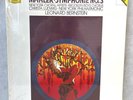
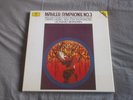
Bernstein/NYPO: Mahler Symphony No. 3 (r. 1987, DDD) - DGG 427 328-1
$
250


Favourite Auctions
To save auctions to your favourites, please login
If you don't have an account, please register
Description
ITEM DESCRIPTION:
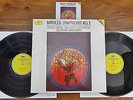
This beautiful and now rare 2LP box set, a fine collector’s copy, from Deutsche Gramophone (427 328-1, German pressing, white circle label, DDD stereo, booklet included) features Leonard Bernstein and the New York Philharmonic Orchestra’s impassioned and searching account of Mahler’s Symphony No. 3 in D minor, recorded “live” at Avery Fischer Hall, New York City, in November 1987 (producer: Hanno Rinke / recording supervision: Hans Weber / engineer: Klaus Scheibe).
On this memorable occasion Bernstein and the NYPO were joined by mezzo-soprano Christa Ludwig, the New York Choral Artists (Chorus Master; Joseph Flummerfelt), and the Brooklyn Boys Chorus.
Fine as his earlier CBS reading was (also with the NYPO), this DG remake benefits from the added frisson of 'live' performance, imbued throughout with a tremendous sense of occasion.
This stirring and moving Mahler Third – along with the conductor's other LPs in this cycle – must be among Bernstein's last recordings to be issued in the long-play format. The sound is of demonstration quality, the artwork striking, the whole a superb memento of Bernstein.
Wrote the outstanding critic Edward Seckerson in his review for the June 1989 issue of The Gramophone:
“’This is the first time I have ever heard Bernstein conduct Mahler, and I certainly hope that it will not be the last.’ So wrote the late Deryck Cooke in these pages in December 1962 of this very symphony. And the rest, as they say, is history. For me too, that particular recording made an immeasurable and lasting impression. To this day, I have regarded Bernstein's handling of the last movement alone—that majestic D major hymn to life and love—as the model against which all others must be measured. The courageous breadth of line (only Abbado on DG has since taken a comparable overview), the sustained intensity, the nobility, the inwardness—this is quite simply one of the finest pieces of Mahler conducting in my recollection. So here we are, nearly 30 years on, with Bernstein no less, if anything more, in awe of the movement, communicating still an overwhelming sense of its transcendental reverence, and coming, what's more, to within five seconds of his previous timing over a duration of some 25 minutes. That in itself is remarkable. Remarkable, too, is the orchestra that makes it all possible: the New York Philharmonic. They have always surpassed themselves in this movement, this symphony (after a decadeplus at their helm, Bernstein chose it for his final concert as Music Director—so it is significant).
“They do so again here. If I might single out the 'final paragraph' from fig. 25 (CD2, track 9) where the solo flute seems to levitate above the orchestra and three trumpets and one trombone (in the most exquisitely blended sound) softly voice once more the noble hymn, right through to the big release at 5'19" of track 9 with its ecstatic brass harmonies (as fine an example as I know of consonance through dissonance). This is marvellous.
“Of course, one has to contend here with the somewhat thankless acoustic of Avery Fisher Hall, and DG have once more attempted to divert attention from its lifelessness by taking us in close to the action. I do miss the spacial perspectives of the old CBS sound, though arguably the reverse was true in that case and one craved a degree or two more impact from the flabbergasting sonorities of the first movement. One certainly gets that here: the dark grainy colour of low horns and contra-bassoon just after the opening summons, the dry rattle of bass drum triplets, the hollow oscillation of the woodwinds, the dramatic upsurges of cellos and basses as nature stirs, twitches from slumber. Bernstein injects great urgency into these seemingly involuntary impulses. Where Mahler marks bervegt (with mobility), one really feels movement in the phrasing. No one profiles the advancing march quite as zealously as Bernstein (piccolos, glockenspiel, trilling horns et al): the chaotic climax of the development, the passage Mahler himself dubbed "the mob", is given the full 'fife and drum' treatment, while the euphoric coda is precisely that, with Bernstein making even more now of those panoramic chords as summer sunshine floods the scene with light. A word, too, for the trombone soloist whose long solos progress so eloquently from primitive severity to melancholic regret.
“As for the inner movements, Bernstein is possibly a little more relaxed and spontaneous of manner in his earlier account of the charming 'flower' minuet. One is marginally more conscious now of the rubato—the little nudges and hesitations—to say nothing of the puckish contrasts of the trios. In the `animal' frolics of the third movement scherzo, there is little to choose between the two readings. Both are boldly characterized, Bernstein and his uninhibited New Yorkers revelling in the rough and ready polka rhythtns and raucous bird calls. The magical posthorn obbligato of Mahler's second trio is as faroff and misty-eyed as it is possible to be without actually blurring clarity; perfect. My only serious disappointment concerns the Nietzsch "Midnight Song" setting—nothing, I hasten to add, to do with Christa Ludwig, who is fine, but a question of dynamics. The recording (surely not Bernstein?) never allows us a true pianissimo, leave alone the pppp marked at the close. The profound darkness, the inky misterioso of the opening page is all but lost here; the murmuring cellos and basses (much too loud), and then muted horns, do not steal, as it were, into our consciousness.
“But then, other contenders have their drawbacks too—and none quite matches Bernstein's unique aura, not least in that wonderful last movement. I very much like the Tennstedt (EMI), Inbal (Denon), and—most of all—Abbado (DG) recordings. But even Abbado, for all his insight and sensitivity (his is unquestionably the most sheerly beautiful of current options), must yield to Bernstein in the matter of Mahler's elemental and uncompromising sound world. Tennstedt, too, scores heavily in this respect. If pressed, I might confess to having a slight preference for Bernstein's earlier CBS account (now on CD coupling the Ruckert and Jungendzeit Lieder), but tonally speaking, the newcomer is not surprisingly the more vivid and opulent of the two. Either way, Bernstein's Mahler Third is special—and that cannot be overstressed.”
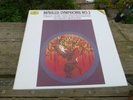
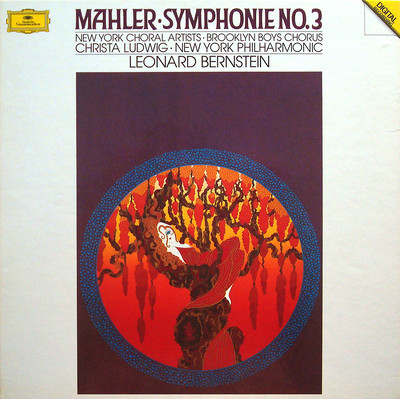
Incidentally, the striking cover art, entitled “Voyage de Rêve” was executed by ERTE. The excellent CD-size (as issued with the LP set) 32-page booklet includes wonderful portraits of Bernstein, as well as extensive notes on the music by Volker Scherliess (German, French, and Italian) and Andrew Clements (English).
CONDITION:
The gradations of condition I use are as follows: MINT, Near-Mint, Excellent, Very Good, Good, Fair, Poor.
The condition of the box is EXCELLENT. There is some faint discoloration/sunning along the spine, but that is all. There are no corner breaks, seamsplits, bends, owners’ markings, or other defects, and the box remains perfectly solid, bright, glossy, and highly attractive in appearance. Overall, this rates as a handsome collector’s copy.
The condition of the CD-size, 32-page booklet is near-MINT. There are no flaws to speak of and the booklet appears as new.
The condition of the 2 LPs is near-MINT throughout. Although surfaces are not absolutely silent (and thus I have rated it NM vs. MINT), really these are very fine copies and playback is truly superb across all 4 sides. However, if you must have absolutely perfect surfaces, then please do not buy this set. Overall, these rate as truly fine collector's copies.
PLEASE NOTE:
The images I've provided are of the actual item you are potentially bidding on - these are not stock images or images I've taken from other sites. Bid with confidence!
PAYMENT:
Payment by PayPal is greatly preferred. Payment should be made within 5 days.
SHIPPING:
Shipping is free to anywhere in the world; this is true regardless of the number of LPs you buy, be it 1 or a 100. All LPs will be sent via standard airmail (7-10 days delivery), though this particular item will be sent by certified airmail - again, not shipping charges. Note: There is no tracking number provided with standard airmail. Should you wish to have your item(s) sent via certified airmail (i.e., with a tracking number), please contact me. The fee for this $5.00 USD.
FEEDBACK:
I will promptly leave feedback for all buyers. Please do not leave negative, or even neutral, feedback without first giving me an opportunity to resolve any dissatisfaction you might have with an item or transaction. I do understand that, on occasion, a buyer might believe the item description to be inaccurate or that a buyer may be disappointed in some other way regarding the sale. I promise I will do my very best to resolve any unhappiness you've experienced in your buying experience with me to your complete satisfaction. Thank you.
REFUNDS:
Returns are honored, and any buyer you makes a return will be refunded in full. Please contact me before making a return.
Please see my other classical LP and CD auctions, and feel free to write with any questions, I'll be glad to help.
price rating